Accession Number
1989.1566
Edo designations
English designations
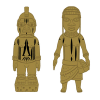
Female Figure
Categories
Figures
Location
4000 N Michigan Rd, Indianapolis, IN 46208, United States
Loading...

Iconographies

3 annotations
tribal marks
Iwu
Facial and Body Markings

Iwu are facial and body markings (scarifications) that were historically worn by Edo men and women. However, since the 1960s, the practice has been nearly extinct (Aisien 2011). In the past, Iwu were used as a way of proving that one was an Edo citizen, and the ceremony of having Iwu completed was an important rite of passage for men and women. The Osiwu, who also practised circumcision and other surgical procedures, would carry out the procedure of adding Iwu. There are different types of Iwu: ‘blades’ worn on the torso (Iwu-eko), and those worn on the face, such as Ikharo (three or four markings above the eyebrows), Irho (two narrow ‘blades’ worn on each cheek), Ovbihue (nasal ‘blades’), Ovbi-agbanmwen (chin ‘blade’), and Igho-okpa/Ukpgho (three forehead ‘blades’) (Aisien 2011, p. 22).

The number of Iwu also varied depending on the identity of the person wearing them. For example, royal men would wear six ‘blades’ on their torso, whilst men who were not royal would wear seven ‘blades’. Meanwhile, the Ọba’s female children would wear fifteen ‘blades’, and all other women would wear sixteen (Aisien 2011).

1 annotation
Iwu
Orhiẹvbẹ
Kola Nut Bowl

Orhiẹvbẹ are boxes or bowls used to store and present kola nuts and other items for offering, particularly in ceremonial and ritual contexts. Kola nuts were, and continue to be, presented to guests by hosts as a gesture of courtesy and friendship, as well as a symbol of peace, order, and civilisation ( ; ).

Orhiẹvbẹ are incorporated into the imagery of Ama-Ẹrọnmwọn (bronze relief plaques), where they are often held by attendants, indicating the presentation of offerings, particularly to the Ọba. Those depicted among the Emwin Arre (royal treasures) take a variety of forms, ranging from simple round or oval bowls and lidded vessels to examples shaped as antelope heads.

1 annotation
Orhiẹvbẹ
Àkpólú
Waist beads

Àkpólú, also spelt Àkpólo, are strings of coral beads worn around the lower waist or hips by women and girls ( ; Ọbazee 2025, p. 23). Before colonial rule in the Benin Kingdom, children were traditionally not permitted to wear clothing until the Ọba gave them cloth to wear; the Àkpólú was an exception to this practice, allowing children to wear these coral bead strands around the waist ( ).

1 annotation
Àkpólú

Provenance

4 events
Production
unknown to February 22, 1897 (day approximate)
The object was produced by Unknown member(s) of the Igbesamwan guild in Benin City.
Looted
February 22, 1897 (day approximate) to June 1899 (year approximate)
The object was looted by Unknown member of the British colonial military campaign on Benin - February 1897 from Benin Kingdom.
Purchase
1970s to 1989
The object was purchased by Edith Morgan & Harrison Eiteljorg with its destination in Indianapolis.
Gift
1989
The object was given as a gift by Edith Morgan & Harrison Eiteljorg to the Indianapolis Museum of Art at Newfields in Indianapolis.

Institution data

Indianapolis Museum of Art at Newfields
The data was transferred directly by the institution.
Last updated: 2021-04-17
Language: english
Institution fieldValue
Accession Number
object id
1989.1566
Previous Number(s)
object id
Title
designation
female figure
Object Label
description
Materials
material
ivory
Medium
material
Dimensions
dimensions
8-1/2 x 2-1/2 x 3-1/4 in.
Object Type
object type
Date Created
date made
18th-19th centuries
Creation Location
production place
Nigeria
Credit Line
prior source
Gift of Mr. and Mrs. Harrison Eiteljorg
Provenance
provenance
Mr. and Mrs. Harrison Eiteljorg, Indianapolis, Indiana; given to the Indianapolis Museum of Art at Newfields in 1989.
Culture or People
ethnic attribution
Edo people
Accession Date
accession date
Exhbitions
exhibition history
Art and Technology: Africa and Beyond, Indianapolis Museum of Art, Indianapolis, Indiana, 3/11/95-5/26/96 | IMA Galleries
Rights
license
Public Domain
URL
weblink
http://collection.imamuseum.org/artwork/28940/
Number of Parts
1
Support
Sensitive Content

Digital Benin collates digital material from institutions, and some of this material is inherently colonial and contains words, terms and phrases that are inaccurate, derogatory and harmful towards African and African diasporic communities. Catalogue transcriptions, book titles, exhibition titles and museum titles may contain harmful terms. We recognise the potential for the material to cause physical and mental distress as well as evoke strong emotions. Owing to the scale of the collection’s data, a process to implement sensitive-content warnings in the displayed data is still incomplete. The material within the catalogue does not represent Digital Benin’s views. Digital Benin maintains a strong anti-colonial, anti-racist position and affirms its support for centring the humanity of historically marginalised and disenfranchised communities. Read more about the background of this statement here