Accession Number
1995.119
Edo designations
English designations
Horn or Flute
Categories
Musical Instruments
Altar & Shrine Objects
Location
4000 N Michigan Rd, Indianapolis, IN 46208, United States
Loading...
112_1995119
112_1995119
112_1995119
112_1995119
112_1995119
112_1995119
112_1995119

Iconographies

2 annotations
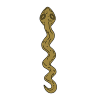
snake
Ẹyẹn
Snake

Ẹyẹn (snakes) are among the most common animals depicted by Edo artists on the Emwin Arhe (royal treasures). The varied depictions of these reptiles suggest different snake species, including the Ikpin (python), Arhunmoto (puff adder), and Olose (red-black striped snake); therefore, here we use the generic term for snake: Ẹyẹn.

The identification of snake motifs and depictions as Ikpin, as well as the importance accorded to this species, is a subject of scholarly debate. Paula Ben-Amos (1976, p. 247) argued that the Edo admired the “stature, colouration and crushing power” of the python, which was in turn associated with Olokun. She went on to identify the brass figures of snakes that formerly adorned the roof of the palace, as well as several other snakes, as pythons. Joseph Nevadomsky (1988, p. 77) argued instead that the importance of the Ikpin had been overstated.

Some of these snake representations may in fact be the Arhunmwoto (puff adder). The first to suggest this was the German curator Felix von Luschan (1919) in his early research into the Benin royal treasures. Nevadomsky (1988, pp. 79–80) suggested that the large head, narrow neck, and rough scales are indicative of either the puff adder, a symbol of “material wealth, tribute, and gifts,” or the Gaboon viper.

Another kind of snake that may be depicted is the Olose (red-black striped snake). It has the praise name “king of the snakes” in Edo. Olose is also closely connected to the deity Olokun, both because of its attractiveness and because it inhabits wet environments such as forest streams, which in turn flow into rivers and the sea, where Olokun lives (Nevadomsky 1988, pp. 76–77). Although the exact meanings of these different snakes vary, they share the characteristic of being spiritually powerful creatures.

1 annotation
Ẹyẹn
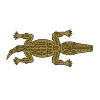
alligator
Ẹghughu
Crocodile

In the riverine area surrounding Benin City, there are two types of crocodile. The Ẹghughu, known in English as the dwarf or bush crocodile, is believed to be more docile ( ; Ọbazee 2025, p. 133). The second type is the Àgbákà, the aggressive Nile crocodile ( ; Ọbazee 2025, p. 11).

Crocodiles are one of the important animals represented in the historical Emwin Arhe, and they are known as Olokun’s guards or the “policemen” of the waters. The powerful and ferocious qualities of these animals might explain why warrior figures are often depicted wearing Uhunmwu-Ẹkuẹ (pendant masks) in the shape of crocodile heads on Ama-Ẹrọnmwọn (bronze relief plaques) ( ). Olokun devotees use crocodiles as sacrificial animals in offerings during the worship of Olokun.

1 annotation
Ẹghughu

Provenance

5 events
Production
unknown to February 22, 1897 (day approximate)
The object was produced by Unknown member(s) of the Igun-Ẹrọnmwọn guild in Benin City.
Looted
February 22, 1897 (day approximate) to June 1899 (year approximate)
The object was looted by Unknown member of the British colonial military campaign on Benin - February 1897 from Benin Kingdom.
Unknown
February 22, 1897 (day approximate) to 1900
The object is known to have come into contact with Augustus Henry Pitt-Rivers (Lane Fox), later in Farnham.
Unknown
1970s to 1995
The object is known to have come into contact with Edith Morgan & Harrison Eiteljorg, later in Indianapolis.
Donation
1995
The object was donated by Edith Morgan & Harrison Eiteljorg to the Indianapolis Museum of Art at Newfields in Indianapolis.

Institution data

Indianapolis Museum of Art at Newfields
The data was transferred directly by the institution.
Last updated: 2021-04-17
Language: english
Institution fieldValue
Accession Number
object id
1995.119
Previous Number(s)
object id
Title
designation
side blown trumpet with crocodile and human head images
Object Label
description
Materials
material
copper alloy
Medium
material
Dimensions
dimensions
14-1/2 x 2-1/2 x 2 in.
Object Type
object type
Date Created
date made
probably 19th century
Creation Location
production place
Nigeria
Credit Line
prior source
Provenance
provenance
Mr. and Mrs. Harrison Eiteljorg, Indianapolis, Indiana; given to the Indianapolis Museum of Art at Newfields in 1995.
Culture or People
ethnic attribution
Edo people
Accession Date
accession date
Exhbitions
exhibition history
IMA Galleries
Rights
license
Public Domain
URL
weblink
http://collection.imamuseum.org/artwork/20325/
Number of Parts
1
Support
Sensitive Content

Digital Benin collates digital material from institutions, and some of this material is inherently colonial and contains words, terms and phrases that are inaccurate, derogatory and harmful towards African and African diasporic communities. Catalogue transcriptions, book titles, exhibition titles and museum titles may contain harmful terms. We recognise the potential for the material to cause physical and mental distress as well as evoke strong emotions. Owing to the scale of the collection’s data, a process to implement sensitive-content warnings in the displayed data is still incomplete. The material within the catalogue does not represent Digital Benin’s views. Digital Benin maintains a strong anti-colonial, anti-racist position and affirms its support for centring the humanity of historically marginalised and disenfranchised communities. Read more about the background of this statement here