Inventarnummer
1710-0004-00
Edo designations
English designations
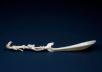
Spoon
Categories
Contextual Objects: Benin-Portuguese Ivories
Location
Steintorwall 14, 38100 Braunschweig, Germany
Loading...
Spoon
Spoon

Iconographies

1 annotations
Ahianmwẹ-Ọrọ
Bird of Prophecy

The Ahianmwẹ-Ọrọ, meaning ‘bird of prophecy’ in English, is a bird with a long beak believed to be a messenger of the spirit world. If it cries ‘OyaO’ (disgrace), it portends danger or disaster. If it cries ‘Oliguegue’ (be grateful), it portends good favour, fortune, or luck. If it persistently cries ‘OyaO, OyaO’ in front of someone, it is prophesying that the person should be cautious and should not undertake a journey, or should return home rather than continue. But if the bird cries ‘Oliguegue’ continuously, the journey will be favourable.

In 1515, as Ọba Ẹsigie passed through the gates of Benin on his way to fight the Attah (king) of Idah, the Ahianmwẹ-Ọrọ made discouraging sounds overhead, ‘OyaO, OyaO’, portending that disaster lay ahead. The Ọba ordered the bird to be killed and went on to win the war. He said, ‘Nẹ O gha yin Agbon, ghẹi daho Ahianmwẹ notiẹ oya’ (whoever wishes to succeed in life should not heed the bird of prophecy). On the Ọba’s triumphant return from battle, he commissioned the Igun-Eronmwon to make an image of the bird on the finial of a battle standard to remind it that the Ọba was not subject to the fate of ordinary spirits (personal communication, Patrick Oronsaye, 2022).

The identification of which bird the Ahianmwẹ-Ọrọ represents has been a subject of scholarly debate throughout the 20th century. Some have suggested that the bird is an African pied wagtail (Melzian 1937, p. 5), an ibis (Dark 1962, p. 46), possibly a kind of kingfisher (Ben-Amos 1976, p. 252), a hornbill (McCall 1975, p. 293), or, lastly, a white-tailed ant thrush (Nevadomsky 1988, pp. 76–77). In the case of the Ahianmwẹ-Ọrọ, however, Joseph Nevadomsky (1988, p. 77) posited that the exact species being represented was in fact less important. Instead, the aim was to “convey certain notions about the supernatural powers of the Ọba” and that the physical attribute (e.g., the long beak) was in fact the Ọba Ẹsigie’s casters’ way of seeking to “emphasise its vocal powers of prophecy, and, perhaps more importantly, the overcoming of these powers by the Ọba.”

1 annotation
Ahianmwẹ-Ọrọ

Provenance

4 events
Production
1525 (approximate) to 1600 (approximate)
The object was produced by Unknown member(s) of the Igbesamwan guild in Benin City.
Unknown
1633 to 1714
The object is known to have come into contact with Anton Ulrich.
Transfer
1754
The object was transferred from Anton Ulrich to Herzog Anton Ulrich-Museum (HAUM) with its destination in Brunswick.
Exchange
1906
The object was exchanged between Herzog Anton Ulrich-Museum (HAUM) and the Städtisches Museum Braunschweig in Brunswick.

Institution data

Städtisches Museum Braunschweig
The data was transferred directly by the institution.
Last updated: 2021-03-31
Language: german
Institution fieldValue
Inventarnummer
object id
1710-0004-00
Material
material
> Zahn > Zahn, tierisch > Elfenbein
Maße
dimensions
Länge: 25.50 cm
Titel
object type
Elfenbeinlöffel, afro-portugiesisch Westafrika, Sierra Leone
Datierungen
date made
Provenienz/Zugang von
prior source
Objektgeschichte
provenance
Herzogliche Kunstkammer, seit 1906 im Austausch mit dem HAUM im Städtischen Museum (Ringtausch) Ethnografie 1710-0004-00
Provenienz/Zugangsdatum
accession date
Provenienz/Zugangsart
accession method
Standort
display status
> Braunschweig > Städtisches Museum Braunschweig als Dauerleihgabe im HAUM
Bemerkungen
bibliography
Geonames-Link
weblink
http://www.geonames.org/2403846
Alte Inventarnummern / andere Nummern
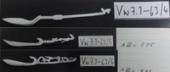
A III c 775 Vw 7.1-63/3 (Hecht-Nr.)
Beschreibung intern (deutsch)
Löffel aus Elfenbein geschnitzt. Der Stil besteht aus einer Vogelfigur, die auf einem Tier, vielleicht einem Hund, sitzt. Früher als "Benin" eingeschätzt
Georeferenzierter Ort (international)
Sierra Leone (Herstellungsort) (Westafrika, Sapi-Portugiesisch, Afro- Portugiesisch)
Sensitive Content

Digital Benin collates digital material from institutions, and some of this material is inherently colonial and contains words, terms and phrases that are inaccurate, derogatory and harmful towards African and African diasporic communities. Catalogue transcriptions, book titles, exhibition titles and museum titles may contain harmful terms. We recognise the potential for the material to cause physical and mental distress as well as evoke strong emotions. Owing to the scale of the collection’s data, a process to implement sensitive-content warnings in the displayed data is still incomplete. The material within the catalogue does not represent Digital Benin’s views. Digital Benin maintains a strong anti-colonial, anti-racist position and affirms its support for centring the humanity of historically marginalised and disenfranchised communities. Read more about the background of this statement here