


Iconographies


Provenance
Institution data
| Institution field | Value |
|---|---|
ID object id | 212548 |
Sachbegriff designation | Sachbegriff: Anhänger für den Gürtel |
Titel designation | Titel: Kopf eines Königs |
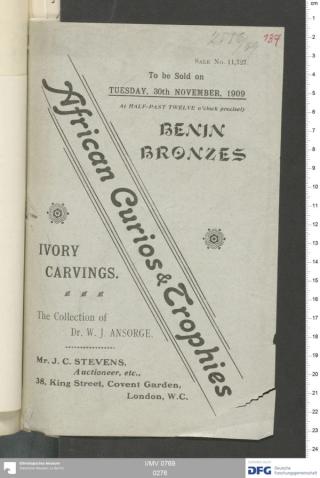
Objektref. description | VIII A 12121, Positiv, SW, Elfenbeinmaske, Kurt Grunst (*04.04.1921); E 1378/1910, Erwerbung: III/59/1910: III C 26372-26376, Ethnogr., Elfenbeinschnitzereien (Westafrika, Benin), Ankauf W.D. Webster, 1910, William Downing Webster (1895); E 2556/1909, Erwerbung: III/7/1910: III C 23971-23976, Ethnogr., Bronzen, Ankauf [aus der Sammlung] Dr. W.J. Ansorge (Stevens) -- Inhalt: Druckwerk: a catalouge of African Curios&Trophies Benin Bronzes, Ivory Carvings ec. ec. - the collection of Dr. W.J. Ansorge, Auction by Mr. J.C. Stevens 38, King Street, Covent Garden W.C., Thesday, the 30th of November 1909, at 12.30 o´clock: Liste mit den Objektbeschreibungen und Losnummern, sowie einigen Objektabbildungen -- Korrespondenz v. Luschan - Stevens - Liste der ersteigerten Objekte - Inv. Vermerk -Abbrechnung, 1909, J.C. Stevens (1899) |
Texte Online description | Online Beschreibung, Elfenbeinmasken dieses Typs sind sehr selten. Ob sie einen König oder die Königinmutter darstellen, ist ungewiss. Die Krone aus Korallenperlen lässt beide Interpretationen zu. Um den Halsansatz zieht sich eine Kette aus stilisierten Welsen. Getragen wurde diese Elfenbeinmaske wohl nur vom König als Schutz. Verstärkt werden konnte dieser durch das Anbringen von Medizin in einem Beutel an der Innenseite der Maske. [Benin_Königreich] |
Material / Technik material | Material: Elfenbein; Ausgabe: Elfenbein; Ausgabe (engl.): Ivory |
Material / Technik // Alle material | Elfenbein, Ivory, Elfenbein |
Maße dimensions | 17,50 x 8,50 x 6,00 cm |
Objekttyp object type | Allgemein |
Sachbegr. Ausgabe object type | Gürtelmaske |
Anzahl Teile object count | 1 |
Datierung date made | 18. Jh. |
Geogr. Bezüge production place | Nigeria ( Land ); Benin ( Königreich ) |
Geogr. Bezüge // Alle production place | Nigeria, Benin |
Beteiligte prior source | Zuordnung unsicher: William John Ansorge (1909), Vorbesitzer; J.C. Stevens (1899), Vorbesitzer; William Downing Webster (1895), Veräußerer |
Beteiligte // (Name, Sortierung=kleinste) prior source | Stevens, J.C. |
Veräußerer prior source | null |
Erwerb. Notiz provenance | Erwerbung von: W.D. Webster; Notiz: Rückführung Wiesbaden; Ausgabe: Auftrag bei der Messinggießergilde Igun Eronmwon im Königreich Benin im 18. Jh.; vermutlich geplündert im Zusammenhang mit der britischen Eroberung von Benin, 1897; in unbekanntem Besitz nach Feb. 1897; gesammelt von William J. Ansorge in Nigeria vor 1905; versteigert von J.C. Stevens, 1909; erworben von William D. Webster, 1910. |
Verw. Institution department and institution | Ethnologisches Museum, Staatliche Museen zu Berlin |
Erwerb. Datum accession date | 1910 |
Besitzart accession method | Eigentum |
Erwerbungsart accession method | Ankauf |
Digital Assets images | Vorlage; Vorlage; Vorlage; Vorlage; Vorlage; Vorlage; Vorlage; Vorlage; III C 26373 ZP.doc, Office; Vervielfältigung; Vervielfältigung; III C 26373 A.jpg, Repro Digitalisat; III C 26373 Benin.JPG, Repro Digitalisat; III C 26373.jpg, Repro Digitalisat; III C 26373-Rio.jpg, Vorlage |
Erwerb. Nr. | III/59/1910 |
Ident. Nr. | III C 26373 |
Ident. Nr. // (Sortiernr.) | 0003 C 26373 |
Obj. Status | vorhanden |
Digital Benin collates digital material from institutions, and some of this material is inherently colonial and contains words, terms and phrases that are inaccurate, derogatory and harmful towards African and African diasporic communities. Catalogue transcriptions, book titles, exhibition titles and museum titles may contain harmful terms. We recognise the potential for the material to cause physical and mental distress as well as evoke strong emotions. Owing to the scale of the collection’s data, a process to implement sensitive-content warnings in the displayed data is still incomplete. The material within the catalogue does not represent Digital Benin’s views. Digital Benin maintains a strong anti-colonial, anti-racist position and affirms its support for centring the humanity of historically marginalised and disenfranchised communities. Read more about the background of this statement here