






Provenance
Institution data
| Institution field | Value |
|---|---|
Accession number object id | 1970-018-001 |
CMH catalogue number object id | B-IV-118 |
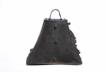
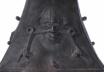
Object Description description | One large cast bronze bell; on one side is a human face in relief, with snakes issuing from the nostrils. |
Materials material | Bronze |
Dimensions dimensions | Height = 26 cm (10 1/4") |
Source prior source | Samuel Dubiner |
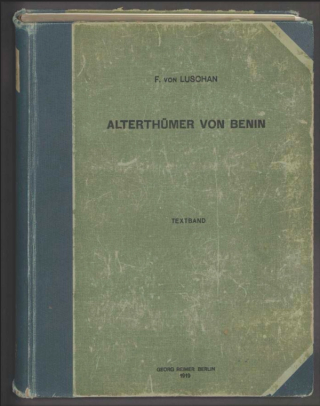
Remarks/Notes in acquisition file provenance notes | Date made: 1501-1897. From a note included with invoice: "Collected in 1897, from the city of Benin, probably by W.D. Webster, who was a member of the punitive expedition that entered the city on January 18th of that year. “Subsequently sold to General Pitt-Rivers in or about 1899, and published by him in 'Antique Works of Art from Benin', 1900. “Although thought to have been cast at Benin originally, it has since been realized that it was made outside, in what has been designated by W.B. Fagg, as the Lower Niger Bronze Industry, the precise source of which has so far not been discovered. Fagg writes of these bronzes: 'in my estimation the very pinnacle of Nigerian artistic achievement.' And 'in years to come it will, I believe, be recognized by the world and by Nigerians that they are more original and distinctive contribution to the enrichment of human experience'. Also 'Certainly the poetic quality of the bronzes of the Lower Niger is striking and moving to a degree not found in Ife and Benin work'. “The thinness of the casting suggests that the work is possibly 16th-century." |
Date acquired accession date | 1970 |
Mode of acquisition accession method | Purchase |
Later notes/remarks notes | An internal review in 1996/1997 identifies the this as one of the rare cases in which we have clear provenance provided by the dealer. "The bell made of bronze (or rather alloy), which comes from the sadly infamous 1897 punitive expedition (which enabled the systematic looting of works of art), is clearly authentic. It is also interesting to note that, in this specific case, and for once, the history of the object (different owners) can be traced. Research should make it possible to identify, with precision, the designs carved in relief on this bell, and to link these to the history of the Kingdom of Benin." (translated from original French) From review appendix, it was suggested that the bell was: “one of the oldest and most valuable objects in all of the CMH collections of African art." |
Source location | New York City, USA |
Digital Benin collates digital material from institutions, and some of this material is inherently colonial and contains words, terms and phrases that are inaccurate, derogatory and harmful towards African and African diasporic communities. Catalogue transcriptions, book titles, exhibition titles and museum titles may contain harmful terms. We recognise the potential for the material to cause physical and mental distress as well as evoke strong emotions. Owing to the scale of the collection’s data, a process to implement sensitive-content warnings in the displayed data is still incomplete. The material within the catalogue does not represent Digital Benin’s views. Digital Benin maintains a strong anti-colonial, anti-racist position and affirms its support for centring the humanity of historically marginalised and disenfranchised communities. Read more about the background of this statement here