Inventarnummer
117889
Edo designations
English designations
Armcuff
Categories
Ceremonial Regalia
Location
1 Adesogbe (Plymouth) Road, P.M.B. 1115, Benin City , Edo State
Loading...

Iconographies

2 annotations
Uhunmwu Ikpotoki
Portuguese Head

These motifs are known as Uhunmwu Ikpotoki in Edo, which translates as ‘Portuguese head’ in English. Portraits of Portuguese men, featuring only their heads and sometimes their shoulders, were used by artists as motifs on the Emwin Arhe (royal treasures), in particular on the Ama-Ẹrọnmwọn (bronze relief plaques) and Aken'ni Elao (carved altar tusks). Also included here are a series of two or three conjoined spirals, which are interpreted as abstract forms of this motif.

One of the earliest suggestions that many of the European figures depicted on objects were Portuguese was made two years after the 1897 British Colonial Military Campaign on Benin City by the British Museum curators Charles Hercules Read and Ormonde Maddock Dalton (1899, p. 19), based on testimony from seven chiefs in the aftermath of the military campaign. The long, straight hair, beards, and domed hats together led to the identification of these representations as Europeans (von Luschan 1919, pp. 54–57; Ezra 1992, p. 246).

When included within the visual imagery of the Emwin Arhe, the Portuguese are associated with the new Atlantic trade and the consequent wealth that emerged following first contact with the Portuguese in the late 15th century. For this reason, Portuguese heads are also often associated with the sea deity Olokun. Eisenhofer (2007, p. 59) argued that the Portuguese figures and heads as motifs on the royal treasures are symbols of the king’s power: “these depictions of foreigners helped to build and strengthen the king’s image.”

When incorporated into the design of the Ama-Ẹrọnmwọn (bronze relief plaques), Curnow (1997, p. 48) instead argued that these motifs could in fact indicate events that took place during Ọba Esigie’s reign. Ọba Esigie is associated with the Portuguese, as they became increasingly important during his reign, assisting with battles against the Igala from Idah, bringing Catholicism to Benin, and introducing weaponry such as guns and cannons, which were instrumental in the expansion of the kingdom.

1 annotation
Uhunmwu Ikpotoki
Ewi
Mudfish

Depictions of Ewi (mudfish) are among the most frequent motifs in the Emwin Arhe (royal treasures). Mudfish hold an important place in Edo belief, both as representations of the god Olokun and as symbols of royalty (Plankensteiner 2007, p. 410), as well as of “prosperity, peace, well-being and fertility” (Ben-Amos 1976, p. 245). Mudfish are also particularly common animals for sacrifice, and mudfish-shaped Orhiẹvbẹ (kola-nut boxes) were used to make offerings or store kola nuts.

Yet, the appearance of Ewi across the Emwin Arhe is not consistent, and it has been argued that different species of mudfish were depicted by Edo artists, each with different qualities and capabilities. For example, the electric shock of Malapterurus electricus resembles the fierceness of the Ọba, while the liminal qualities of the Synodontis clarias mudfish, which lives both on land and in water, similarly reflect the Ọba’s rule over land and sea (Gallagher 1983, p. 93). With these different qualities in mind, the mudfish is an important symbol of Benin kingship and royalty.

Sometimes the Ọba was depicted by artists with mudfish rather than legs (see Ọba with Mudfish Legs).

1 annotation
Ewi

Provenance

7 events
Production
unknown to February 22, 1897 (day approximate)
The object was produced by Unknown member(s) of the Igbesamwan guild in Benin City.
Looted
February 22, 1897 (day approximate) to June 1899 (year approximate)
The object was looted by Unknown member of the British colonial military campaign on Benin - February 1897 from Benin Kingdom.
Unknown
February 22, 1897 (day approximate) to 1913
The object is known to have come into contact with William Downing Webster, later in London.
Unknown
February 22, 1897 (day approximate) to 1913
The object is known to have come into contact with William Downing Webster and Hans Meyer, in London and later Leipzig.
Unknown
February 22, 1897 (day approximate) to 1940
The object is known to have come into contact with Hermann Seeger.
Unknown
1940
The object is known to have come into contact with Hermann Seeger and the Linden-Museum Stuttgart, Staatliches Museum für Völkerkunde, later in Stuttgart.
Restitution
December 14, 2022
The object was restituted by the Linden-Museum Stuttgart, Staatliches Museum für Völkerkunde to the Omo n'Oba n'Edo Uku Akpolokpolo, Ọba of Benin & National Commission for Museums and Monuments, Nigeria from Stuttgart to Nigeria.

Related archival documents

2 documents
See all
An archival document representing a Inventories of 257 page(s)
Inventory
Museum of New Zealand Te Papa Tongarewa
Stock books
Date
March 24, 1900 to December 31, 1903
An archival document representing a Sales Catalogs of 48 page(s)
Sales Catalogue
Wellcome Collection
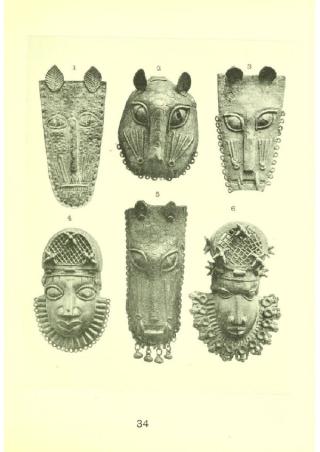
Catalogue of ethnological specimens : European and Eastern arms & armour, Prehistoric and other curiosities / W.D. Webster, Oxford House, Bicester, Oxon., England.
Date
January 1, 1901 to December 31, 1901

Institution data

Linden-Museum Stuttgart, Staatliches Museum für Völkerkunde
The data was transferred directly by the institution.
Last updated: 2021-07-01
Languages: german, english
Institution fieldValue
Inventarnummer
object id
117889
Objektbeschreibung
description
Der Oba (König) von Benin legte für bestimmte Feste solche breiten Armmanschetten aus Elfenbein an. Die Elfenbeinschnitzer arbeiteten fast ausschließlich für den Staatskult zur Verherrlichung der religiös-politischen Ordnung. Sie bereiteten sich daher rituell auf ihre Arbeit vor und hielten sich für inspiriert von spirituellen Wesen. Die Deutung der stark abgetragenen Reliefs als Köpfe von Portugiesen und Lungenfische (eher als Welse) scheint plausibel. Text: Dietmar Neitzke.
Objektbeschreibung englisch
description
The Oba (king) of Benin put on such broad ivory arm cuffs for certain festivals. The ivory carvers worked almost exclusively for the state cult to glorify the religious-political order. Therefore, they ritually prepared for their work and considered themselves inspired by spiritual beings. The interpretation of the heavily worn reliefs as heads of Portuguese and lungfish (rather than catfish) seems plausible. Text: Dietmar Neitzke.
Material
material
Elfenbein; Kupfer <Blech>
Material (Englischer Name)
material
Ivory; Copper sheet
Technik
production technique
getrieben; geschnitzt
Technik (Englischer Name)
production technique
driven; carved
Geographische Herkunft
production place
Königreich Benin
Geographische Herkunft (Englischer Name)
production place
Benin Kingdom
politische Herkunft
production place
Nigeria
Sammlung
prior source
Seeger, Hermann, Korntal
Objektgeschichte
provenance
Im Inventarbuch wurde bei diesem Objekt angemerkt, dass es wahrscheinlich von Hans Meyer bei W.D. Webster gekauft wurde, bevor es durch Seeger an das Linden-Museum kam. Ein Referenzbild befindet sich in W.D. Webster's Illustrated Catalogue 29, Bild. 13 (11275). Text: Markus Himmelsbach.
Objektgeschichte englisch
provenance
The inventory book noted for this object that it was probably purchased by Hans Meyer from W.D. Webster before it came to the Linden Museum through Seeger. A reference image can be found in W.D. Webster's Illustrated Catalogue 29, fig. 13 (11275). Text: Markus Himmelsbach.
Ethnie
ethnic attribution
Edo <E>
Eingangsdatum (Text)
accession date
1940
Objektbezeichnung Thesaurus
Armmanschette
Sensitive Content

Digital Benin collates digital material from institutions, and some of this material is inherently colonial and contains words, terms and phrases that are inaccurate, derogatory and harmful towards African and African diasporic communities. Catalogue transcriptions, book titles, exhibition titles and museum titles may contain harmful terms. We recognise the potential for the material to cause physical and mental distress as well as evoke strong emotions. Owing to the scale of the collection’s data, a process to implement sensitive-content warnings in the displayed data is still incomplete. The material within the catalogue does not represent Digital Benin’s views. Digital Benin maintains a strong anti-colonial, anti-racist position and affirms its support for centring the humanity of historically marginalised and disenfranchised communities. Read more about the background of this statement here