

Object Number
1978.412.310
Edo designations
English designations
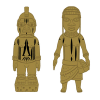
Hornblower or Fluteplayer Figure
Categories
Figures
Location
1000 5th Ave, New York, NY 10028, United States
Loading...

Iconographies

7 annotations
Ẹrhu
Headwear

Many different kinds of Ẹrhu (headwear) are worn by the various figures depicted in the imagery of Benin royal artefacts. Through comparisons with ceremonial regalia still worn by chiefs and members of the royal court, including the Ọba himself, some Ẹrhu have been used to identify the different figures depicted. For example, the conical hat worn by high-ranking town chiefs as part of the pangolin regalia, still worn at ceremonies, is also visible on figures on some Ama-Ẹrọnmwọn (bronze relief plaques) ( ). Other examples include the distinctive bell-shaped helmet associated with the Iyasẹ ( ). Figures who wear a shallow-brimmed hat and a cross have been identified as Ewua or Ohensa priests ( ).

Different kinds of helmets and headwear were worn by warriors, reflecting the many different ranks and roles in the army at any given time, as well as developing trends that were in turn represented on Emwin Arhe created at different points in time. Warrior figures wearing helmets covered in cowrie shells were carved on the Aken'ni Elao (carved tusks) (Blackmun 1984, p. 330), yet on the brass Ama, warriors are sometimes depicted wearing helmets made from crocodile hide or horsehair with a front plate (Osadolor in Plankensteiner 2007, cat. no. 238, p. 457). Helmets made from horsehair with a front plate are one of the more common types represented on the Ama-Ẹrọnmwọn, and the demand for black horse tails was noted by both Portuguese and British traders during the late 17th and 18th centuries (Osadolor in Plankensteiner 2007, cat. no. 238, p. 457). Other warriors depicted on Ama-Ẹrọnmwọn wear helmets with a rounded top, chinstrap, and sometimes also a feather tucked into the left side. These types of headwear are known as Ẹrhu Iyokuo.

Attire worn for battle also differed from that worn for ceremonial occasions, such as the pointed headwear worn in combination with an ornate leopard-head tunic by war chiefs. Depictions of figures wearing this attire on brass Ama-Ẹrọnmwọn (bronze relief plaques) have been interpreted as representing the war chiefs’ participation in the war-ritual Isiokuo festival (Osadolor in Plankensteiner 2007, cat. no. 238, p. 457).

Another distinctive form of headwear is that worn by figures identified as leopard hunters on the brass Ama-Ẹrọnmwọn (relief plaques). These large helmets cover almost all of the leopard hunters’ faces except for their noses, eyes, and upper lips, and are made of an unusual material that remains unidentifiable (Plankensteiner 2007, cat. nos. 68–69, p. 322).

European figures are also portrayed with distinctive hats, such as Portuguese three-cornered hats. These depictions reflect the artists’ keen observation and highlight the impact of European trade and military assistance (Ezra 1992).

1 annotation
Ẹrhu
Round Neck Bead
Ikele
Coral bead circlet

Ikele is a single stiff string or circlet of coral beads. It is worn by chiefs, such as senior chiefs who have been made Enigie (Inneh 2007, p.107), and is a sign of nobility and rank. The Ikele may only be worn once the Ọba has conferred a person with the right to wear the beads, and the Ikele must always be worn when appearing before the Ọba. According to Ekhaguosa Aisien (in Plankensteiner 2007, cat. nr. 301, p.512) when a chief is wearing the Ikele, they may not eat nor drink in public, and they “constitute an embassy of the Benin Palace wherever he might be.”

1 annotation
Ikele
Oko/Akohẹn
Horn/Flute

Akohẹn, or ivory horns, are played by members of the Ikpakoen (guild of ivory hornblowers), while Oko, or flutes, are played by members of the Ikpeziken (guild of royal flute players). Among the Emwin Arhe (royal treasures), Oko and Akohẹn are usually depicted being played by brass-cast figures representing members of these guilds, and also appear on Ama-Ẹrọnmwọn (bronze relief plaques), Aken'ni Elao (carved altar tusks), and Urhotọ (altar tableau).

Today in Benin City, when a public procession leaves the palace, a court official may sound side-blown horns made from ivory. Historically, these instruments were also used during warfare, where they were played alongside Ema (drums) and Ẹroro (bells), producing a “cacophony of sound” whose “[t]he psychological effect of the barrage of noise magnified the size of Benin’s forces” ( ).

Some Oko/Akohẹn were also cast in brass by members of the Igun-Ẹrọnmwọn. However, these brass examples are understood not to have been functional instruments and could not have been blown like their ivory counterparts ( ).

1 annotation
Oko/Akohẹn
Ohian Ẹkpẹn
Leopard tunic

The Ohian Ẹkpẹn is a significant ceremonial garment in Benin royal court art, primarily associated with warriors and military officials, underscoring their delegated authority and ferocious skill as warriors (Ben-Amos 1995, fig. 93).

The leopard tunic is typically made from leather and cloth decorated to imitate leopard skin, usually with the face of a leopard emblazoned on the chest using appliqué. An Akọn Ẹkpẹn (leopard tooth neck ornament) and quadrangular Ẹroro (bells) are often worn on top of the Ohian Ẹkpẹn. This tunic would be worn by the Ọba’s military chiefs (Blackmun 1984, p. 323).

In historical Benin, the Ọba held the exclusive right to distribute leopard skins to those officials to whom he delegated the power to take human life. This made the leopard tunic a potent symbol of delegated authority over life and death. Osarhieme Benson Osadolor (in Plankensteiner 2007, cat. no. 244, p. 459) recalled an Edo proverb: “It is the head of the leopard that accomplishes things for the leopard,” which is particularly significant for warrior chiefs, as this proverb indicates that the Ọba, known as the “Leopard of the Home,” relied on them to carry out his military campaigns.

1 annotation
Ohian Ẹkpẹn
Colar Bead
Odigba
Coral beaded collar

Odigba (coral-beaded collar) is a rigid neck collar made of coral beads, worn as part of ceremonial attire only by senior princes who have been made Enigie (Inneh 2007, p. 107). Although Ibafe (2007, p. 43) argued that the Odigba was introduced during the Ogiso period (c. 900–c. 1170 AD) by Ogiso Ere, along with other symbolically important Emwin Arhe, such as the Ada (ceremonial sword) and the Ẹbẹn (ceremonial sword), this seems unlikely, as coral was only introduced in the late 15th century through trade with Portuguese merchants.

1 annotation
Odigba
tribal marks
Iwu
Facial and Body Markings

Iwu are facial and body markings (scarifications) that were historically worn by Edo men and women. However, since the 1960s, the practice has been nearly extinct (Aisien 2011). In the past, Iwu were used as a way of proving that one was an Edo citizen, and the ceremony of having Iwu completed was an important rite of passage for men and women. The Osiwu, who also practised circumcision and other surgical procedures, would carry out the procedure of adding Iwu. There are different types of Iwu: ‘blades’ worn on the torso (Iwu-eko), and those worn on the face, such as Ikharo (three or four markings above the eyebrows), Irho (two narrow ‘blades’ worn on each cheek), Ovbihue (nasal ‘blades’), Ovbi-agbanmwen (chin ‘blade’), and Igho-okpa/Ukpgho (three forehead ‘blades’) (Aisien 2011, p. 22).

The number of Iwu also varied depending on the identity of the person wearing them. For example, royal men would wear six ‘blades’ on their torso, whilst men who were not royal would wear seven ‘blades’. Meanwhile, the Ọba’s female children would wear fifteen ‘blades’, and all other women would wear sixteen (Aisien 2011).

1 annotation
Iwu
Ikpakohẹn
Fluteplayer or Hornblower

Hornblower and flute-player figures recur frequently in the visual language of Emwin Arhe (royal treasures), particularly on Ama-Ẹrọnmwọn (bronze relief plaques) and Aken’ni Elao (carved tusks). Horns and flutes made from ivory and brass have long been used in the Benin Kingdom, with ivory instruments continuing to be used today ( ).

Akohẹn are the largest type of horn and were used exclusively by the Ọba’s retainers before sacrifices in the palace. The Ikpakohẹn is a specialist hornblower responsible for playing the ivory Akohẹn, a role introduced during the reign of Ọba Eresonyẹn. According to Ọba Akẹnzua II, a group of six hornblowers from Use played these horns during Ugie (in Bradbury 1957, B.S. 85; ). Another type of horn, the Oko, was used by Ebo “to call witches and wizards to come to the crossroads” ( ).

Ọba Akẹnzua II (in Bradbury 1957, B.S. 85) also described the Eziken, a thin, side-blown fife or flute made from calabash or ivory. These instruments were played by members of the Ikpeziken, the guild of royal flute players, who performed as part of musical ensembles during ceremonies such as Ugie.

1 annotation
Ikpakohẹn

Provenance

9 events
Production
unknown to February 22, 1897 (day approximate)
The object was produced by Unknown member(s) of the Igun-Ẹrọnmwọn guild in Benin City.
Looted
February 22, 1897 (day approximate) to June 1899 (year approximate)
The object was looted by Unknown member of the British colonial military campaign on Benin - February 1897 from Benin Kingdom.
Unknown
February 22, 1897 (year approximate) to 1899
The object is known to have come into contact with J. Young, later in Glasgow.
Unknown
1899
The object is known to have come into contact with J. Young and Augustus Henry Pitt-Rivers (Lane Fox), in Glasgow and later Farnham.
Purchase
1957
The object was purchased by Kenneth John Hewett from Farnham Pitt-Rivers Museum with its destination in London.
Purchase
1957
The object was purchased by Nelson Aldrich Rockefeller from Kenneth John Hewett from London to New York City.
Loan
1957 to 1972
The object was loaned by Nelson Aldrich Rockefeller to New York Museum of Primitive Arts in New York City.
Gift
1972
The object was given as a gift by Nelson Aldrich Rockefeller to New York Museum of Primitive Arts in New York City.
Transfer
1978
The object was transferred from New York Museum of Primitive Arts to the Metropolitan Museum of Art in New York City.

Institution data

Metropolitan Museum of Art
The data was transferred directly by the institution.
Last updated: 2021-07-30
Language: english
Institution fieldValue
Object Number
object id
1978.412.310
Object Sort Number
object id
1978 412 310
Primary Rendition No
object id
DT10214
Title
designation
object type
Figure: Horn Player
Medium
material
Brass
Dimensions
dimensions
H. 24 3/4 × W. 11 1/2 × D. 6 3/4 in. (62.9 × 29.2 × 17.2 cm)
Classification
object type
Metal-Sculpture
Date
date made
1550–1680
Geo: City
production place
Court of Benin
Geo: Country
production place
Nigeria
Credit Line
prior source
The Michael C. Rockefeller Memorial Collection, Gift of Nelson A. Rockefeller, 1972
Provenance
provenance
Court of Benin, taken from the Royal Palace in 1897 during the British military occupation of Benin; [J. Young, Glasgow, Scotland, until 1899]; Augustus Lane-Fox Pitt-Rivers, Farnham, Dorset, U.K.; an anonymous source, until 1957; [K. John Hewett, London, until 1957]; Nelson A. Rockefeller, New York, on loan to The Museum of Art, New York, 1957–1972; Museum of Art, New York, 1972–1978
Dynasty
reign associated name
Oranmiyan
Culture
ethnic attribution
Edo peoples
ExhibitionHistory
exhibition history
The African Origin of Civilization: Myth orReality The Metropolitan Museum of Art, Egyptian Art, Benin Bronzes Museum of Art, May 20, 1959–September 6,1959 African Festival Union Church, Pocantico Hills, NY, May 14, 1960–May 14,1960 The Traditional Arts of Africa's New Nations Museum of Art, May 17, 1961–September 10,1961 Traditional Sculpture of Africa Art Institute of Chicago, October 12, 1961–November 12,1961 West African Sculpture Wadsworth Atheneum Museum of Art, September 25, 1963–November 3,1963 Art from Africa, Oceania, and the Americas Lent by theMPA The Society of the Four Arts, March 7, 1964–March 29,1964 The World of Art Museum of Art, July 12, 1966–September 11,1966 Selections from the Museum Collection Museum of Art, September 13, 1967–February 4,1968 Art of Sub Sahara Africa Bowdoin College Museum of Art, March 15, 1968–April 14,1968 Benin Museum of Fine Arts, Houston, September 21, 1968–November 24,1968 New Orleans Museum of Art, December 15, 1968–January 15,1969 Art of Oceania, Africa and the Americas from The Museum of Art The Metropolitan Museum of Art, May 10, 1969–August 17,1969 Sounding Forms: African Musical Instruments Musee des Arts Africains et Oceaniens, January 25, 1989–March 20,1990 American Federation of Arts, – National Museum of African Art, April 26, 1989–June 18,1989 Virginia Museum of Fine Arts, July 16, 1989–September 10,1989 Nelson Atkins Museum of Art, October 7, 1989–December 3,1989 Musée National des Arts d'Afrique et d'Oceanie, January 25,1990–March 20, 1990 Making The Met, 1870–2020 The Metropolitan Museum of Art, August 29, 2020–January 3,2021
Bibliography
bibliography
The Metropolitan Museum of Art. Art of Oceania, Africa, and the Americas from the Museum of Art. New York: The Metropolitan Museum of Art, 1969, no. 376. Museum of Art. Traditional Art of the African Nations in the Museum of Art. New York: University Publishers, Inc., 1961, no. 56. Museum of Art. Masterpieces in the Museum of Art: Africa, Oceania, North America, Mexico, Central to South America, Peru. Handbook series. New York, NY: Museum of Art, 1965, no. 19. Newton, Douglas. Masterpieces of Art: The Nelson A. Rockefeller Collection. New York: Alfred A. Knopf, 1978, p. 150 (left).
Published References
bibliography
"THE METROPOLITAN MUSEUM OF ART. The Pacific Islands, Africa, and the Americas." by Douglas Newton, Julie Jones, Kate Ezra, MMA, New York 1987, p. 86. Brincard, Marie-Thérèse, ed. 1989. Sounding Forms: African Musical Instruments. The American Federation of the Arts: New York, p. 178; pl. 151.
Sensitive Content

Digital Benin collates digital material from institutions, and some of this material is inherently colonial and contains words, terms and phrases that are inaccurate, derogatory and harmful towards African and African diasporic communities. Catalogue transcriptions, book titles, exhibition titles and museum titles may contain harmful terms. We recognise the potential for the material to cause physical and mental distress as well as evoke strong emotions. Owing to the scale of the collection’s data, a process to implement sensitive-content warnings in the displayed data is still incomplete. The material within the catalogue does not represent Digital Benin’s views. Digital Benin maintains a strong anti-colonial, anti-racist position and affirms its support for centring the humanity of historically marginalised and disenfranchised communities. Read more about the background of this statement here