
Accession/Inventory No.
BIRRC-D0002
Edo designations
English designations
Chest
Categories
Containers
Contextual Objects: Post-1930s
Location
University of Birmingham, Muirhead Tower, Birmingham, B15 2TT, England, UK
Loading...
Box
Box
Box
Box
Box
Box
Box
Box
Box
Box
Box
Box

Iconographies

4 annotations
cattle (dwarf mutu cow)
Ẹmila
Cattle (dwarf mutu cow)

Ẹmila are used mainly for social functions. Although, they maybe used by some affluent chiefs and the royal palace for ceremonial purposes

1 annotation
Ẹmila
Ẹkpẹn
Leopard

The Ẹkpẹn (leopard) is an animal that appears most often among the motifs decorating the Emwin Arhe (royal treasures). The Ẹkpẹn symbolises the valour and strength of the Ọba, as well as his political authority. The Benin people eulogise the Ọba as the ‘ẹkpẹn n'owa’ (leopard of the home).

When a hunter kills a leopard, he must say “ẹkpẹn n'oha” (I killed a bush leopard), as it is taboo to say that a hunter killed a leopard without specifying that it is a bush leopard, as otherwise this would “be tantamount to symbolically killing the king” (Nevadomsky 1988, p. 81). For this reason, leopards of the bush are called Atalakpa to distinguish them from those that represent the Ọba.

1 annotation
Ẹkpẹn
Ahianmwẹ
Birds

A variety of different kinds of Ahianmwẹ (birds) were depicted by artists from the palace guilds on royal artefacts over the centuries. The precise identification and interpretation of these birds, and the meanings attributed to them, vary. Some of the most commonly depicted are the Akala (white-backed vulture), Oɛɣohɔ (vulturine fish eagle), and Esughusughu (owl).

The Akala is usually depicted on top of Osogan, potent staffs kept by priests for the worship of Osun. Its ewawa (beak) is associated with the azen (witches), and the Akala is associated with “death, abandonment, morbidity, and spoils” ( ). The Oɛɣohɔ is known as the “king of the day birds,” and its feathers are often worn by chiefs in their headwear as symbols of respected old age and proper chieftaincy ( ).

1 annotation
Ahianmwẹ
Eni
Elephant

Compared to the Ẹkpẹn (leopard), the Eni (elephant) is not as prominent in the visual language of the Emwin Arhe (royal treasures). It is found on two elephant-head pendant masks and as a full figure, with a chief standing on top of it, on some staffs, but more recurrently only as a trunk, either curved or straight, sometimes terminating in a human fist clenching a bunch of leaves. For example, in her PhD thesis, Barbara Blackmun ( ) identified eight different kinds of ‘trunk hand’ motifs on the Aken'ni Elao (carved tusks) alone.

When a chief or important man passes away, it is said in Edo that ‘an elephant has fallen out of society’. Eni are also said to be the ogie (lord) of the animals, and together these associations have led to the interpretation of Eni as symbols of chiefs, possibly even rebel chiefs, in Benin iconography ( ). Based on the qualities of the animals themselves, representations of Eni on the Emwin Arhe (royal treasures) are believed to represent “physical power, leadership, wisdom, and longevity” ( ).

1 annotation
Eni

Provenance

4 events
Production
1949
The object was produced by H. I. Erhabor in Benin City.
Purchase
1949 (approximate)
The object was purchased by John Danford in Nigeria.
Loan
1964 to 1975
The object was loaned by John Danford to the Research and Cultural Collections, University of Birmingham in Birmingham.
Purchase
1975
The object was purchased by the Research and Cultural Collections, University of Birmingham from John Danford in Birmingham.

Institution data

Research and Cultural Collections, University of Birmingham
The data was transferred directly by the institution.
Last updated: 2022-07-27
Language: english
Institution fieldValue
Accession/Inventory No.
object id
BIRRC-D0002
Title/Object name
designation
Carved chest of drawers
Description
description
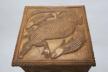
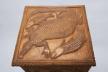
This tall unit comprises six drawers with a lidded top. Intricate relief carving on the top and four sides depicts various animals and forest scenes, including rats, elephants and warthogs.
Materials
material
Sida wood (W.A. Golden Walnut)
Measurements
dimensions
107 x 45 x 44 cm
Object type
object type
Furniture
Mobius inscriptions
inscriptions
Date made
date made
1949
Artist/Maker
provenance
producer
Erhabor, H. I.
Place made
production place
Benin City, Nigeria
Collector
prior source
Danford, John
Culture
ethnic attribution
Edo (Bini)
Institution
department and institution
Research and Cultural Collections
Named collection
department and institution
Danford Collection of West African Art and Artefacts
Acquisition
accession date
accession method
Danford Collection purchased in 1975.
Digital Benin note
notes
Note
notes
Bibliography
bibliography
Legal status
legal status
PERMANENT COLLECTION
Copyright statement
license
© Copyright holder unknown. Photo credit: Research and Cultural Collections, University of Birmingham
Category
Decorative art
Create Date
2/4/99
Created By
HAMILTJH
External Mobius publish?
Y
ID Prefix
BIRRC
ID Sort1
D
ID Sort2
2
ID Sort3
0
ID Sort4
0
ID Sort5
0
ID Sort6
0
Internal Mobius publish?
Y
Item count
1
Loan allowed?
Y
Location date
2/7/18
MKEY
102214
Miscellaneous
Lent by J. Danford 1964. Purchased 1975. See 1957 Ibadan catalogue no. 37.
Offsite?
N
Update Date
5/27/21
Updated By
AYOUNG
Whole/Part
Whole
XG_STATE
0
Sensitive Content

Digital Benin collates digital material from institutions, and some of this material is inherently colonial and contains words, terms and phrases that are inaccurate, derogatory and harmful towards African and African diasporic communities. Catalogue transcriptions, book titles, exhibition titles and museum titles may contain harmful terms. We recognise the potential for the material to cause physical and mental distress as well as evoke strong emotions. Owing to the scale of the collection’s data, a process to implement sensitive-content warnings in the displayed data is still incomplete. The material within the catalogue does not represent Digital Benin’s views. Digital Benin maintains a strong anti-colonial, anti-racist position and affirms its support for centring the humanity of historically marginalised and disenfranchised communities. Read more about the background of this statement here