

Reg No.
III 1038
Edo designations
English designations
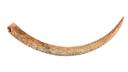
Altar Tusk
Categories
Altar & Shrine Objects
Location
Münsterpl. 20, 4051 Basel, Switzerland
Loading...
Altar Tusk

Iconographies

8 annotations
Ukpan obọ eva
Crossed Beaded Baldrics

The Ukpan obọ eva (coral-bead crossed baldrics) were worn as part of the ehaingbehia, the full ceremonial regalia, by only high-ranking members of the palace, including the Ọba himself, the Iy’Ọba, the Edaiken, and the Ezọmọ (Ben-Amos 1999, pp. 68, 141; Osadolor in Plankensteiner 2007, cat. no. 70, pp. 322–323).

1 annotation
Ukpan obọ eva
Colar Bead
Odigba
Coral beaded collar

Odigba (coral-beaded collar) is a rigid neck collar made of coral beads, worn as part of ceremonial attire only by senior princes who have been made Enigie (Inneh 2007, p. 107). Although Ibafe (2007, p. 43) argued that the Odigba was introduced during the Ogiso period (c. 900–c. 1170 AD) by Ogiso Ere, along with other symbolically important Emwin Arhe, such as the Ada (ceremonial sword) and the Ẹbẹn (ceremonial sword), this seems unlikely, as coral was only introduced in the late 15th century through trade with Portuguese merchants.

1 annotation
Odigba
alligator
Ẹghughu
Crocodile

In the riverine area surrounding Benin City, there are two types of crocodile. The Ẹghughu, known in English as the dwarf or bush crocodile, is believed to be more docile ( ; Ọbazee 2025, p. 133). The second type is the Àgbákà, the aggressive Nile crocodile ( ; Ọbazee 2025, p. 11).

Crocodiles are one of the important animals represented in the historical Emwin Arhe, and they are known as Olokun’s guards or the “policemen” of the waters. The powerful and ferocious qualities of these animals might explain why warrior figures are often depicted wearing Uhunmwu-Ẹkuẹ (pendant masks) in the shape of crocodile heads on Ama-Ẹrọnmwọn (bronze relief plaques) ( ). Olokun devotees use crocodiles as sacrificial animals in offerings during the worship of Olokun.

1 annotation
Ẹghughu
Asoro
Spears

Asoro (spears) were used as weapons in battle and for hunting ( ; Ọbazee 2025, p. 37). According to , there were two types: long and short. Figures holding Asoro are often depicted on Ama-Ẹrọnmwọn (bronze relief plaques), sometimes in battle scenes and at ceremonies and festivals.

1 annotation
Asoro
Ewi
Mudfish

Depictions of Ewi (mudfish) are among the most frequent motifs in the Emwin Arhe (royal treasures). Mudfish hold an important place in Edo belief, both as representations of the god Olokun and as symbols of royalty (Plankensteiner 2007, p. 410), as well as of “prosperity, peace, well-being and fertility” (Ben-Amos 1976, p. 245). Mudfish are also particularly common animals for sacrifice, and mudfish-shaped Orhiẹvbẹ (kola-nut boxes) were used to make offerings or store kola nuts.

Yet, the appearance of Ewi across the Emwin Arhe is not consistent, and it has been argued that different species of mudfish were depicted by Edo artists, each with different qualities and capabilities. For example, the electric shock of Malapterurus electricus resembles the fierceness of the Ọba, while the liminal qualities of the Synodontis clarias mudfish, which lives both on land and in water, similarly reflect the Ọba’s rule over land and sea (Gallagher 1983, p. 93). With these different qualities in mind, the mudfish is an important symbol of Benin kingship and royalty.

Sometimes the Ọba was depicted by artists with mudfish rather than legs (see Ọba with Mudfish Legs).

1 annotation
Ewi
Ẹkpẹn
Leopard

The Ẹkpẹn (leopard) is an animal that appears most often among the motifs decorating the Emwin Arhe (royal treasures). The Ẹkpẹn symbolises the valour and strength of the Ọba, as well as his political authority. The Benin people eulogise the Ọba as the ‘ẹkpẹn n'owa’ (leopard of the home).

When a hunter kills a leopard, he must say “ẹkpẹn n'oha” (I killed a bush leopard), as it is taboo to say that a hunter killed a leopard without specifying that it is a bush leopard, as otherwise this would “be tantamount to symbolically killing the king” (Nevadomsky 1988, p. 81). For this reason, leopards of the bush are called Atalakpa to distinguish them from those that represent the Ọba.

1 annotation
Ẹkpẹn
Ahianmwẹ-Ọrọ
Bird of Prophecy

The Ahianmwẹ-Ọrọ, meaning ‘bird of prophecy’ in English, is a bird with a long beak believed to be a messenger of the spirit world. If it cries ‘OyaO’ (disgrace), it portends danger or disaster. If it cries ‘Oliguegue’ (be grateful), it portends good favour, fortune, or luck. If it persistently cries ‘OyaO, OyaO’ in front of someone, it is prophesying that the person should be cautious and should not undertake a journey, or should return home rather than continue. But if the bird cries ‘Oliguegue’ continuously, the journey will be favourable.

In 1515, as Ọba Ẹsigie passed through the gates of Benin on his way to fight the Attah (king) of Idah, the Ahianmwẹ-Ọrọ made discouraging sounds overhead, ‘OyaO, OyaO’, portending that disaster lay ahead. The Ọba ordered the bird to be killed and went on to win the war. He said, ‘Nẹ O gha yin Agbon, ghẹi daho Ahianmwẹ notiẹ oya’ (whoever wishes to succeed in life should not heed the bird of prophecy). On the Ọba’s triumphant return from battle, he commissioned the Igun-Eronmwon to make an image of the bird on the finial of a battle standard to remind it that the Ọba was not subject to the fate of ordinary spirits (personal communication, Patrick Oronsaye, 2022).

The identification of which bird the Ahianmwẹ-Ọrọ represents has been a subject of scholarly debate throughout the 20th century. Some have suggested that the bird is an African pied wagtail (Melzian 1937, p. 5), an ibis (Dark 1962, p. 46), possibly a kind of kingfisher (Ben-Amos 1976, p. 252), a hornbill (McCall 1975, p. 293), or, lastly, a white-tailed ant thrush (Nevadomsky 1988, pp. 76–77). In the case of the Ahianmwẹ-Ọrọ, however, Joseph Nevadomsky (1988, p. 77) posited that the exact species being represented was in fact less important. Instead, the aim was to “convey certain notions about the supernatural powers of the Ọba” and that the physical attribute (e.g., the long beak) was in fact the Ọba Ẹsigie’s casters’ way of seeking to “emphasise its vocal powers of prophecy, and, perhaps more importantly, the overcoming of these powers by the Ọba.”

1 annotation
Ahianmwẹ-Ọrọ
Ẹbẹn
Ceremonial Sword

Ẹbẹn are a type of ceremonial sword of significant importance in the Benin Kingdom. During ceremonies, titled chiefs would hold them or toss them during dances, thereby paying homage to the Ọba at these public events, particularly when a chief receives a certain status. It is forbidden for Ẹbẹn to touch the ground, so the chief must take extra precautions to avoid dropping the Ẹbẹn during the dance. Therefore, the Okae-Odionmwan (head of executioners) dances with the Umozo (warfare or executioner’s sword) behind the dancing chief.

There are two central ceremonial swords used in the royal court of the Benin Kingdom, one of which is the Ẹbẹn, along with the Ada (ceremonial swords). They are distinguished by their blades: the Ẹbẹn blade reflects the shape of a leaf or an oar. Sometimes, it is decorated with openwork designs and/or brass inlays, most commonly shaped as small Ẹbẹn and Ẹkpẹn (leopards). The handle of the Ẹbẹn also has an unusual ring-shaped form, which further differentiates it from the Ada.

1 annotation
Ẹbẹn

Provenance

4 events
Production
1750 (year uncertain/approximate) to February 22, 1897 (day approximate)
The object was produced by Unknown member(s) of the Igbesamwan guild in Benin City.
Looted
February 22, 1897 (day approximate) to June 1899 (year approximate)
The object was looted by Unknown member of the British colonial military campaign on Benin - February 1897 from Benin Kingdom.
Unknown
February 22, 1897 (day approximate) to 1899
The object is known to have come into contact with J. F. G. Umlauff and Heinrich Umlauff, later in Hamburg.
Unknown
1899
The object is known to have come into contact with Freiwilliger Museumsverein Basel and the Museum der Kulturen Basel, in Basel.

Related archival documents

1 documents
See all
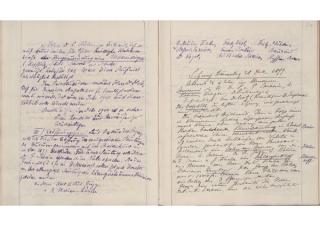
Accession Record
Museum der Kulturen Basel
Museum Commission Protocols
Date
December 28, 1899

Institution data

Museum der Kulturen Basel
The data was transferred directly through the Swiss Benin Initiative.
Last updated: 2022-07-04
Language: english
Institution fieldValue
Reg No.
object id
III 1038
Object name and materials
designation
Carved elephant tusk
Material
material
ivory, fire marks
Dimension/s
dimensions
Provisional dating
date made
18th century
Creditline
prior source
Deposit: Freiwilliger Museumsverein Basel
Provenances
provenance
Unknown date comissioned from the Royal Ivory-sculptors Guild (Igbesanmwan) by the Royal Palace of Benin; by descent to Oba Ovonramwen (Ovonramwen Nogbaisi, b. about 1857 - d. about 1914; r. 1888 - 1897); 1897, looted from the Royal Palace during the British military occupation of Benin; [...]; (dates unknown), Johann Friederich Gustav Umlauff; 1899 deposited by the Freiwilliger Museumsverein Basel
Institution
department and institution
MKB Museum der Kulturen Basel
Institution acquisition date
accession date
1899
Additional IDs
Sensitive Content

Digital Benin collates digital material from institutions, and some of this material is inherently colonial and contains words, terms and phrases that are inaccurate, derogatory and harmful towards African and African diasporic communities. Catalogue transcriptions, book titles, exhibition titles and museum titles may contain harmful terms. We recognise the potential for the material to cause physical and mental distress as well as evoke strong emotions. Owing to the scale of the collection’s data, a process to implement sensitive-content warnings in the displayed data is still incomplete. The material within the catalogue does not represent Digital Benin’s views. Digital Benin maintains a strong anti-colonial, anti-racist position and affirms its support for centring the humanity of historically marginalised and disenfranchised communities. Read more about the background of this statement here