Reg No.
III 1935
Edo designations
English designations
Commemorative Head
Categories
Altar & Shrine Objects
Heads
Location
Münsterpl. 20, 4051 Basel, Switzerland
Loading...
Commemorative Head

Iconographies

4 annotations
Igan
Feather

Igan (feathers) are commonly depicted tucked into the headdresses and hats of chiefs represented on Emwin Arre (royal treasures). These feathers are from the Oɛɣohɔ (vulturine fish eagle) and symbolise respected old age and proper chieftaincy ( ).

1 annotation
Igan
Colar Bead
Odigba
Coral beaded collar

Odigba (coral-beaded collar) is a rigid neck collar made of coral beads, worn as part of ceremonial attire only by senior princes who have been made Enigie (Inneh 2007, p. 107). Although Ibafe (2007, p. 43) argued that the Odigba was introduced during the Ogiso period (c. 900–c. 1170 AD) by Ogiso Ere, along with other symbolically important Emwin Arhe, such as the Ada (ceremonial sword) and the Ẹbẹn (ceremonial sword), this seems unlikely, as coral was only introduced in the late 15th century through trade with Portuguese merchants.

1 annotation
Odigba
Udahae
Beaded forehead band

The Udahae is a forehead band made from coral beads and worn by chiefs. Sometimes a white Igan (feather) from the Oɛɣohɔ (vulturine fish eagle) is tucked into the left side of the Udahae. According to Benin oral tradition, the Udahae was introduced by Ọba Ezoti, the first son of Ọba Ewuare I. During his coronation, Ezoti was shot in the forehead with a poisoned arrow. To stop the bleeding, a band of red beads was wrapped around his forehead while he made public appearances. Fourteen days later, he died from his wound. Since then, Benin chiefs have worn the red-beaded Udahae around their foreheads to commemorate the cap used by Ezoti to stop the bleeding (Egharevba 1968, p. 21).

1 annotation
Udahae
Ikharo
Forehead markings

Ikharo are linear keloid markings depicted on the forehead of Uhunmwu-Elao (commemorative heads) in groups of three or four above each eye. The exact meaning of Ikharo is debated; some have argued that they relate to the gender or tribal identification of the person on whom they are depicted. For example, has argued that they were worn only by men; however, their use in depictions is not consistent with this, and the Iy’Ọba are also shown wearing them. argued that they are instead a stylistic feature employed by artists that varied over time.

The naming of these markings differs between publications. For example, describe these markings as “agbaguda n'ehae”, which they write translates literally as “blades of the forehead”. However, later went on to call these “ikharo”, as used here. referred to these forehead markings as ikharo, meaning “tribal mark [of eye]”.

1 annotation
Ikharo

Provenance

5 events
Production
unknown to February 22, 1897 (day approximate)
The object was produced by Unknown member(s) of the Igbesamwan guild in Benin City.
Looted
February 22, 1897 (day approximate) to June 1899 (year approximate)
The object was looted by Unknown member of the British colonial military campaign on Benin - February 1897 from Benin Kingdom.
Unknown
February 22, 1897 (day approximate) to 1904
The object is known to have come into contact with J. F. G. Umlauff and Heinrich Umlauff, later in Hamburg.
Unknown
1904
The object is known to have come into contact with J. F. G. Umlauff, Heinrich Umlauff and Karl Friedrich 'Fritz' Sarasin, in Hamburg.
Gift
1904
The object was given as a gift by Karl Friedrich 'Fritz' Sarasin to the Museum der Kulturen Basel with its destination in Basel.

Related archival documents

2 documents
See all
An archival document representing a Correspondence of 2 page(s)
Correspondence
Museum der Kulturen Basel
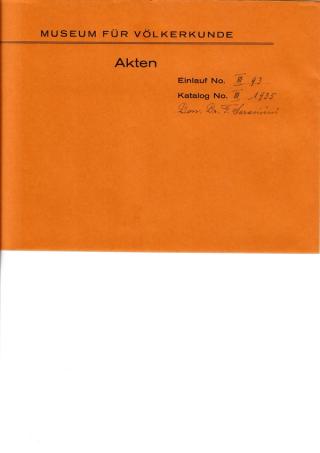
Einlauf III 93
Date
July 1, 1904
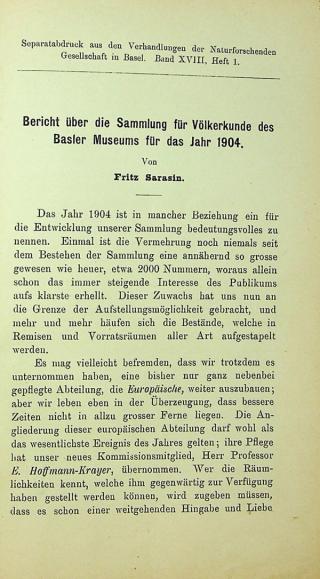
Annual Report
Museum der Kulturen Basel
Reports on the Ethnographic Collections
Date
January 1, 1904

Institution data

Museum der Kulturen Basel
The data was transferred directly through the Swiss Benin Initiative.
Last updated: 2022-07-04
Language: english
Institution fieldValue
Reg No.
object id
III 1935
Object name and materials
designation
Commemorative head of a dignitary
Material
material
wood, brass plate, copper sheet
Dimension/s
dimensions
H. 52 cm D. 20 cm
Provisional dating
date made
19th century
Creditline
prior source
Gift from: Fritz Sarasin
Provenances
provenance
Date of production unknown, probably produced by the Wood and Ivory Carvers Guild (Igbesanmwan); 1897, probably looted from Benin City during the military occupation of Benin; [...]; until 1904 Johann Friederich Gustav Umlauff (dealer, Hamburg), 1904, gifted to Museum der Kulturen Basel by Fritz Sarasin
Institution
department and institution
MKB Museum der Kulturen Basel
Institution acquisition date
accession date
1904
Additional IDs
Sensitive Content

Digital Benin collates digital material from institutions, and some of this material is inherently colonial and contains words, terms and phrases that are inaccurate, derogatory and harmful towards African and African diasporic communities. Catalogue transcriptions, book titles, exhibition titles and museum titles may contain harmful terms. We recognise the potential for the material to cause physical and mental distress as well as evoke strong emotions. Owing to the scale of the collection’s data, a process to implement sensitive-content warnings in the displayed data is still incomplete. The material within the catalogue does not represent Digital Benin’s views. Digital Benin maintains a strong anti-colonial, anti-racist position and affirms its support for centring the humanity of historically marginalised and disenfranchised communities. Read more about the background of this statement here