
Provenance
Institution data
| Institution field | Value |
|---|---|
irn object id | 36318 |
Main Title designation object type | Box in the form of a mudfish or catfish |
Materials and Technique material | carved ivory |
Dimensions dimensions | 19.5 x 12.0 x 4.6 x cm |
Date Created date made | 15th century |
Creators producer | Edo people, Court of Benin |
Place Of Creation production place | Northern Niger Delta, Nigeria |
Provenance provenance | with George R. Harding (1888–c.1912), London; from whom bought by Augustus Pitt-Rivers (1827–1900), Oxford, 27 June 1899 (£5); with Everett Rassiga (1922–2003), New York; from whom bought by the Australian National Gallery, Canberra, April 1974 The collecting history of this work of art is partial. Its location and ownership are unknown before the 19th century, and between the 1910s and the 1970s. The National Gallery of Australia welcomes further information regarding its history of ownership. |
Credit Line accession date | Purchased 1974 |
Exhibited exhibition history | Die Kunst von Schwartz-Afrika, Kunsthaus, Zurich 31 October 1970–10 February 1971, K28, p.383, illus. p.161; Kunst am Niger, Villa Hugel, Essen, 25 March–13 June 1971, cat.1 p.26, no.75; cat.2, K28, p.164, illus.165; Kunst ujt Afrika, Haags G |
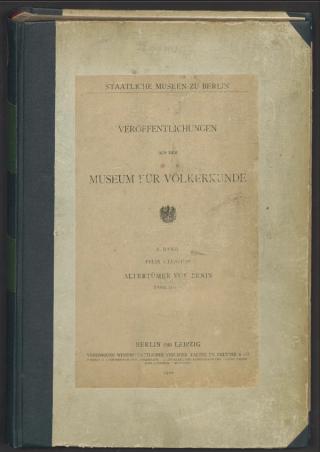
Literature bibliography | Catalogue of the Pitt Rivers museum, Farnham, 1899, vol.6, p.1913; Lieutenant-General Pitt-Rivers, Antique Works of Art from Benin, London: private printing 1900 (reprinted 1974), plate XLVII, figs 372–73, p.94, illus. b&w; Felix von Luschan, Die Altertümer von Benin, Berlin and Leipzig:De Gruyter1919 (reprinted New York: Hacker Art Books 1968), vol.1, p.485, vol.3, pl.117, illus. b&w; Elsy Leuzinger, The Art of Black Africa , London: Studio Vista 1972, K30, pp.168–69, illus. b&w, as ‘collection: George Ortiz, Geneva’ |
Accession Number | 74256 |
Digital Benin collates digital material from institutions, and some of this material is inherently colonial and contains words, terms and phrases that are inaccurate, derogatory and harmful towards African and African diasporic communities. Catalogue transcriptions, book titles, exhibition titles and museum titles may contain harmful terms. We recognise the potential for the material to cause physical and mental distress as well as evoke strong emotions. Owing to the scale of the collection’s data, a process to implement sensitive-content warnings in the displayed data is still incomplete. The material within the catalogue does not represent Digital Benin’s views. Digital Benin maintains a strong anti-colonial, anti-racist position and affirms its support for centring the humanity of historically marginalised and disenfranchised communities. Read more about the background of this statement here