
Iconographies







Provenance
Institution data
| Institution field | Value |
|---|---|
Inventarisnummer object id | RV-1243-14 |
Objectnaam designation object type | Beeld |
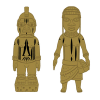
Titel designation object type | Beeld van een koninginmoeder |
Associatie/beschrijving (online getoond) description | Beeld van een vrouw, getooid met kralennetwerk op hoofd en om romp; om hals een hoge kralen kraag. Deze figuur heeft ooit deel uitgemaakt van een groep figuren op een voorouderaltaar. |
Materiaal en techniek (NB: ook thesaurustermen aanpassen!) material | Messing of brons ; ijzer ; verlorenwastechniek |
Afmetingenlabel (H x B x D) dimensions | 21 cm 21 x 7,5 x 7,5 cm |
Datering date made | 18e eeuw |
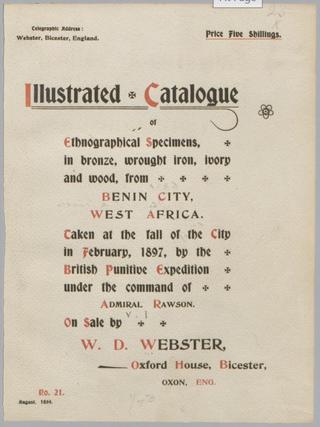
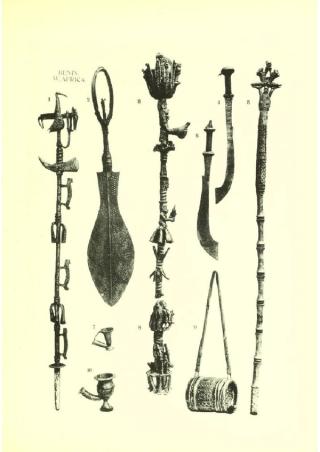
Verzamelgeschiedenis (toelichting) provenance | The acquisition of 53 Benin objects (RV-1243-1 to -46 and RV-1295-2 to -7) from William Downing Webster (1868-1913), a British ethnographic art dealer and collector, known to have assembled a large collection from the Benin military campaign of 1897, is characterised by budgeting issues (Waterfield & King 2006: 55-63). When Johannes Schmeltz received a first letter from Webster on 7 December 1899 with a list of Benin objects offered for sale, he realised it would need fundraising on his part to acquire this important collection (NL-LdnRMV-A1-30-542/545). Schmeltz managed to secure funds from, amongst others, Her Majesty the Queen of the Netherlands, Queen Wilhelmina, and the Queen Mother, Princess Emma van Waldeck-Pyrmont. The Queen Mother’s secretary sent a letter to Schmeltz confirming the donation for the purchase of the Benin objects on 8 June 1900 (NL-LdnRMV-A1-31-344/345; CL-L: Nl- LdnRMV_A01_277_00109; AR-L 1899-1900: 13; MR-L: NL-LdnRMV_A03_007_0237). All the financial donors were listed in the Nederlandsche Staatscourant, the Dutch national state newspaper on 25 April 1902. While on 16 February 1900 Schmeltz writes to Webster that he wants ‘the greatest part’ of the objects offered to him but that he has not yet found the money to pay for them (NL-LdnRMV-A1-210-531/534), the first purchase of 30 objects was confirmed in the day book on 26 February 1900 and included one object from the Admiralty Islands (DB-L: NL-LdnRMV-A3-7-237). In a letter to Schmeltz dated 17 February 1900, Webster includes a newspaper clipping mentioning that he bought the objects at the J.C. Stevens auction. By doing this, he also gives evidence of the current prices of Benin objects (NL-LdnRMV-A1-31-505/506). All the objects that had been sent to the Netherlands for viewing and had not been selected were sent back. Also, some of the objects were first registered as loans, allowing Schmeltz to secure the funds to buy them as they were considered important: ‘From the objects still on loan some deserve to be mentioned here already as especially noteworthy.’ Two men, Elco M. Vis and R. Langenbach enabled the procurement of some loan objects: ‘Because of the gentlemen Elco M. Vis in Amsterdam and R. Langenbach in Worms, yours truly was able to once more purchase one of the objects on loan from the Kingdom of Benin [serie 1243].’ The plates in the annual report show that Schmeltz, used the donations to acquire Webster collections (series RV-1243) and Umlauff collections (series RV-1286, series RV-1310) as the money became available, irrespective of which artworks he had received on view first. (Excerpt from Provenance no. 2 'The Benin collections at the National Museum of World Cultures' written by Rosalie Hans with Annette Schmidt, 05-01-2021) |
Cultuur (NB: ook thesaurusterm aanpassen!) ethnic attribution | Bini |
Deelcollectie department and institution | Materiële cultuurcollectie |
Verwervingsdatum accession date | 1900-02-01 |
Wijze van verwerving accession method | Aankoop |
Literatuur bibliography | |
Publicaties over het object bibliography | Bedaux, R.M.A. 1990 De geschiedenis van de Leidse Benin-verzameling. In: A. Duchâteau, Benin: vroege hofkunst uit Afrika. Brussel: 164 en 165. Marquart, J., 'Die Benin-Sammlung des Reichsmuseums für Völkerkunde in Leiden'. Veroffentlichungen des Reichsmuseums für Völkerkunde in Leiden. Serie II nr. 7. Leiden: Brill, 1913. For more information about the provenance, see <a href="https://issuu.com/tropenmuseum/docs/2021_provenance_2__benin__e-book" target="_blank"> Provenance #2 – the Benin collections at the National Museum of World Cultures </a> (NB: Issuu uses cookies). |
Objectstatus legal status | Eigendom |
Met dank aan (online getoond) | |
Periode (NB: ook thesaurusterm aanpassen!) | Benin |
Verkorte naam | AFRIK |
Digital Benin collates digital material from institutions, and some of this material is inherently colonial and contains words, terms and phrases that are inaccurate, derogatory and harmful towards African and African diasporic communities. Catalogue transcriptions, book titles, exhibition titles and museum titles may contain harmful terms. We recognise the potential for the material to cause physical and mental distress as well as evoke strong emotions. Owing to the scale of the collection’s data, a process to implement sensitive-content warnings in the displayed data is still incomplete. The material within the catalogue does not represent Digital Benin’s views. Digital Benin maintains a strong anti-colonial, anti-racist position and affirms its support for centring the humanity of historically marginalised and disenfranchised communities. Read more about the background of this statement here