
Ident. Nr.
III C 8196
Edo designations
English designations
Commemorative Head
Categories
Altar & Shrine Objects
Location
1 Adesogbe (Plymouth) Road, P.M.B. 1115, Benin City , Edo State
Loading...
Commemorative Head
Commemorative Head

Iconographies

9 annotations
Beaded Crown
Ẹde
Beaded Crown

Although many other members of the Benin royal court wore a variety of hats and forms of headwear, only the Ọba may wear the Ẹde (beaded crown). The Ọba must never be seen bare-headed, and successive Ọbas introduced different styles and types of crowns ( ).

Across different media and objects, Ọbas are depicted wearing various types of crowns, all elaborately crafted from coral beads. Some feature tall projections rising from the crown, known as Oro, while others have curved projections extending from either side of the head, known as the winged cap. The latter was introduced only in the 19th century, most likely by Ọba Osẹmwẹndẹ ( ). Depictions of Ọba Esigie on Ama-Ẹrọnmwọn (bronze relief plaques) show him wearing an elaborate crown decorated with large jasper or coral beads ( ).

1 annotation
Ẹde
Ughavan
Celts

Ughavan (celts) are often seen as part of the decoration along the flanges of the Uhunmwu-Elao (commemorative heads), alongside trunk hand, leopard, or cow’s head motifs, or held in the left hand of the Ọba on the Ikẹgobọ (altar to the hand). This imagery has a particular meaning: when the Ọba holds the Ughavan in his left hand, it is said to be known instead as isauan (faeces of thunder) and is believed to “increase the potency of a curse or a blessing” ( ).

1 annotation
Ughavan
TBC ov-ene obo
Trunk hand

The trunk hand motif, comprising an elephant’s trunk ending in a fist, is believed to have complex and varied symbolic meanings. During the 15th and 16th centuries, the era of the warrior kings, the motif appeared only occasionally. During the 18th century, it was revived to honour the richest of all Ọbas, Ọba Akenzua I. This was particularly the case on the Aken'ni Elao (carved tusks), and the trunk hand motif commonly appears on these ivories from the 18th century and throughout the 19th and into the 20th centuries ( ). In her PhD thesis, Barbara Blackmun ( ) identified eight different kinds of motifs of this type on the Aken’ni Elao alone, indicating that the form itself is variable. In addition to the ivory Aken’ni Elao, the motif also commonly appears on the flanges of Uhunmwu-Elao (commemorative heads), the bases of Urhotọ (altar tableaux), and some ornately decorated bronze Ukhurhẹ (ancestral staffs).

The elephant trunk hand has been interpreted as a symbol of physical power ( ) and strength ( ), and as the “ultimate Hand of Hands” ( ). A past Ihama n’Igun-Ẹrọnmwọn ( ) interpreted the motif as a symbol of “taking life”. On some Emwin Arhe (royal treasures) where the trunk hand motif is present, depictions of human sacrifices are also present, representing the ultimate power held by the divine Ọbas. The potent nature of the trunk hand motif is further emphasised by Barbara Blackmun through the combination of “the head of one of the most powerful animals with a hand that grasps with enormous strength”; together, these signify “the acquisition of great wealth for the kingdom” ( ).

2 annotations
TBC ov-ene obo
TBC ov-ene obo
Ikharo
Forehead markings

Ikharo are linear keloid markings depicted on the forehead of Uhunmwu-Elao (commemorative heads) in groups of three or four above each eye. The exact meaning of Ikharo is debated; some have argued that they relate to the gender or tribal identification of the person on whom they are depicted. For example, has argued that they were worn only by men; however, their use in depictions is not consistent with this, and the Iy’Ọba are also shown wearing them. argued that they are instead a stylistic feature employed by artists that varied over time.

The naming of these markings differs between publications. For example, describe these markings as “agbaguda n'ehae”, which they write translates literally as “blades of the forehead”. However, later went on to call these “ikharo”, as used here. referred to these forehead markings as ikharo, meaning “tribal mark [of eye]”.

1 annotation
Ikharo
Colar Bead
Odigba
Coral beaded collar

Odigba (coral-beaded collar) is a rigid neck collar made of coral beads, worn as part of ceremonial attire only by senior princes who have been made Enigie (Inneh 2007, p. 107). Although Ibafe (2007, p. 43) argued that the Odigba was introduced during the Ogiso period (c. 900–c. 1170 AD) by Ogiso Ere, along with other symbolically important Emwin Arhe, such as the Ada (ceremonial sword) and the Ẹbẹn (ceremonial sword), this seems unlikely, as coral was only introduced in the late 15th century through trade with Portuguese merchants.

1 annotation
Odigba
Ogho
Ram

The Ogho (ram) is associated with masculine and aggressive qualities, bravery and agility in Edo belief, as well as with conflict and trouble ( ). Due to these symbolic associations, the Ogho is one of the animals often used for sacrifice, particularly at the Ikẹgobọ (altar to the hand), as an offering associated with physical strength and power. Rams, particularly ram’s heads, are a common motif used to decorate the flanges of Uhunmwu-Elao (commemorative heads), as well as serving as the central decorative motif on pendant plaques. These Ogho pendant plaques are believed to have been worn by the Ọba, based on evidence from depictions of a figure interpreted as Ọba Ewuakpe ( ; ). According to Barbara Blackmun ( ), the Ogho head motif was one of the dynastic motifs that were revived during the 18th century. The widespread use of the ram’s head motif suggests connections with other southern Nigerian casting centres, such as Ife, Owo, and the Lower Niger Bronzes.

In addition to the ram’s head motif, two unusual aquamaniles in the form of whole Ogho figures were also cast by artists from the Igun-Ẹrọnmwọn.

1 annotation
Ogho
Ewi
Mudfish

Depictions of Ewi (mudfish) are among the most frequent motifs in the Emwin Arhe (royal treasures). Mudfish hold an important place in Edo belief, both as representations of the god Olokun and as symbols of royalty (Plankensteiner 2007, p. 410), as well as of “prosperity, peace, well-being and fertility” (Ben-Amos 1976, p. 245). Mudfish are also particularly common animals for sacrifice, and mudfish-shaped Orhiẹvbẹ (kola-nut boxes) were used to make offerings or store kola nuts.

Yet, the appearance of Ewi across the Emwin Arhe is not consistent, and it has been argued that different species of mudfish were depicted by Edo artists, each with different qualities and capabilities. For example, the electric shock of Malapterurus electricus resembles the fierceness of the Ọba, while the liminal qualities of the Synodontis clarias mudfish, which lives both on land and in water, similarly reflect the Ọba’s rule over land and sea (Gallagher 1983, p. 93). With these different qualities in mind, the mudfish is an important symbol of Benin kingship and royalty.

Sometimes the Ọba was depicted by artists with mudfish rather than legs (see Ọba with Mudfish Legs).

1 annotation
Ewi
Ẹkpẹn
Leopard

The Ẹkpẹn (leopard) is an animal that appears most often among the motifs decorating the Emwin Arhe (royal treasures). The Ẹkpẹn symbolises the valour and strength of the Ọba, as well as his political authority. The Benin people eulogise the Ọba as the ‘ẹkpẹn n'owa’ (leopard of the home).

When a hunter kills a leopard, he must say “ẹkpẹn n'oha” (I killed a bush leopard), as it is taboo to say that a hunter killed a leopard without specifying that it is a bush leopard, as otherwise this would “be tantamount to symbolically killing the king” (Nevadomsky 1988, p. 81). For this reason, leopards of the bush are called Atalakpa to distinguish them from those that represent the Ọba.

1 annotation
Ẹkpẹn

Provenance

6 events
Production
unknown to February 22, 1897 (day approximate)
The object was produced by Unknown member(s) of the Igun-Ẹrọnmwọn guild in Benin City.
Looted
February 22, 1897 (day approximate) to June 1899 (year approximate)
The object was looted by Unknown member of the British colonial military campaign on Benin - February 1897 from Benin Kingdom.
Unknown
some day in March 1897 to September 10, 1898
The object is known to have come into contact with Eduard Schmidt.
Purchase
September 13, 1898 to December 31, 1898
The object was purchased by the Ethnologisches Museum, Staatliche Museen zu Berlin from Eduard Schmidt with its destination in Berlin.
Restitution
July 1, 2022
The object was restituted by the Ethnologisches Museum, Staatliche Museen zu Berlin to the Omo n'Oba n'Edo Uku Akpolokpolo, Ọba of Benin & National Commission for Museums and Monuments, Nigeria through Hermann Parzinger and Abba Isa Tijani from Berlin to Nigeria.
Restitution
July 1, 2022
The object was restituted by the Ethnologisches Museum, Staatliche Museen zu Berlin to the Omo n'Oba n'Edo Uku Akpolokpolo, Ọba of Benin & National Commission for Museums and Monuments, Nigeria through Hermann Parzinger and Abba Isa Tijani from Berlin to Nigeria.

Related archival documents

1 documents
See all
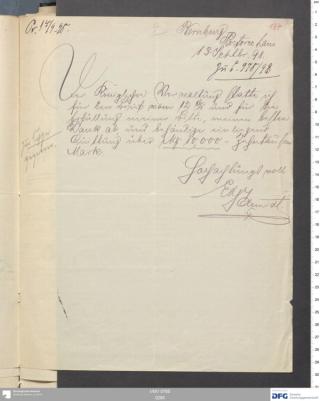
An archival document representing a Correspondence of 2 page(s)
Correspondence
Ethnologisches Museum, Staatliche Museen zu Berlin
Die Erwerbung ethnologischer Gegenstände aus der Benin-Expedition. Vol. 2
Date
September 13, 1898

Institution data

Omo n'Oba n'Edo Uku Akpolokpolo, Ọba of Benin & National Commission for Museums and Monuments, Nigeria
The data was transferred directly from Ethnologisches Museum, Staatliche Museen zu Berlin, DE. The NCMM gave permission to Digital Benin to display this data.
Last updated: 2021-06-14
Language: german
Institution fieldValue
ID
object id
211036
Ident. Nr.
object id
III C 8196
Ident. Nr. // (Sortiernr.)
object id
0003 C 08196
Titel
designation
Titel: Gedenkkopf eines Königs
Texte Online
description
Online Beschreibung, Die aus dieser Zeit in größerer Zahl erhaltenen Gedenkköpfe sind stark formalisiert. Ihre Gesichter sind weitgehend identisch, die königlichen Insignien dagegen stärker ausgearbeitet, ihre Formen variieren.Gemeinsam ist allen die aus Korallenperlen bestehende Kappe. Verschiedene Motive auf einer Plinthe um die Basis verweisen auf die spirituelle Macht des Königs. Gleichzeitig werden die Köpfe größer und ihre Wanddicke wird erheblich stärker. Auf den Altären des 18. und 19. Jahrhunderts dienen die Gedenkköpfe nämlich zugleich als Basis für große Elefantenzähne, die mit Motiven beschnitzt sind, die in der frühen Zeit Benins, im 16. und 17 Jahrhundert, auf den Reliefplatten dargestellt waren. [Benin_Königreich]
Material / Technik
material
production technique
Material: Messing; Ausgabe: Messing
Material / Technik // Alle
material
production technique
Messing, Messing
Maße
dimensions
52,00 x 32,50 x 35,50 cm; 35,10 kg; 34,00 cm
Objekttyp
object type
Allgemein
Sachbegriff
object type
Sachbegriff: Plastik; Sachbegriff: Menschlicher Kopf (Plastik)
Anzahl Teile
object count
1
Datierung
date made
18. Jh.
Geogr. Bezüge
production place
Nigeria ( Land ); Benin ( Königreich )
Geogr. Bezüge // Alle
production place
Nigeria, Benin
Veräußerer
prior source
null
Beteiligte
provenance
Eduard Schmidt (1892), Sammler
Beteiligte // (Name, Sortierung=kleinste)
provenance
Schmidt, Eduard
Verw. Institution
department and institution
Ethnologisches Museum, Staatliche Museen zu Berlin
Erwerb. Datum
accession date
1898
Besitzart
accession method
Erwerb. Notiz
accession method
Notiz: Rückführung Wiesbaden; Ausgabe: 18. Jh., Auftragsarbeit der Igun Eronmwon oder Gilde der Messinggießer im Königreich Benin für einen königlichen Gedenkaltar gegeben; durch Erbschaft an Oba Ovonramwen (ca. 1857-1914; reg. 1888-97), Königspalast, Benin-Stadt; vermutlich geplündert im Zusammenhang mit der britischen Eroberung von Benin, 1897; in unbekanntem Besitz nach der Eroberung des Königreichs Benin; gesammelt von Konsul Eduard Schmidt, Angestellter der Woermann Linie, zwischen 1897 und 1898 im Gebiet des späteren kolonialen Nigeria; verkauft an das Königliche Museum für Völkerkunde in Berlin, 1898.
Digital Assets
images
Farb-Positiv, Vorlage; Vorlage; Vorlage; Vorlage; Vorlage; III C 8196 -A.JPG, Repro Digitalisat; III C 8196.JPG, Repro Digitalisat
Erwerb. Nr.
I/133/1898
Erwerbungsart
Ankauf
Obj. Status
vorhanden
Objektref.
VIII A 14282, Positiv, SW, Bronzekopf, Landesbildstelle Bonn; E 663/1898, Erwerbung: a.) I/131/1898 + b.) I/132/1898 + I/133/1898: a.) III C 8164-8182 + b.) III C 8183-8192 + c.) III C 8193-8218, a,b.) Bronzen c.) Bronzen u. Elefantenzahn (Benin), Consul Schmidt, 1898, Eduard Schmidt (1892); R-04161, Kopf, Gedenkkopf eines Königs, 1931
Sachbegr. Ausgabe
Plastik
fileNames
iii_c_8196.jpg, iii_c_8196_1.jpg
Sensitive Content

Digital Benin collates digital material from institutions, and some of this material is inherently colonial and contains words, terms and phrases that are inaccurate, derogatory and harmful towards African and African diasporic communities. Catalogue transcriptions, book titles, exhibition titles and museum titles may contain harmful terms. We recognise the potential for the material to cause physical and mental distress as well as evoke strong emotions. Owing to the scale of the collection’s data, a process to implement sensitive-content warnings in the displayed data is still incomplete. The material within the catalogue does not represent Digital Benin’s views. Digital Benin maintains a strong anti-colonial, anti-racist position and affirms its support for centring the humanity of historically marginalised and disenfranchised communities. Read more about the background of this statement here