



Iconographies






Provenance
Institution data
| Institution field | Value |
|---|---|
ID number object id | BIRBI-48.1 |
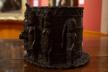
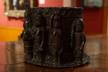
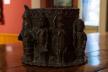
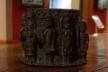
Title_Object-name designation | An altarpiece for the altar of a queen mother |
Materials material | Brass |
Measurements dimensions | 21.3 x 26.7cm diameter at base; 21.3 x 23 x 23cm |
Handout provenance | AN ALTARPIECE FOR THE ALTAR OF A QUEEN MOTHER 18TH/19TH CENTURY Brass Purchased 1948 The Henry Barber Trust purchased this hand altar in January 1948 from the well-known London dealers, Spink & Son. It had previously been part of the vast collection of William Randolph Hearst (1863-1951), the extraordinary Californian media magnate who inspired Orson Welles’s 1941 film Citizen Kane. Hearst is understood to have acquired it at the sale in London, on 1 May 1930, of the collection formed by the Hon. G. W. Neville, who had been a member of the Benin Expedition of 1897 (see below). Why is there now a debate about these objects? The Benin Expedition of 1897: The Benin Expedition of 1897 was a punitive expedition by a United Kingdom force of 1,200 under Admiral Sir Harry Rawson in response to the ambush of a previous British-led party under Acting Consul General James Philips (which had left all but two men dead). Rawson's troops captured, burned, and looted Benin City, bringing to an end the west African Kingdom of Benin. Immediately after the invaders secured the city, looting began. It was an exercise that was carried out by all members of the expedition . Most of the looted objects from the city, including the Benin bronzes, were retained by the expedition with some 2,500 religious artefacts and artworks being sent to England. About 40% of the art was accessioned to the British Museum in London, some works were given to individual members of the British Military as spoils of war, and the remainder was sold at auction by the British Admiralty to pay for the expedition as early as May 1897. Most of the Benin bronzes sold at auction were purchased by museums, mainly in Germany. There are also Benin bronzes in the collections at the Pitt Rivers Museum (Oxford), the Metropolitan Museum of Art (New York) and the Weltmuseum Wien (Vienna, Austria). What’s the current situation? There is currently an international debate about these objects and how Western museum s should respond. Nigerian governments have sought the return of these objects since the country gained independence in 1960. The return of cultural objects to their country of origin is known as restitution. This is a very complex issue that has divided opinion. Not all non-Western cultural objects in Western museum s were obtained by force or under duress; legitimate trade, exchange and gifts have also taken place and continue to do so, but the Benin bronzes embody a particularly stark example of illegitimate seizure within the context of colonialism. The Benin Dialogue Group, which includes Nigerian representatives and European museum officials, was formed in 2007 to discuss the issue. In 2018 the Group announced that major museums across Europe (including the British Museum) have agreed to loan artefacts back to Nigeria to be displayed in a new museum which is due to open in 2021. This marks a significant development after many years of negotiations. In addition, in 2018 the French President Emmanuel Macron agreed to return 26 works (mainly royal statues from the Palaces of Abomey) “without delay”. The French army took artefacts from Benin during a war in 1892 which were housed in Paris's Quai Branly museum. Museums internationally are watching the discussions and developments closely to see how the situation progresses. What does this mean for the Barber Institute? Staff at the Barber Institute are watching developments closely and the Henry Barber Trust, which owns the object, and the Barber Institute of Fine Arts, as an accredited public museum, will be guided by any official guidelines or decisions that are made. In the UK the issue is currently being discussed jointly by the National Museum Directors’ Council, the Department of Culture, Media and Sport (DCMS), the Museums Association, Arts Council England and the University Museums Group. The Barber Institute is facilitating wider consideration and exploration of both this debate and similar issues through our Learning and Engagement programme- to find out more contact learning@barber.org.uk |
Culture ethnic attribution | Benin, Nigeria |
Institution department and institution | The Barber Institute of Fine Arts |
Purchased accession date | 1948 |
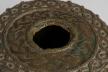
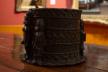
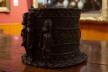
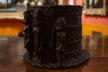
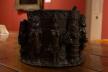
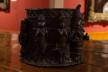
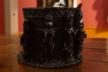
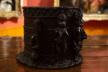
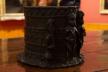
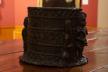
Notes notes | In the royal court of Benin, Nigeria, the iyoba or queen mother, enjoyed great political importance. Indeed, she benefitted from many of the privileges granted to high-ranking men in Benin culture. She is depicted here as the most prominent figure on a brass hand altar. These altars were usually made to celebrate an individual’s accomplishments which the queen mother would have been accorded by virtue of her relationship to her son, the king. In this, and similar sculptures, she can be identified by her size, her crown, jewellery and high collar. Here she is flanked by two female attendants who were traditionally raised in the royal palace by the iyoba herself. These women were respected for their education and refinement and were usually offered in diplomatic marriages to reinforce political alliances with important chiefs of other tribe s. |
Artist/Maker | West African |
Date made | about 18th/19th century |
Description Website | This altarpiece originated in Benin, in West Africa, and was dedicated to the Queen Mother of the Edo people. She is depicted in the centre, flanked by three attendants to either side. She wears an elaborate headdress covered with coral beads called ‘the chicken’s beak’. According to Edo ritual, the King (Oba) had dominion over the leopard, and the Queen Mother (Lyoba) over the cockerel. The altar was used in the worship of the cult of the hand. Benin religion attached mystical significance to both the head and hand in understanding human personality. Whereas the head symbolised those gifts the individual had been given at birth, the hand indicated the use to which they had been put in later life. Originally anyone using the altar to strengthen the hand would have placed his or her hand on the top and accompanied this gesture with a small offering of seeds or nuts. This hand altar was taken from Benin by the Hon G.W. Neville during the notorious punitive expedition of 1897, when British troops captured Benin City and looted many thousands of objects. This work eventually found its way onto the London art market, where it was purchased from the dealers Spink & Son, in 1948. |
Label Text | Unrecorded Edo Sculptor Ikegobo to the Iyoba (Hand Altar to the Queen Mother) Kingdom of Benin, Edo state (modern-day southern Nigeria), late 18th/early 19th century Brass This Ikegobo (altarpiece) comes from the Kingdom of Benin, specifically its capital, Benin, a city known for its centuries-old tradition of metal castings using complex and highly skilled techniques. Although now often referred to as a ‘Benin bronze’, it is actually made of brass. Only royalty and privileged chiefs owned these pieces and all were men with one exception, the Iyoba (Queen Mother), who is celebrated in this Ikegobo. Here, she is the largest figure flanked by her six attendants. The Ikegobo is a ‘Hand Altar’. Traditional Benin religion attached significance to both the head and the hand. Whereas the head symbolised reasoning and qualities an individual had been born with, the hand indicated the use to which these talents had been put in life. Offerings and prayers would have been made at the Ikegobo to bring wealth and prosperity. Purchased 1948 (No. 48.1) *** Unlike other parts of Africa, Benin retained its independence from European colonising states up to the late 19th century. However, the British saw great economic opportunity in the Benin forests, and resented the custom duties and trade restrictions imposed by Oba Ovoranmwen, King of Benin. This gave rise to the notorious ‘punitive expedition ’ of February 1897, which brought a violent end to the Kingdom of Benin. The British looted many thousands of objects, including this Ikegobo, which was probably seized by George William Neville, a Lagos-based banker and shipping agent. It eventually found its way onto the London art market, where it was purchased from the dealers Spink & Son by the Henry Barber Trust in 1948 for display at the Barber Institute. With the violent removal of Benin’s treasures again under the spotlight, dialogue between western museum s and Nigerian stakeholders has a new urgency. The Barber is a partner in the Digital Benin project, a collaborative resource supporting these discussions. For more information, please see our website or ask the Visitor Services Team for an information sheet. |
Object type | Sculpture |
Digital Benin collates digital material from institutions, and some of this material is inherently colonial and contains words, terms and phrases that are inaccurate, derogatory and harmful towards African and African diasporic communities. Catalogue transcriptions, book titles, exhibition titles and museum titles may contain harmful terms. We recognise the potential for the material to cause physical and mental distress as well as evoke strong emotions. Owing to the scale of the collection’s data, a process to implement sensitive-content warnings in the displayed data is still incomplete. The material within the catalogue does not represent Digital Benin’s views. Digital Benin maintains a strong anti-colonial, anti-racist position and affirms its support for centring the humanity of historically marginalised and disenfranchised communities. Read more about the background of this statement here