
Provenance
Institution data
| Institution field | Value |
|---|---|
Accession Number object id | 1899.78.4.1 |
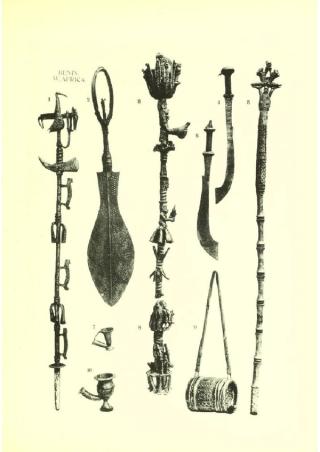
Description description | Wooden weaving sword with carved butt. For the other associated weaving apparatus see [1899.78.4 .2 - .8] [BS [OPS Move] 20/4/2017] |
Material / Process material | Material of original: Wood Plant |
Dimensions dimensions | max 7,00 mm; Width: max 48,00 mm; Length: max 816,00 mm |
Keywords object type | Keyword: Loom Part; Keyword: Weaving Accessory |
No. of objects object count | 1 |
Dating date made | Date made: 1899 |
Geographical Provenance production place | Africa -> Western Africa -> Nigeria, Benin |
Persons prior source | PRM source: William Downing Webster |
Provenance prior source provenance | Other Owners, William Downing Webster |
When Collected date collected | When collected: |
Cultural Groups ethnic attribution | -> Edo |
Acquired accession date | Acquired: 10/1899 |
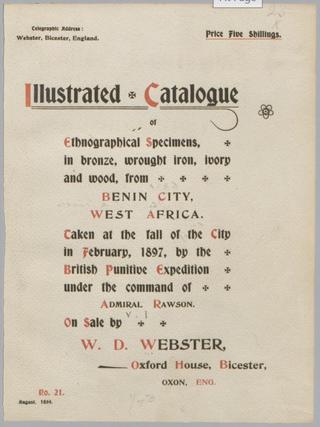
Primary Documentation notes | Accession book entry: : 1899. Oct. W. D. WEBSTER. Bicester. - Weaving implements, Benin city, W. Africa. comprising: 2 weaving swords [4.1,2], 2 long shuttle needles [.4.3,4], 2 notched bars for separating warp threads [.4.5,6], rod with loops for alternative warp threads [4.7], thin bamboo rod [4.8]. 20/-; Accession book entry: : [added] - 5-6-6 pd M.M.F. [Museum Maintenance of Collections Fund] 20.10.99 [price includes all items from 1899.78.1 - .17]; Written on object: : WEAVING SWORD. BENIN CITY, W. AFRICA. Purch: 1899 [BS [OPS Move] 20/4/2017]; Written on object: : 7292 [BS [OPS Move] 20/4/2017] |
Research Notes notes | |
Archaological / Ethnographic | E |
Archival documentation ID | |
Class | Class: Textile |
Collection Type | Object |
Related Collections |
Digital Benin collates digital material from institutions, and some of this material is inherently colonial and contains words, terms and phrases that are inaccurate, derogatory and harmful towards African and African diasporic communities. Catalogue transcriptions, book titles, exhibition titles and museum titles may contain harmful terms. We recognise the potential for the material to cause physical and mental distress as well as evoke strong emotions. Owing to the scale of the collection’s data, a process to implement sensitive-content warnings in the displayed data is still incomplete. The material within the catalogue does not represent Digital Benin’s views. Digital Benin maintains a strong anti-colonial, anti-racist position and affirms its support for centring the humanity of historically marginalised and disenfranchised communities. Read more about the background of this statement here