
ObjectNumber_Original
VO_98155
Institution
Weltmuseum Wien
Edo designations
English designations
Altar Tableau
Categories
Altar & Shrine Objects
Location
Heldenplatz, 1010 Wien, Austria
Loading...
Altar Tableau
Altar Tableau
Altar Tableau
Altar Tableau

Iconographies

14 annotations
Ẹkpẹn
Leopard

The Ẹkpẹn (leopard) is an animal that appears most often among the motifs decorating the Emwin Arhe (royal treasures). The Ẹkpẹn symbolises the valour and strength of the Ọba, as well as his political authority. The Benin people eulogise the Ọba as the ‘ẹkpẹn n'owa’ (leopard of the home).

When a hunter kills a leopard, he must say “ẹkpẹn n'oha” (I killed a bush leopard), as it is taboo to say that a hunter killed a leopard without specifying that it is a bush leopard, as otherwise this would “be tantamount to symbolically killing the king” (Nevadomsky 1988, p. 81). For this reason, leopards of the bush are called Atalakpa to distinguish them from those that represent the Ọba.

1 annotation
Ẹkpẹn
Eni
Elephant

Compared to the Ẹkpẹn (leopard), the Eni (elephant) is not as prominent in the visual language of the Emwin Arhe (royal treasures). It is found on two elephant-head pendant masks and as a full figure, with a chief standing on top of it, on some staffs, but more recurrently only as a trunk, either curved or straight, sometimes terminating in a human fist clenching a bunch of leaves. For example, in her PhD thesis, Barbara Blackmun ( ) identified eight different kinds of ‘trunk hand’ motifs on the Aken'ni Elao (carved tusks) alone.

When a chief or important man passes away, it is said in Edo that ‘an elephant has fallen out of society’. Eni are also said to be the ogie (lord) of the animals, and together these associations have led to the interpretation of Eni as symbols of chiefs, possibly even rebel chiefs, in Benin iconography ( ). Based on the qualities of the animals themselves, representations of Eni on the Emwin Arhe (royal treasures) are believed to represent “physical power, leadership, wisdom, and longevity” ( ).

1 annotation
Eni
Ẹgogo
Gong

Ẹgogo (gongs) hold significant importance in Benin art and ritual, serving as powerful instruments with both practical and symbolic roles. Ivory gongs, especially “double-bell” types, were highly prized and reserved for the royal court, particularly those made entirely of ivory, which were used exclusively by the Ọba. The whiteness of ivory Ẹgogo symbolises purity and peace and is linked to sacred Orhue (white kaolin chalk) and the deity Olokun (Blackmun 2007, cat. no. 60, p. 315).

When depicted in the imagery of the Emwin Arhe (royal treasures), Ẹgogo are usually held by figures such as the Ọba or high-ranking chiefs, illustrating their historical and ongoing use as idiophones during ceremonies and festivals. The Ọba dances with an ornately carved ivory Ẹgogo during the Emobo festival, which takes place three days after the Iguẹ festival (Ben-Amos 1995, p. 108).

1 annotation
Ẹgogo
Round Neck Bead
Ikele
Coral bead circlet

Ikele is a single stiff string or circlet of coral beads. It is worn by chiefs, such as senior chiefs who have been made Enigie (Inneh 2007, p.107), and is a sign of nobility and rank. The Ikele may only be worn once the Ọba has conferred a person with the right to wear the beads, and the Ikele must always be worn when appearing before the Ọba. According to Ekhaguosa Aisien (in Plankensteiner 2007, cat. nr. 301, p.512) when a chief is wearing the Ikele, they may not eat nor drink in public, and they “constitute an embassy of the Benin Palace wherever he might be.”

1 annotation
Ikele
TBC ov-ene obo
Trunk hand

The trunk hand motif, comprising an elephant’s trunk ending in a fist, is believed to have complex and varied symbolic meanings. During the 15th and 16th centuries, the era of the warrior kings, the motif appeared only occasionally. During the 18th century, it was revived to honour the richest of all Ọbas, Ọba Akenzua I. This was particularly the case on the Aken'ni Elao (carved tusks), and the trunk hand motif commonly appears on these ivories from the 18th century and throughout the 19th and into the 20th centuries ( ). In her PhD thesis, Barbara Blackmun ( ) identified eight different kinds of motifs of this type on the Aken’ni Elao alone, indicating that the form itself is variable. In addition to the ivory Aken’ni Elao, the motif also commonly appears on the flanges of Uhunmwu-Elao (commemorative heads), the bases of Urhotọ (altar tableaux), and some ornately decorated bronze Ukhurhẹ (ancestral staffs).

The elephant trunk hand has been interpreted as a symbol of physical power ( ) and strength ( ), and as the “ultimate Hand of Hands” ( ). A past Ihama n’Igun-Ẹrọnmwọn ( ) interpreted the motif as a symbol of “taking life”. On some Emwin Arhe (royal treasures) where the trunk hand motif is present, depictions of human sacrifices are also present, representing the ultimate power held by the divine Ọbas. The potent nature of the trunk hand motif is further emphasised by Barbara Blackmun through the combination of “the head of one of the most powerful animals with a hand that grasps with enormous strength”; together, these signify “the acquisition of great wealth for the kingdom” ( ).

1 annotation
TBC ov-ene obo
alligator
Ẹghughu
Crocodile

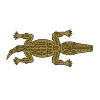
In the riverine area surrounding Benin City, there are two types of crocodile. The Ẹghughu, known in English as the dwarf or bush crocodile, is believed to be more docile ( ; Ọbazee 2025, p. 133). The second type is the Àgbákà, the aggressive Nile crocodile ( ; Ọbazee 2025, p. 11).

Crocodiles are one of the important animals represented in the historical Emwin Arhe, and they are known as Olokun’s guards or the “policemen” of the waters. The powerful and ferocious qualities of these animals might explain why warrior figures are often depicted wearing Uhunmwu-Ẹkuẹ (pendant masks) in the shape of crocodile heads on Ama-Ẹrọnmwọn (bronze relief plaques) ( ). Olokun devotees use crocodiles as sacrificial animals in offerings during the worship of Olokun.

1 annotation
Ẹghughu
Umọmọ
Hammer

The Umọmọ is an L-shaped hammer made of iron that holds profound importance, symbolising power, transformation, and spiritual efficacy. The hammer is fundamentally associated with Ogun, the god of iron, embodying “the force inherent in metal, [with] a mystical power with the potential to create or destroy” ( ). This dual aspect of the hammer—its capacity for both shaping and destruction—mirrors the formidable power of the Ọba. The L-shaped hammer is often associated specifically with Ọba Eresonyẹn, as it most commonly appears within the visual language of Emwin Arhe (royal treasures) that he commissioned, for example, held by Ewua figures and on one ornate cast Ẹrhẹ, thought to have been Ọba Eresonyẹn’s throne (id. no. 209779) ( ).

The hammer is notably held by figures identified as Ewua palace officials or Ohensa priests, who also wear a cross pendant on their chests. The consistent portrayal of these figures holding the Umọmọ underscores its connection to the origins of the Benin dynasty and the spiritual authority of the Ọba. Ọba Esigie, the powerful 16th-century “warrior king”, is credited with encouraging ironworking, further solidifying the hammer’s link to royal martial strength and divine kingship.

Appearing on Aken'ni Elao (carved ivory tusks), Ama-Ẹrọnmwọn (bronze relief plaques), and even as a charm, the hammer symbolises the Ọba’s ability to “mold and transform” events, to overcome challenges, and to provide spiritual protection ( ). Its presence thus reinforces the complex interplay of hierarchy, spiritual authority, and military might within the Benin Kingdom, consistent with other potent symbols such as the Akọn Ẹkpẹn (leopard’s tooth neck ornament). The Umọmọ often appears on Emwin Arhe (royal treasures) believed to have been commissioned during the reign of Ọba Eresonyẹn ( ; ).

Other terms for hammer in Edo are Avan or Avalaka ( ), which are used interchangeably with Umọmọ by members of the Igun-Ẹrọnmwọn.

1 annotation
Umọmọ
Ukpẹ ọkhọkhọ
Curved conical hairstyle worn by Iy'Ọba

The Ukpẹ ọkhọkhọ is a distinctive hairstyle and coral-beaded headdress worn by the Iy’Ọba. The headdress includes a projection called the ‘ede Iy’Ọba’, which indicates that “her spiritual potentialities are closer in quality to those of her ruling son than they are to the powers of the nobles” (Aigbe Eson and Ihama Iguneronmwon in Blackmun 1991, p. 60). The Iy’Ọba’s hairstyle and headdress are meant to resemble ukpe-okhue, or the curved parrot’s beak (Kaplan 1993).

Barbara Blackmun (1991, p. 60) argued that “Benin art is multivocal, and any depiction of the Iye Ọba [sic] is a reference to Idia. Every woman who holds the office of lye Ọba plays the part of Idia, the ideal model of an Ọba’s mother.” Wearing the Ukpẹ ọkhọkhọ is one of the ways the Iy’Ọba plays the role of Idia.

1 annotation
Ukpẹ ọkhọkhọ
Ewua
Ẹwua officials or Ohensa priest

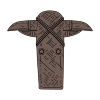
Figures bearing an equal-armed cross on the chest have been interpreted variously as messengers from Ife ( ), or, more likely, as either Ẹwua officials or Ohensa priests ( ; ). These differing interpretations highlight the ambiguity of the visual language of Emwin Arre (royal treasures), in which the meaning and identity of a figure may depend on the type of object on which it appears, the period in which the object was made, and the combination of motifs surrounding it.

The Ẹwua guild was established by Ọba Ẹsigie, and its members were responsible for waking the Ọba each morning ( ). In 1959, Ọba Akẹnzua II identified the cross-bearing figure specifically as an Ẹwua official (in Bradbury 1959, B.S. 207/2). Alternatively, the figure has been identified as an Ohensa, a priest of the High God Osanobua, whose worship also became closely associated with Christianity following the arrival of Portuguese missionaries during the reign of Ọba Ẹsigie.

These figures were cast in brass and bronze both as freestanding figures and as elements within the compositions of Ama-Ẹrọnmwọn (bronze relief plaques), as well as being carved on 18th- and 19th-century Aken'ni Elao (carved tusks). They are typically identifiable by their rounded, bowler-like hats with narrow brims and the equal-armed cross pendants worn on their chests. In their left hand they hold an L-shaped hammer known as Umọmọ, while in their right hand they sometimes carry a tall, straight staff ( ).

1 annotation
Ewua
Asa
Shield

Asa (shields) are a crucial attribute of warriors and warrior chiefs, forming part of their ceremonial and battle attire as represented on the Emwin Arhe (royal treasures). Asa were usually made from elephant or crocodile skin and used by warriors for protection during hand-to-hand combat (Osadolor 2001, p. 102). Interestingly, the form of Asa depicted on historic royal artefacts differs from those found in museum collections today, reflecting changes in shield shapes and designs over time.

1 annotation
Asa
cattle (dwarf mutu cow)
Ẹmila
Cattle (dwarf mutu cow)

Ẹmila are used mainly for social functions. Although, they maybe used by some affluent chiefs and the royal palace for ceremonial purposes

1 annotation
Ẹmila
Ewi
Mudfish

Depictions of Ewi (mudfish) are among the most frequent motifs in the Emwin Arhe (royal treasures). Mudfish hold an important place in Edo belief, both as representations of the god Olokun and as symbols of royalty (Plankensteiner 2007, p. 410), as well as of “prosperity, peace, well-being and fertility” (Ben-Amos 1976, p. 245). Mudfish are also particularly common animals for sacrifice, and mudfish-shaped Orhiẹvbẹ (kola-nut boxes) were used to make offerings or store kola nuts.

Yet, the appearance of Ewi across the Emwin Arhe is not consistent, and it has been argued that different species of mudfish were depicted by Edo artists, each with different qualities and capabilities. For example, the electric shock of Malapterurus electricus resembles the fierceness of the Ọba, while the liminal qualities of the Synodontis clarias mudfish, which lives both on land and in water, similarly reflect the Ọba’s rule over land and sea (Gallagher 1983, p. 93). With these different qualities in mind, the mudfish is an important symbol of Benin kingship and royalty.

Sometimes the Ọba was depicted by artists with mudfish rather than legs (see Ọba with Mudfish Legs).

1 annotation
Ewi
Ẹrhu
Headwear

Many different kinds of Ẹrhu (headwear) are worn by the various figures depicted in the imagery of Benin royal artefacts. Through comparisons with ceremonial regalia still worn by chiefs and members of the royal court, including the Ọba himself, some Ẹrhu have been used to identify the different figures depicted. For example, the conical hat worn by high-ranking town chiefs as part of the pangolin regalia, still worn at ceremonies, is also visible on figures on some Ama-Ẹrọnmwọn (bronze relief plaques) ( ). Other examples include the distinctive bell-shaped helmet associated with the Iyasẹ ( ). Figures who wear a shallow-brimmed hat and a cross have been identified as Ewua or Ohensa priests ( ).

Different kinds of helmets and headwear were worn by warriors, reflecting the many different ranks and roles in the army at any given time, as well as developing trends that were in turn represented on Emwin Arhe created at different points in time. Warrior figures wearing helmets covered in cowrie shells were carved on the Aken'ni Elao (carved tusks) (Blackmun 1984, p. 330), yet on the brass Ama, warriors are sometimes depicted wearing helmets made from crocodile hide or horsehair with a front plate (Osadolor in Plankensteiner 2007, cat. no. 238, p. 457). Helmets made from horsehair with a front plate are one of the more common types represented on the Ama-Ẹrọnmwọn, and the demand for black horse tails was noted by both Portuguese and British traders during the late 17th and 18th centuries (Osadolor in Plankensteiner 2007, cat. no. 238, p. 457). Other warriors depicted on Ama-Ẹrọnmwọn wear helmets with a rounded top, chinstrap, and sometimes also a feather tucked into the left side. These types of headwear are known as Ẹrhu Iyokuo.

Attire worn for battle also differed from that worn for ceremonial occasions, such as the pointed headwear worn in combination with an ornate leopard-head tunic by war chiefs. Depictions of figures wearing this attire on brass Ama-Ẹrọnmwọn (bronze relief plaques) have been interpreted as representing the war chiefs’ participation in the war-ritual Isiokuo festival (Osadolor in Plankensteiner 2007, cat. no. 238, p. 457).

Another distinctive form of headwear is that worn by figures identified as leopard hunters on the brass Ama-Ẹrọnmwọn (relief plaques). These large helmets cover almost all of the leopard hunters’ faces except for their noses, eyes, and upper lips, and are made of an unusual material that remains unidentifiable (Plankensteiner 2007, cat. nos. 68–69, p. 322).

European figures are also portrayed with distinctive hats, such as Portuguese three-cornered hats. These depictions reflect the artists’ keen observation and highlight the impact of European trade and military assistance (Ezra 1992).

1 annotation
Ẹrhu
hairstyles
Eto
hairstyles

Hairstyles are used to determine a person's status in the society, as chiefs, common folks, chief's wives and the wives of the Ọba all wear different hairstyles. We have Okuku, Ikpe~okhokho, Idu~akpata

1 annotation
Eto

Provenance

4 events
Production
unknown to February 22, 1897 (day approximate)
The object was produced by Unknown member(s) of the Igun-Ẹrọnmwọn guild in Benin City.
Looted
February 22, 1897 (day approximate) to June 1899 (year approximate)
The object was looted by Unknown member of the British colonial military campaign on Benin - February 1897 from Benin Kingdom.
Unknown
February 22, 1897 (day approximate) to 1918
The object is known to have come into contact with Hans Meyer, later in Leipzig.
Unknown
1918
The object is known to have come into contact with Hans Meyer and the Weltmuseum Wien, in Leipzig and later Vienna.

Related archival documents

1 documents
See all
An archival document representing a Inventories of 1 page(s)
InventoryAccession Record
Weltmuseum Wien
Inventory book - objects
Date
January 1, 1918

Institution data

Weltmuseum Wien
The data was transferred directly by the institution.
Last updated: 2022-05-24
Languages: german, english
Institution fieldValue
ObjectNumber_Original
object id
VO_98155
NativeTitle
edo designation
aseberia
TextEntry
description
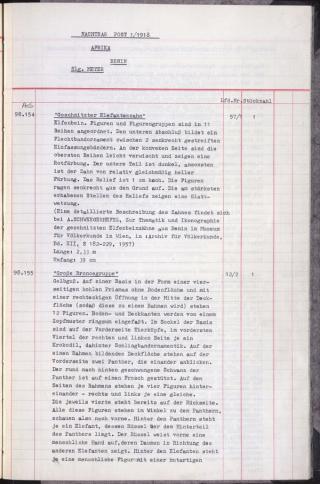
Diese Altargruppe für eine Iyoba ist Teil der historischen Sammlungen aus dem Königreich Benin im heutigen Nigeria. 1897 wurde das Königreich erobert und dessen Oba (König) Ovonramwen ins Exil verbannt. Die aus dem Königspalast geraubten Kunstschätze wurd
Medium
material
Gelbguss
Medium_en
material
Brass
ObjectName
object type
Altargruppe für eine Königinmutter (Iyoba)
ObjectName_en
object type
Altar Group for a Queen Mother (Iyoba)
DateBegin
date made
1600
DateEnd
date made
1800
Dated
date made
17./18. Jahrhundert
Dated_en
date made
17th/18th century
Period
date made
Term
production place
Afrika südlich der Sahara
Term2
production place
West-Afrika
Term3
production place
Nigeria
Term4
production place
Benin
Thesaurus
production place
Afrika südlich der Sahara/West-Afrika/Nigeria/Benin
Provenance
provenance
Role_person
provenance
Sammlung-Collection-Hans Meyer|
Culture
ethnic attribution
Edo, Benin Königreich
Culture_en
ethnic attribution
Edo, Benin Kingdom
CreditLine
department and institution
Weltmuseum Wien
Department
department and institution
MVK Objekte - Afrika südlich der Sahara
Zugangsdatum
accession date
1918
LocationString
display status
Raum Me.40
FileName
images
VO_98155_01_ret.jpg|
PrimaryImage
images
VO_98155_01_ret.jpg
Classification
||
DepartmentID
35
Department_cut
Afrika südlich der Sahara
DisplayOrder
1|2|
Last_Modified
2021-12-06 08:15:34
LocationID
75091
ObjectID
428240
ObjectNumber
98155
PublicAccess
1
SortNumber
VO 98155
TextDate_en
|
TextEntryHTML
Diese Altargruppe für eine Iyoba ist Teil der historischen Sammlungen aus dem Königreich Benin im heutigen Nigeria. 1897 wurde das Königreich erobert und dessen Oba (König) Ovonramwen ins Exil verbannt. Die aus dem Königspalast geraubten Kunstschätze wurd
TextEntryHTML_en
This Altar Group with Iyoba is part of the historical collections from the Benin Kingdom, in present-day Nigeria. In 1897, the kingdom was conquered and Oba (king) Ovonramwen banned into exile. The loot from the royal palace was then sold through the art
TextEntry_en
This Altar Group with Iyoba is part of the historical collections from the Benin Kingdom, in present-day Nigeria. In 1897, the kingdom was conquered and Oba (king) Ovonramwen banned into exile. The loot from the royal palace was then sold through the art
cxrDisplayOrder
1|
Sensitive Content

Digital Benin collates digital material from institutions, and some of this material is inherently colonial and contains words, terms and phrases that are inaccurate, derogatory and harmful towards African and African diasporic communities. Catalogue transcriptions, book titles, exhibition titles and museum titles may contain harmful terms. We recognise the potential for the material to cause physical and mental distress as well as evoke strong emotions. Owing to the scale of the collection’s data, a process to implement sensitive-content warnings in the displayed data is still incomplete. The material within the catalogue does not represent Digital Benin’s views. Digital Benin maintains a strong anti-colonial, anti-racist position and affirms its support for centring the humanity of historically marginalised and disenfranchised communities. Read more about the background of this statement here