


Provenance
Institution data
| Institution field | Value |
|---|---|
Registration number object id | Af1898,0630.3 |
PRN object id | EAF14550 |
Object Type designation | fly-whisk ~regalia |
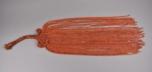
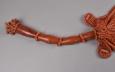
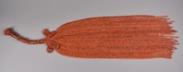
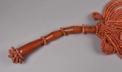
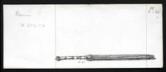
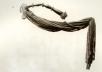
Description description | Fly-whisk, regalia (ugbudien ugie); made from coral and agate beads. Whisk has long strings of coral beads with four beaded flaps at top; handle composed of four large agate beads with cluster of coral beads at top. |
Ethnic name (made by) ethnic attribution | Edo |
Date | 18thC-19thC (circa) |
Production place production place | Made in: Benin City |
Findspot place collected | Found/Acquired: Benin City |
Materials material | coral ~agate |
Dimensions dimensions | Height: 103.00 cm~Width: 24.00 cm (max)~Depth: 4.70 cm~Weight: 2.50 kg |
Curator’s comments provenance | Plankensteiner 2007: ‘A child surpasses beads’. This Edo adage compares offspring to costly red coral (ivie ebo’ or ‘European beads’) and stone beads (‘ivie egbo’ or ‘forest beads’). The latter, brownish-red agate or jasper (both varieties of chalcedony), are older imports from the north. The Portuguese introduced red Mediterranean coral in the last 15th century; its colour fit pre-existing tastes and symbolism – red is power, blood and danger. In Benin, both types are collectively referred to as ‘ivie’ and called ‘coral’ by English-speakers. The monarch’s identity is linked to coral. After the 1897 invasion, Oba Ovonramwen faced the British in a white wrapper ‘covered with masses of strings of coral, interspersed with larger pieces […] His head dress […] was composed wholly of coral of excellent quality, meshed closely together, and must have weighed very heavily on his head, for it was constantly being temporarily removed by an attendant. His wrists up to his elbows were closely covered with coral bangles, so were his ankles’ (Roth 1968:xiii). These...belongings are very similar to today’s royal dress. ...Beaded regalia...would have been assembled and maintained by the Enisen, members of the palace Iwebo society. These official dressers assist the Oba, his mother and the more important chiefs. ...Beaded accessories accentuate wealth. Horse-tail whisks are popular prestige objects throughout Africa, raised and shaken in approbation, appreciation and acknowledgement. This unusual example replaces hair with coral strands; its 2.5 kilogram weight (Fagg 1978:28) speaks to the importance of status over comfort. Oba Ovonramwen owned at least one other example (Pitt Rivers 1977: pl26). Coral beads have a mystical, medicinal aspect and are protective. In Renaissance Europe, coral averted the evil eye, a belief probably communicated to Africa. Its defensive use in Benin is supported by an annual ‘charging’ at the Ugie Ivie ceremony, held at Oba Ewuare’s shrine. The Oba’s and his chiefs’ coral are touched with sacrificial animal heads to purify and reinvigorate it; in centuries past, a slave was killed for this purpose.; Read & Dalton 1899: Fly whisk of the King of Benin, formed of strings of coral beads with a handle of four large beads of red jasper. The coral beads are no doubt of European make, as well as the jasper ones. These last are similar in shape to the long carnelian beads which were exported from Europe for use in the slave trade.; Note from EPS Roupell (3 June 1898): "Coral. Fly whisk carried before the king by female naked youth - the ordinary fly whihsk is made from a horses tail this is evidently made from that idea. " |
Bibliographic references bibliography | Barley 2010: p.85~Plankensteiner 2007: 152~Read & Dalton 1899: pl VIII.1 |
Exhibition history exhibition history | Exhibited: 1970-1973, London, Museum of Mankind, Divine Kingship in Africa 1993-1997, London, Museum of Mankind, Great Benin: a West African Kingdom 2007 May-Sept, Vienna, Museum für Völkerkunde, Benin. Kings and Rituals: Court Arts from Nigeria 2007-2008 Oct-Jan, Paris, Musée du quai Branly, Benin. Kings and Rituals: Court Arts from Nigeria 2008 Feb-May, Berlin, Staatliche Museen zu Berlin, Ethnologisches Museum, Benin. Kings and Rituals: Court Arts from Nigeria 2008 Jun-Sept, Chicago, The Art Institute of Chicago, Benin. Kings and Rituals: Court Arts from Nigeria 2024-2025, 17 Oct–9 Feb, London, BM, G35, 'Hew Locke: what have we here?' |
Condition condition | Good. |
Associated events event | Associated Event: British Expedition to Benin City - Feb 1897 |
Acquisition name (acquisition) provenance | Captain Ernest Percy Stuart Roupell |
Acquisition name (excavator) provenance | Field Collection by: Captain Ernest Percy Stuart Roupell |
Acquisition date accession date | 30 June 1898 |
Acquisition notes (excavation) provenance | This fly-whisk was looted from Benin City in 1897 by Captain Ernest Roupell. |
Digital Benin collates digital material from institutions, and some of this material is inherently colonial and contains words, terms and phrases that are inaccurate, derogatory and harmful towards African and African diasporic communities. Catalogue transcriptions, book titles, exhibition titles and museum titles may contain harmful terms. We recognise the potential for the material to cause physical and mental distress as well as evoke strong emotions. Owing to the scale of the collection’s data, a process to implement sensitive-content warnings in the displayed data is still incomplete. The material within the catalogue does not represent Digital Benin’s views. Digital Benin maintains a strong anti-colonial, anti-racist position and affirms its support for centring the humanity of historically marginalised and disenfranchised communities. Read more about the background of this statement here