




Iconographies



Related oral histories

Provenance
Institution data
| Institution field | Value |
|---|---|
Registration number object id | Af1910,0513.1 |
PRN object id | EAF15200 |
Object Type designation | pendant-mask ~regalia |
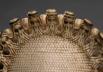
Description description | Pendant mask; regalia; carved from ivory. In form of naturalistic human face. Hairstyle carved in low relief; head crowned with circlet of European heads inlaid with copper alloy. Decorative pierced lattice-work ruff below chin inlaid with copper alloy; series of suspension loops around outside. Two vertical bars incised into forehead inlaid with iron. Four scarification marks carved above each eye. Iron inlay around eyes; pupils inlaid wth iron. Two suspension loops on each side of face. |
Ethnic name (made by) ethnic attribution | Edo |
Date | 16thC |
Production place production place | Made in: Benin City |
Findspot place collected | Found/Acquired: Benin City |
Materials material | elephant ivory ~iron ~copper alloy |
Technique production technique | carved ~inlaid |
Dimensions dimensions | Height: 24.50 cm~Width: 12.50 cm~Depth: 6.00 cm |
Curator’s comments provenance | This is one of five stylistically similar ivory hip-pendants that were produced specifically for the use of the Oba during the sixteenth century. Three of the other masks of this type are in public collections in the UK and the USA. They are recorded as being found in a cache in the bedchamber of the Oba in Benin City and were looted during the British expedition of 1897. These hip-pendants are thought to represent Queen Mother Idia, the mother of Oba Esigie (c.1504-1550), celebrated as one of the great ‘warrior kings’, who ruled in the sixteenth century. Esigie created the title of Queen Mother in honour of Idia and in gratitude for her efforts in supporting his military campaigns. These pendants are widely considered as some of the finest ivory carvings in the Benin corpus. They are also among the most enduring and emotive examples of the representation of women in Benin court art. ; This type of mask was worn by the Oba, on the hip, during important ceremonies. The mask is said to represent Idia, mother of Oba Esigie who ruled in the sixteenth century. The top of the hip mask is decorated with heads representing the Portuguese, symbolizing Benin's alliance with and control over Europeans. The Portuguese continued to appear in Benin art long after they had disappeared from Benin itself. P. Girshick Ben-Amos, The Art of Benin (London, The British Museum Press, 1995) |
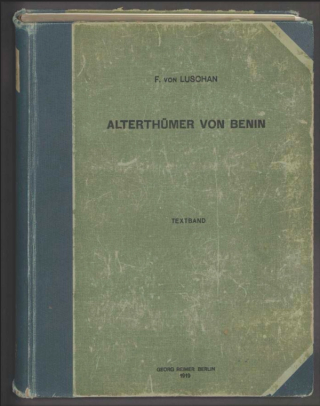
Bibliographic references bibliography | Barley 2010: Fig.72; pp.102-3~Fagg 1970: ~Read 1910: p.50; plate D~Read & Dalton 1899: |
Exhibition history exhibition history | Exhibited: 1970-1973, London, Museum of Mankind, Divine Kingship in Africa 1993-1997, London, Museum of Mankind, Great Benin: a West African Kingdom |
Associated events event | Associated Event: British Expedition to Benin City - Feb 1897 |
Acquisition name (acquisition) provenance | Prof Charles Gabriel Seligman |
Acquisition name (excavator) provenance | Field Collection by: Sir Ralph Moor |
Acquisition date accession date | 1910.0 |
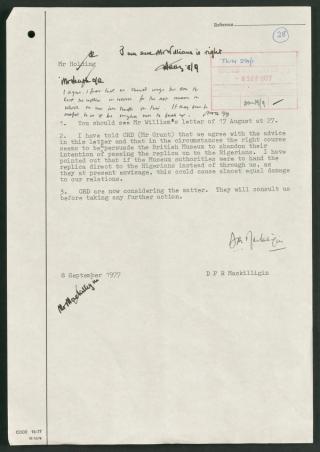
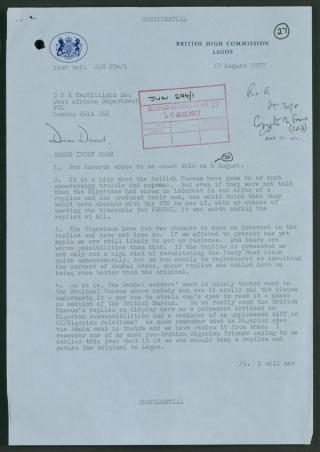
Acquisition notes (excavation) provenance | Looted by Ralph Moor, Commissioner and Consul-General of the Niger Coast Protectorate, during British Expedition to Benin City in 1897. |
Digital Benin collates digital material from institutions, and some of this material is inherently colonial and contains words, terms and phrases that are inaccurate, derogatory and harmful towards African and African diasporic communities. Catalogue transcriptions, book titles, exhibition titles and museum titles may contain harmful terms. We recognise the potential for the material to cause physical and mental distress as well as evoke strong emotions. Owing to the scale of the collection’s data, a process to implement sensitive-content warnings in the displayed data is still incomplete. The material within the catalogue does not represent Digital Benin’s views. Digital Benin maintains a strong anti-colonial, anti-racist position and affirms its support for centring the humanity of historically marginalised and disenfranchised communities. Read more about the background of this statement here