

Registration number
Af1954,23.282
Institution
British Museum
Edo designations
English designations
Altar of the Hand
Categories
Altar & Shrine Objects
Location
Great Russell St, Bloomsbury, London WC1B 3DG, United Kingdom
Loading...
Altar of the Hand
Altar of the Hand
Altar of the Hand
Altar of the Hand
Altar of the Hand
Altar of the Hand

Iconographies

6 annotations
Round Neck Bead
Ikele
Coral bead circlet

Ikele is a single stiff string or circlet of coral beads. It is worn by chiefs, such as senior chiefs who have been made Enigie (Inneh 2007, p.107), and is a sign of nobility and rank. The Ikele may only be worn once the Ọba has conferred a person with the right to wear the beads, and the Ikele must always be worn when appearing before the Ọba. According to Ekhaguosa Aisien (in Plankensteiner 2007, cat. nr. 301, p.512) when a chief is wearing the Ikele, they may not eat nor drink in public, and they “constitute an embassy of the Benin Palace wherever he might be.”

1 annotation
Ikele
Ubanu'hi / Obanu'hi
Ubanu'hi / Obanu'hi
Inifinity Symbol

The Ubanu'hi (infinity symbol) is a kind of guilloche or interlaced strapwork motif that can be angular or rounded. It was used by Edo artists in the decoration of many Emwin Arhe (royal treasures) and is ubiquitous in Benin royal arts. Ubanu'hi is a shortened form of “uba no Ọba ya de agbon ke ehimwin yi”, which means “the rope with which the Ọba ties the heaven and earth together” (pers. comm. Chief John Igbineweka Inneh n’Igbesawman, 2022). Similarly, Paula Ben-Amos Girshick (in Plankensteiner 2007, pp. 339, 341) described this as “Ọba n’iri agbon”, or the “rope of the world” pattern.

According to Ọbabanmu Ineh (in Blackmun 1984, p. 51), the use of this motif indicates that objects were carved by members of the Igbesanmwan. However, the motif is found on all types of Emwin Arhe (royal treasures), not only those made of ivory or wood. On the flanges of the Ama (relief plaques) alone, Kathryn Gunsch (2018, pp. 75–77) identified three different versions of the Ubanu'hi and, through her analysis of over 850 plaques, found that these different Ubanu'hi forms align with other characteristics, such as dimensions, the prevalence of ornamental motifs, and stylistic qualities. Together, these provide evidence, she argues, of different production groups among the plaque makers .

Kate Ezra (1992, pp. 209, 264) went on to argue that the use of these motifs indicates that certain objects were used in a “royal context” and were associated with “royal patronage”.

1 annotation
Ubanu'hi / Obanu'hi
Obọ
Fist/Hand

The fist motif—particularly a clenched fist with an extended thumb—carries significant symbolic weight. It is central to the cult of the hand, a major aspect of Edo religion that focuses on an individual’s ability to achieve success through their own actions, skills, and enterprise ( ). This cult is primarily observed by those who have already attained considerable wealth or status, including hunters, warriors, and craftsmen.

The fist symbolises physical prowess and strength, denoting the individual’s might and accomplishment ( ). The hand is credited with enabling the accumulation of great riches and high status. This is sometimes linked to the idea that wealth results from both personal effort and the favour of Olokun, the god of wealth. On Ukhurhẹ (ancestral staffs), a clenched fist or hand grasping a mudfish signifies royal or chiefly authority. The image of a hand holding a coiled mudfish can also illustrate the Ọba’s formidable power to “cast and then release a curse” or to “set up obstacles and remove them” ( ). The fist is sometimes accompanied by other motifs symbolising strength, chieftaincy, and longevity, such as tools like the hammer and pliers or feathers of the vulturine fish eagle ( ). The fist motif is frequently depicted on Aken'ni Elao (carved tusks), on wooden Ikẹgobọ (altars to the hand), and on Ukhurhẹ.

1 annotation
Obọ
Umọmọ
Hammer

The Umọmọ is an L-shaped hammer made of iron that holds profound importance, symbolising power, transformation, and spiritual efficacy. The hammer is fundamentally associated with Ogun, the god of iron, embodying “the force inherent in metal, [with] a mystical power with the potential to create or destroy” ( ). This dual aspect of the hammer—its capacity for both shaping and destruction—mirrors the formidable power of the Ọba. The L-shaped hammer is often associated specifically with Ọba Eresonyẹn, as it most commonly appears within the visual language of Emwin Arhe (royal treasures) that he commissioned, for example, held by Ewua figures and on one ornate cast Ẹrhẹ, thought to have been Ọba Eresonyẹn’s throne (id. no. 209779) ( ).

The hammer is notably held by figures identified as Ewua palace officials or Ohensa priests, who also wear a cross pendant on their chests. The consistent portrayal of these figures holding the Umọmọ underscores its connection to the origins of the Benin dynasty and the spiritual authority of the Ọba. Ọba Esigie, the powerful 16th-century “warrior king”, is credited with encouraging ironworking, further solidifying the hammer’s link to royal martial strength and divine kingship.

Appearing on Aken'ni Elao (carved ivory tusks), Ama-Ẹrọnmwọn (bronze relief plaques), and even as a charm, the hammer symbolises the Ọba’s ability to “mold and transform” events, to overcome challenges, and to provide spiritual protection ( ). Its presence thus reinforces the complex interplay of hierarchy, spiritual authority, and military might within the Benin Kingdom, consistent with other potent symbols such as the Akọn Ẹkpẹn (leopard’s tooth neck ornament). The Umọmọ often appears on Emwin Arhe (royal treasures) believed to have been commissioned during the reign of Ọba Eresonyẹn ( ; ).

Other terms for hammer in Edo are Avan or Avalaka ( ), which are used interchangeably with Umọmọ by members of the Igun-Ẹrọnmwọn.

1 annotation
Umọmọ
Anwa and Akpoka
Anwa and Akpoka

Anwa and Akpoka (tongs) were used by members of the Igun-Ematon and Igun-Eronmwon (Dark, 1973 ,p.48, 55[61]). Today they are still used by members of the Igun-Ematon to handle hot objects, such as crucibles, during the casting process.

Miniaturised versions of tongs were made by the Igun-Ematon for use as charms on shrines to Ogun (Dark, 1973, p.55[61]). Tongs thus have both practical and ritual uses in Benin Kingdom.

1 annotation
Anwa and Akpoka
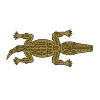
alligator
Ẹghughu
Crocodile

In the riverine area surrounding Benin City, there are two types of crocodile. The Ẹghughu, known in English as the dwarf or bush crocodile, is believed to be more docile ( ; Ọbazee 2025, p. 133). The second type is the Àgbákà, the aggressive Nile crocodile ( ; Ọbazee 2025, p. 11).

Crocodiles are one of the important animals represented in the historical Emwin Arhe, and they are known as Olokun’s guards or the “policemen” of the waters. The powerful and ferocious qualities of these animals might explain why warrior figures are often depicted wearing Uhunmwu-Ẹkuẹ (pendant masks) in the shape of crocodile heads on Ama-Ẹrọnmwọn (bronze relief plaques) ( ). Olokun devotees use crocodiles as sacrificial animals in offerings during the worship of Olokun.

1 annotation
Ẹghughu

Provenance

4 events
Production
unknown to February 22, 1897 (day approximate)
The object was produced by Unknown member(s) of the Igun-Ẹrọnmwọn guild in Benin City.
Looted
February 22, 1897 (day approximate) to June 1899 (year approximate)
The object was looted by Unknown member of the British colonial military campaign on Benin - February 1897 from Benin Kingdom.
Unknown
February 22, 1897 (day approximate) to 1936
The object is known to have come into contact with Henry Solomon Wellcome, the Wellcome Collection and London Wellcome Institute for the History of Medicine, later in London.
Donation
1954
The object was donated by the Wellcome Collection and London Wellcome Institute for the History of Medicine to the British Museum in London.

Institution data

British Museum
The data was transferred directly by the institution.
Last updated: 2025-06-10
Language: english
Institution fieldValue
Registration number
object id
Af1954,23.282
Additional IDs
object id
N/N (Wellcome Collection number)
PRN
object id
EAF21218
Object Type
designation
altar
Description
description
Altar of the hand (ikegobo); made of terracotta. Cylindrical in form with figures modelled in high relief around central section. Band around base decorated with interlace design. Circular hole in top of altar.
Ethnic name (made by)
ethnic attribution
Edo
Date
19thC
Production place
production place
Made in: Benin City
Findspot
place collected
Found/Acquired: Benin City
Materials
material
terracotta
Technique
production technique
hand-modelled
Dimensions
dimensions
Height: 23.50 cm~Width: 22.80 cm~Depth: 22.60 cm
Curator’s comments
provenance
Register 1954 Solid clay, drum shaped altar with moulded decorations:- the base is surrounded with a band of guilloche pattern, above it are four human figures, two clenched hands and a number of objects some of which appear to be blacksmith's tools; on top are two lizards (crocodiles?). The object is pierced from top to bottom by a narrow cylindrical aperture.
Exhibition history
exhibition history
Exhibited: 1970-1973, London, Museum of Mankind, Divine Kingship in Africa
Condition
condition
Fair; damage to top and upper sides of altar.
Associated events
event
Associated Event: British to Benin City - Feb 1897
Acquisition name (acquisition)
provenance
Wellcome Institute for the History of Medicine
Acquisition date
accession date
1954.0
Sensitive Content

Digital Benin collates digital material from institutions, and some of this material is inherently colonial and contains words, terms and phrases that are inaccurate, derogatory and harmful towards African and African diasporic communities. Catalogue transcriptions, book titles, exhibition titles and museum titles may contain harmful terms. We recognise the potential for the material to cause physical and mental distress as well as evoke strong emotions. Owing to the scale of the collection’s data, a process to implement sensitive-content warnings in the displayed data is still incomplete. The material within the catalogue does not represent Digital Benin’s views. Digital Benin maintains a strong anti-colonial, anti-racist position and affirms its support for centring the humanity of historically marginalised and disenfranchised communities. Read more about the background of this statement here