

Iconographies



Provenance
Institution data
| Institution field | Value |
|---|---|
Registration number object id | Af1954,23.788 |
Additional IDs object id | N/N (Wellcome Collection number) |
PRN object id | EAF21742 |
Object Type designation | waist-pendant |
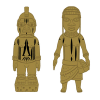
Description description | Waist-pendant; lost-wax cast in brass. Single large suspension loop at back. Series of suspension loops around outer edge. Depicts single female figure in high relief wearing pinted headdress, armlets and anklets and beaded collar. Figure holds circular ?vessel at left proper shoulder. |
Ethnic name (made by) ethnic attribution | Edo |
Date | 16thC - 19thC |
Production place production place | Made in: Benin City |
Findspot place collected | Found/Acquired: Benin City |
Materials material | brass |
Technique production technique | lost-wax cast |
Dimensions dimensions | Height: 12.50 cm~Width: 11.60 cm~Depth: 5.00 cm~Weight: 242.00 g |
Curator’s comments provenance | The term ‘Lower Niger Bronze Industry’ was created and first used by William Buller Fagg (1957, 1963, 1970) to identify a miscellaneous group of lost-wax cast objects which were stylistically and/or iconographically distinct from Igbo-Ukwu, Ife and Benin City pieces. The objects are associated with various locations in southern Nigeria, south of the confluence of Benue and Niger Rivers and between the borders with the Republic of Benin and Cameroon. They are thought to have been made prior to European contact, circa pre-1500 A.D. Sometimes referred to as the ‘Lower Niger Bronze Industries’ or ‘Lower Niger Bronzes’. Fagg, William B. (1957) ‘Introduction’. In Plass, Margaret. Lost wax; metal casting on the Guinea Coast. London: London Institute of Contemporary Arts. Fagg, William. (1963). Nigerian images: The splendor of African sculpture. New York ; London: Praeger. Fagg, William. (1970) Divine Kingship in Africa. London: Published for the Trustees of the British Museum by British Museum Publications. ; Register 1954: Brass scutiform pendant with a figure of a woman holding a pot on her shoulder, in high relief, the head is modelled in the round, there is a large ring at the back of the head of the figure, seven small rings are attached to the lower edge of the pendant, others have been broken off. Cf. 1934.10-25.1. BENIN. |
Condition condition | Good; some suspension rings around edge of pendant are missing, damaged or bent. |
Associated events event | Associated Event: British Expedition to Benin City - Feb 1897 |
Acquisition name (acquisition) provenance | Wellcome Institute for the History of Medicine |
Acquisition date accession date | 1954.0 |
Digital Benin collates digital material from institutions, and some of this material is inherently colonial and contains words, terms and phrases that are inaccurate, derogatory and harmful towards African and African diasporic communities. Catalogue transcriptions, book titles, exhibition titles and museum titles may contain harmful terms. We recognise the potential for the material to cause physical and mental distress as well as evoke strong emotions. Owing to the scale of the collection’s data, a process to implement sensitive-content warnings in the displayed data is still incomplete. The material within the catalogue does not represent Digital Benin’s views. Digital Benin maintains a strong anti-colonial, anti-racist position and affirms its support for centring the humanity of historically marginalised and disenfranchised communities. Read more about the background of this statement here