Registration number
Af1963,09.1
Institution
British Museum
Edo designations
English designations
Trophy Head
Categories
Altar & Shrine Objects
Heads
Location
Great Russell St, Bloomsbury, London WC1B 3DG, United Kingdom
Loading...
Trophy Head
Trophy Head
Trophy Head
Trophy Head
Trophy Head
Trophy Head

Iconographies

3 annotations
Colar Bead
Odigba
Coral beaded collar

Odigba (coral-beaded collar) is a rigid neck collar made of coral beads, worn as part of ceremonial attire only by senior princes who have been made Enigie (Inneh 2007, p. 107). Although Ibafe (2007, p. 43) argued that the Odigba was introduced during the Ogiso period (c. 900–c. 1170 AD) by Ogiso Ere, along with other symbolically important Emwin Arhe, such as the Ada (ceremonial sword) and the Ẹbẹn (ceremonial sword), this seems unlikely, as coral was only introduced in the late 15th century through trade with Portuguese merchants.

1 annotation
Odigba
Ikharo
Forehead markings

Ikharo are linear keloid markings depicted on the forehead of Uhunmwu-Elao (commemorative heads) in groups of three or four above each eye. The exact meaning of Ikharo is debated; some have argued that they relate to the gender or tribal identification of the person on whom they are depicted. For example, has argued that they were worn only by men; however, their use in depictions is not consistent with this, and the Iy’Ọba are also shown wearing them. argued that they are instead a stylistic feature employed by artists that varied over time.

The naming of these markings differs between publications. For example, describe these markings as “agbaguda n'ehae”, which they write translates literally as “blades of the forehead”. However, later went on to call these “ikharo”, as used here. referred to these forehead markings as ikharo, meaning “tribal mark [of eye]”.

1 annotation
Ikharo
Ikan Aro
Incised forehead markings

Ikan Aro are two linear markings in the centre of the forehead, located in between the eyes. These are usually inset with iron on depictions otherwise made of brass, bronze, ivory or wood.The use of iron was significant due the association of this metal with Ogun, who is god of iron and metal. These markings appear on both men and women, however are a common feature of representations of Iy'Oba Idia. Flora Kaplan (1993, 59) argued these are not tattoos, unlike the Ikharo. According to Nevadomsky (1986, 42), these incisions "signify determination, firmness, resolve, or even maturity". Kaplan (1993, 59) has also made a link between these markings and oral history told to her by Oba Erediauwa describing the events leading up to Idia (before she was Iy’Ọba) becoming the wife of Ọba Ozolua, whereby her parents tried to disfigure her to “repel” the Ọba. According to this history, the Ọba “sensing something was wrong”, called his doctors to intervene and treat her quickly, and as so she still became his wife.

1 annotation
Ikan Aro

Provenance

5 events
Production
unknown to February 22, 1897 (day approximate)
The object was produced by Unknown member(s) of the Igun-Ẹrọnmwọn guild in Benin City.
Looted
February 22, 1897 (day approximate) to June 1899 (year approximate)
The object was looted by Unknown member of the British colonial military campaign on Benin - February 1897 from Benin Kingdom.
Unknown
1900s to 1959
The object is known to have come into contact with Alfred Walter Francis Fuller, later in London.
Inheritance
1961
The object was inherited by Estelle W. Fuller from Alfred Walter Francis Fuller in Singleton.
Donation
1963
The object was donated by Estelle W. Fuller to the British Museum through The Art Fund from Singleton to London.

Related archival documents

1 documents
See all
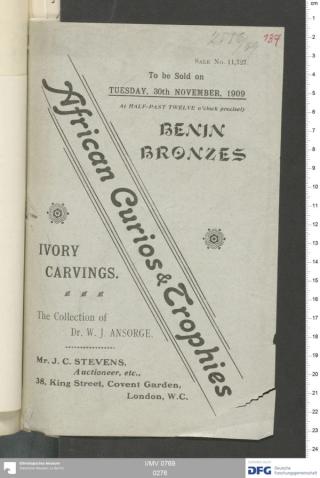
An archival document representing a Auction Catalog of 24 page(s)
Auction Catalogue
Ethnologisches Museum, Staatliche Museen zu Berlin
Die Erwerbung ethnologischer Gegenstände aus der Benin-Expedition. Vol. 6
Date
November 30, 1909

Institution data

British Museum
The data was transferred directly by the institution.
Last updated: 2025-06-10
Language: english
Institution fieldValue
Registration number
object id
Af1963,09.1
PRN
object id
EAF23815
Object Type
designation
sculpture
Description
description
'Trophy' or commemorative head; hollow with large opening in top of head. Made of brass; lost-wax cast. Two vertical incisions between the eyebrows inlaid with iron; four short raised vertical scarification marks above the eyes. Stylised hairstyle with circle and dot motifs. Short coral bead collar below chin, flanged base.
Ethnic name (made by)
ethnic attribution
Edo
Date
15thC(late)-17thC(early) (?)
Production place
production place
Made in: Benin City
Findspot
place collected
Found/Acquired: Benin City
Materials
material
brass ~iron
Technique
production technique
lost-wax cast ~inlaid
Dimensions
dimensions
Height: 19.00 cm~Width: 16.00 cm~Depth: 16.50 cm~Weight: 1966.00 g
Curator’s comments
provenance
Register 1963: "A Benin bronze head of the earliest type, [the head] possibly depicting the pathological condition of acromegaly."; See Collection File: Af1963,09.1.
Exhibition history
exhibition history
Exhibited: 1970-1973, London, Museum of Mankind, Divine Kingship in Africa 1995-96, London, Museum of Mankind, Made in Africa: Africa and the National Art Collection Fund 2004 Jun-Aug, Palma de Mallorca, Spain, Centro Cultural de la Fundacio 'la Caixa', Africa: The Invention of the Human Body 2004 Sep-Oct, Tarragona, Spain, Centro Social y Cultural de la Fundacio 'la Caixa', Africa: The Invention of the Human Body 2004-2005 Nov-Jan, Valencia, Spain, Sala de exposiciones l'Almondi, Africa: The Invention of the Human Body 2005 Feb-Apr, Zaragoza, Spain, La Lonja, Africa: The Invention of the Human Body
Associated events
event
Associated Event: British to Benin City - Feb 1897
Acquisition name (acquisition)
provenance
Mrs Estelle W Fuller; Art Fund; Capt. A W F Fuller
Acquisition date
accession date
1963.0
Sensitive Content

Digital Benin collates digital material from institutions, and some of this material is inherently colonial and contains words, terms and phrases that are inaccurate, derogatory and harmful towards African and African diasporic communities. Catalogue transcriptions, book titles, exhibition titles and museum titles may contain harmful terms. We recognise the potential for the material to cause physical and mental distress as well as evoke strong emotions. Owing to the scale of the collection’s data, a process to implement sensitive-content warnings in the displayed data is still incomplete. The material within the catalogue does not represent Digital Benin’s views. Digital Benin maintains a strong anti-colonial, anti-racist position and affirms its support for centring the humanity of historically marginalised and disenfranchised communities. Read more about the background of this statement here