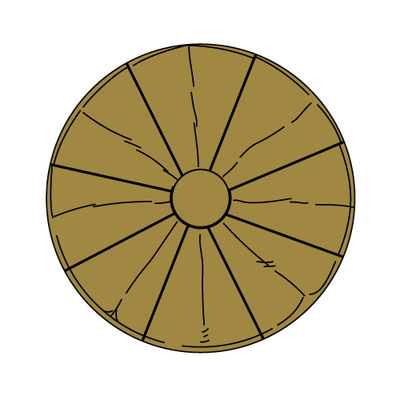
Owẹn
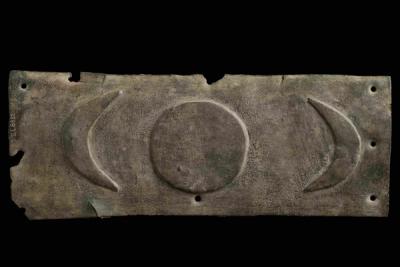
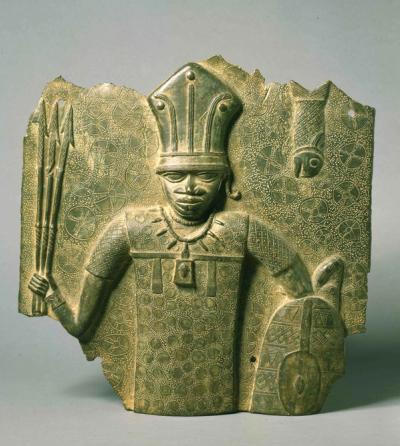
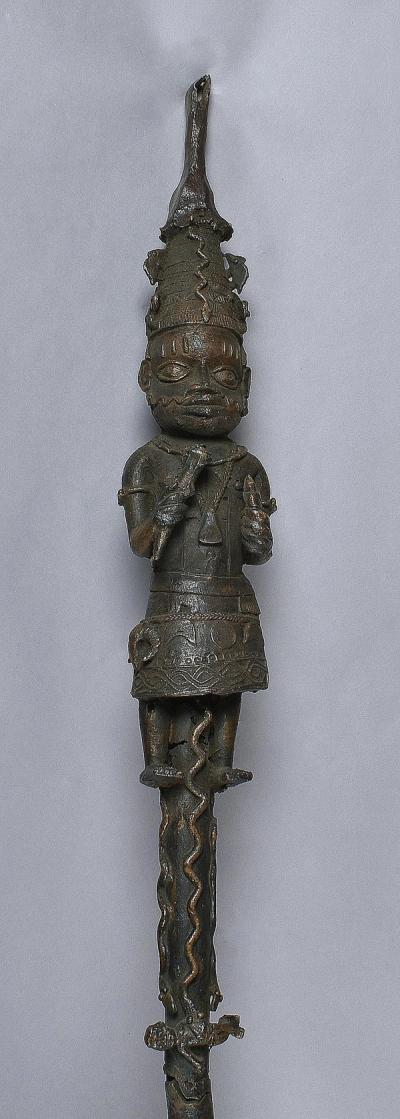
This circular-shaped motif represents Owẹn (the sun). As with Uki (the moon) in its crescent or half-moon form—which this motif often appears alongside—the sun is associated with the Iwoki, the guild of astrologists and meteorologists established by Ọba Esigie (c. 1504–50). When depicted together, Owẹn and Uki are understood to be protective; just as the sun and the moon reach their destinations through the day and the night, so will those who use these symbols. Given these protective associations, artists often incorporated depictions of these dual motifs into the clothing of warriors ( ), for example, on the Ama-Ẹrọnmwọn (bronze relief plaques).
Additionally, a single Ama-Ẹrọnmwọn shows Owẹn and Uki as its central subjects, a unique occurrence that further indicates the importance of these motifs when depicted together.
The Owẹn motif is much less common than the sun in its rosette form, the latter being associated with the proverb Owẹn iba ẹdẹ ku (‘The Sun Never Misses a Day’ – Rosette).

Digital Benin collates digital material from institutions, and some of this material is inherently colonial and contains words, terms and phrases that are inaccurate, derogatory and harmful towards African and African diasporic communities. Catalogue transcriptions, book titles, exhibition titles and museum titles may contain harmful terms. We recognise the potential for the material to cause physical and mental distress as well as evoke strong emotions. Owing to the scale of the collection’s data, a process to implement sensitive-content warnings in the displayed data is still incomplete. The material within the catalogue does not represent Digital Benin’s views. Digital Benin maintains a strong anti-colonial, anti-racist position and affirms its support for centring the humanity of historically marginalised and disenfranchised communities. Read more about the background of this statement here