
Accession Number
1980.31
Institution
de Young museum
Edo designations
English designations
Relief Plaque
Categories
Palace Architecture & Ornamentation
Location
50 Hagiwara Tea Garden Dr, San Francisco, CA 94118, United States
Loading...
Relief Plaque
Relief Plaque
Relief Plaque

Iconographies

4 annotations
Water fern
Ebe Amẹ
Water Fern

Ebe Amẹ refers to a wide variety of plants, particularly the leaves of the water fern or river leaf, found in riverine areas of southern Nigeria ( ). Artists from the Igun-Ẹrọnmwọn used these as a decorative motif in the background of most Ama-Ẹrọnmwọn (bronze relief plaques). The petals of the Ebe Amẹ, like the points of the ἀghàdàgháda (crossroads), represent the four cardinal directions: north, east, south, and west. The number four plays a foundational role in the Edo calendar, which is structured around four market days ( ).

1 annotation
Ebe Amẹ
Ikan Aro
Incised forehead markings

Ikan Aro are two linear markings in the centre of the forehead, located in between the eyes. These are usually inset with iron on depictions otherwise made of brass, bronze, ivory or wood.The use of iron was significant due the association of this metal with Ogun, who is god of iron and metal. These markings appear on both men and women, however are a common feature of representations of Iy'Oba Idia. Flora Kaplan (1993, 59) argued these are not tattoos, unlike the Ikharo. According to Nevadomsky (1986, 42), these incisions "signify determination, firmness, resolve, or even maturity". Kaplan (1993, 59) has also made a link between these markings and oral history told to her by Oba Erediauwa describing the events leading up to Idia (before she was Iy’Ọba) becoming the wife of Ọba Ozolua, whereby her parents tried to disfigure her to “repel” the Ọba. According to this history, the Ọba “sensing something was wrong”, called his doctors to intervene and treat her quickly, and as so she still became his wife.

1 annotation
Ikan Aro
Ẹkpẹn
Leopard

The Ẹkpẹn (leopard) is an animal that appears most often among the motifs decorating the Emwin Arhe (royal treasures). The Ẹkpẹn symbolises the valour and strength of the Ọba, as well as his political authority. The Benin people eulogise the Ọba as the ‘ẹkpẹn n'owa’ (leopard of the home).

When a hunter kills a leopard, he must say “ẹkpẹn n'oha” (I killed a bush leopard), as it is taboo to say that a hunter killed a leopard without specifying that it is a bush leopard, as otherwise this would “be tantamount to symbolically killing the king” (Nevadomsky 1988, p. 81). For this reason, leopards of the bush are called Atalakpa to distinguish them from those that represent the Ọba.

1 annotation
Ẹkpẹn
Colar Bead
Odigba
Coral beaded collar

Odigba (coral-beaded collar) is a rigid neck collar made of coral beads, worn as part of ceremonial attire only by senior princes who have been made Enigie (Inneh 2007, p. 107). Although Ibafe (2007, p. 43) argued that the Odigba was introduced during the Ogiso period (c. 900–c. 1170 AD) by Ogiso Ere, along with other symbolically important Emwin Arhe, such as the Ada (ceremonial sword) and the Ẹbẹn (ceremonial sword), this seems unlikely, as coral was only introduced in the late 15th century through trade with Portuguese merchants.

1 annotation
Odigba

Provenance

6 events
Production
1504 (approximate) to 1550 (approximate)
The object was produced by Unknown member(s) of the Igun-Ẹrọnmwọn guild in Benin City.
Looted
February 22, 1897 (day approximate) to June 1899 (year approximate)
The object was looted by Unknown member of the British colonial military campaign on Benin - February 1897 from Benin Kingdom.
Unknown
1949 (approximate) to June 16, 1980
The object is known to have come into contact with Kenneth John Hewett, later in London.
Unknown
1950s to June 16, 1980
The object is known to have come into contact with Hélène Leloup (born Copin), later in Paris.
Unknown
1950s to June 16, 1980
The object is known to have come into contact with Adolph Schwartz and Hélène Leloup (born Copin), in Paris and later Amstelveen.
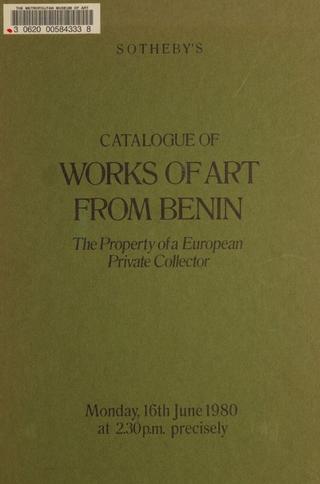
Auction
June 16, 1980
The object was auctioned to the de Young museum by Adolph Schwartz through Sotheby's and James W. Willis in London.

Related archival documents

1 documents
See all
An archival document representing a Auction Catalog of 82 page(s)
Auction Catalogue
Metropolitan Museum of Art
Thomas J. Watson Library sales and auction catalogues
Date
June 16, 1980

Institution data

de Young museum
The data was transferred directly by the institution.
Last updated: 2021-11-02
Language: english
Institution fieldValue
Accession Number
object id
1980.31
DESCRIPTION
description
Media
material
Bronze Or Brass
Dimensions
dimensions
17 3/4 x 7 (45.1 x 17.8 cm)
TITLE
object type
Plaque
Date
date made
16th century
Continent
production place
Africa
Country
production place
Nigeria
REGION
production place
Court of Benin
Credit Line
prior source
Museum purchase, William H. Noble Bequest Fund
Provenance/Former Ownership History
provenance
Purchased by Mr. James Willis for the Fine Arts Museums at Sotheby Parke Bernet & Co., 34-35 New Bond Street, London WIA 2AA on June 16, 1980 (lot 17).
Culture/People
ethnic attribution
Edo
Department
department and institution
Africa, Oceania, and the Americas
Acquisition Date
accession date
7/1/80
Additional notes
notes
The dealer James Willis bid at auction on behalf of the museum. “European private collector” (Sotheby’s 1980 sale catalogue) Dutch collector (“Schwartz” - Leloup, email 2015) (“Schwarz” - Fagg, 1958). Possibly Adolph Schwartz, Amstelveen, The Netherlands) till 1980 Hélène Leloup, Paris, dealer and collector sold it to Schwartz John Hewett, Bog Farm, Kent, England, dealer Collection in Switzerland (Fagg, 1958)
REMARKS
notes
Published in Tryptych, FAMSF Autumn 1980 pp. 12-15 "Girl with Leopard: A Benin Bronze Plaque" K. Berrin
Exhibition History
exhibition history
“West Africa Court and Art,” Arts Council 1967, L’Art e, Dakar and Paris, 1966 “Benin Art” March 2 - May 2, 1983, The Museum of Cultural History, LA, CA “Animals in African Art: From the Familiar to the Marvelous” traveling exhibition organized by The Museum for African Art, New York, NY (Montgomery Museum of Fine Arts, Montgomery, AL Feb-April 1996; Joslyn Art Museum, Omaha, Nebraska, May - July 1996; Mint Museum, Charlotte, North Carolina, Sept-Dec 1996; Dallas Art Museum, Dallas, TX, Feb-April 1997) M.H. de Young-Art of the Americas: Art and Ethnography -3/28/98-7/5/98
Location
display status
de Young Gallery 40
PUBLICATIONS
bibliography
Warren M. Robbins and Nancy Ingram Nooter, African Art in American Collections, Washington DC: Smithsonian Press, 1989, pg. 217, fig. 559
Publication History
bibliography
Fagg, 1969, pl. ZII a, No.72 Fagg, 1958, pl. I Leuzinger, 1972, p.102, K7 (ill.) Meauze, 1967 Berrin, Kathy "Girl with Leopard: A Benin Bronze Plaque," Triptych, FAM/AAM/SFO, Autumn 1980, pp. 12-15
Century
16th Century AD
Object Type
Sculpture
Sensitive Content

Digital Benin collates digital material from institutions, and some of this material is inherently colonial and contains words, terms and phrases that are inaccurate, derogatory and harmful towards African and African diasporic communities. Catalogue transcriptions, book titles, exhibition titles and museum titles may contain harmful terms. We recognise the potential for the material to cause physical and mental distress as well as evoke strong emotions. Owing to the scale of the collection’s data, a process to implement sensitive-content warnings in the displayed data is still incomplete. The material within the catalogue does not represent Digital Benin’s views. Digital Benin maintains a strong anti-colonial, anti-racist position and affirms its support for centring the humanity of historically marginalised and disenfranchised communities. Read more about the background of this statement here