

ID
211940
Edo designations
English designations
Relief Plaque
Categories
Palace Architecture & Ornamentation
Location
1 Adesogbe (Plymouth) Road, P.M.B. 1115, Benin City , Edo State
Loading...
Relief Plaque
Relief Plaque

Iconographies

10 annotations
Iviawẹ
Stacked Beaded Anklet

Ọba gha ye Ivie gie ọwan, ẹ ghi tama rẹn ehe nọ gha bae yi (When the Ọba gifts you a bead, he doesn’t tell you how to wear it) (Daniel Inneh, pers. comm., 27 September 2025).

Iviawẹ (also spelled ĺvîowẹ) are coral-beaded anklets, often worn stacked together (Aigbe 1985, p. 28; Okpokunu, Agbontaen-Eghafona & Ojo 2005, p. 162; Ọbazee 2025, p. 279). Many of the figures depicted on the Emwin Arhe (royal treasures) in brass, bronze, ivory, and wood are shown wearing these. According to Daniel Inneh (pers. comm., 27 September 2025), beads were sent to people whom the Ọba wished to honour, although there was no directive on how to wear them.

Mostly, people who wear Iviawẹ are identified as palace chiefs or priests and priestesses. However, today anyone can wear them as cultural identifiers or fashion pieces.

1 annotation
Iviawẹ
Ikharo
Forehead markings

Ikharo are linear keloid markings depicted on the forehead of Uhunmwu-Elao (commemorative heads) in groups of three or four above each eye. The exact meaning of Ikharo is debated; some have argued that they relate to the gender or tribal identification of the person on whom they are depicted. For example, has argued that they were worn only by men; however, their use in depictions is not consistent with this, and the Iy’Ọba are also shown wearing them. argued that they are instead a stylistic feature employed by artists that varied over time.

The naming of these markings differs between publications. For example, describe these markings as “agbaguda n'ehae”, which they write translates literally as “blades of the forehead”. However, later went on to call these “ikharo”, as used here. referred to these forehead markings as ikharo, meaning “tribal mark [of eye]”.

1 annotation
Ikharo
Akuọghọ
Sheath

Akuọghọ are sheaths for swords and bladed weapons. They are usually made from leather or other materials and can be highly decorated with brass sheet and coral beads. The importance of Akuọghọ is indicated by the fact that these are some of the very few inanimate objects that serve as the focal motif on some Ama-Eronmwon (bronze relief plaques).

1 annotation
Akuọghọ
Ukpọn
Wrapper

Ukpọn is the Edo term for cloth (Aigbe 1985, p. 55; Ọbazee 2025, p. 542) and is used here to refer to the wrappers or kilts worn by many of the figures depicted on the Emwin Arre (royal treasures). The cloth worn around the waist may be plain, but it is more commonly richly decorated with motifs associated with the monarchy, power, and wealth, such as the Ọba'nui (infinity symbol) and Uhunme Ikpotoki (Portuguese heads).

The Benin Kingdom was renowned for its textile production, both for local use and for trade ( ). Within the royal court, members of the Owina n’Ido produced ukhuen cloth for the Ọba and other members of the court, who wore it as wrappers during festivals and ceremonies ( ).

Alongside locally produced textiles, imported cloth was also an important commodity in the Benin Kingdom’s trade networks. Textiles were exchanged with neighbouring production centres, particularly Ijebu ( ), while European traders brought silks, woollens, linens, and cotton from Europe and Asia from the 15th century onwards ( ).

1 annotation
Ukpọn
Round Neck Bead
Ikele
Coral bead circlet

Ikele is a single stiff string or circlet of coral beads. It is worn by chiefs, such as senior chiefs who have been made Enigie (Inneh 2007, p.107), and is a sign of nobility and rank. The Ikele may only be worn once the Ọba has conferred a person with the right to wear the beads, and the Ikele must always be worn when appearing before the Ọba. According to Ekhaguosa Aisien (in Plankensteiner 2007, cat. nr. 301, p.512) when a chief is wearing the Ikele, they may not eat nor drink in public, and they “constitute an embassy of the Benin Palace wherever he might be.”

1 annotation
Ikele
hairstyles
Eto
hairstyles

Hairstyles are used to determine a person's status in the society, as chiefs, common folks, chief's wives and the wives of the Ọba all wear different hairstyles. We have Okuku, Ikpe~okhokho, Idu~akpata

1 annotation
Eto
Water fern
Ebe Amẹ
Water Fern

Ebe Amẹ refers to a wide variety of plants, particularly the leaves of the water fern or river leaf, found in riverine areas of southern Nigeria ( ). Artists from the Igun-Ẹrọnmwọn used these as a decorative motif in the background of most Ama-Ẹrọnmwọn (bronze relief plaques). The petals of the Ebe Amẹ, like the points of the ἀghàdàgháda (crossroads), represent the four cardinal directions: north, east, south, and west. The number four plays a foundational role in the Edo calendar, which is structured around four market days ( ).

1 annotation
Ebe Amẹ
Ẹgba
Bracelets

Ẹgba (bracelets) are worn as part of ceremonial costumes and could be made of brass, bronze, iron, ivory or wood. The material determines the status of the individual wearing it, as the Ọba controls the use and production of brass, bronze and ivory. Ẹgba is the designation used to describe bracelets worn around the upper arm that could potentially become amulets by putting charms or medicine in them.

2 annotations
Ẹgba
Ẹgba
Abuwa
Hand of Wealth

Abuwa ornaments are made from red ododo cloth and are a symbol of wealth (Inneh 2007, pp. 110–111). ‘Abuwa’ is understood to translate directly as “hand of wealth” (Ezra 1992, p. 313). The Abuwa is worn at the waist by high-ranking chiefs as part of their ‘pangolin skin’ ceremonial regalia (Inneh 2007, p. 110) and continues to be worn today.

1 annotation
Abuwa

Provenance

6 events
Production
1504 (approximate) to 1550 (approximate)
The object was produced by Unknown member(s) of the Igun-Ẹrọnmwọn guild in Benin City.
Looted
February 22, 1897 (day approximate) to June 1899 (year approximate)
The object was looted by Unknown member of the British colonial military campaign on Benin - February 1897 from Benin Kingdom.
Unknown
January 1898 to July 1898
The object is known to have come into contact with Friedrich Erdmann, in Benin City.
Transfer
July 1898 (year approximate)
The object was transferred from Friedrich Erdmann through Bey & Co. from Benin City to Hamburg.
Purchase
1899
The object was purchased by the Ethnologisches Museum, Staatliche Museen zu Berlin from Heinrich Bey and Bey & Co. from Hamburg to Berlin.
Restitution
August 25, 2022
The object was restituted by the Ethnologisches Museum, Staatliche Museen zu Berlin to the Omo n'Oba n'Edo Uku Akpolokpolo, Ọba of Benin & National Commission for Museums and Monuments, Nigeria through Hermann Parzinger and Abba Isa Tijani from Berlin to Nigeria.

Related archival documents

1 documents
See all
Museum Catalogue
Staatsbibliothek zu Berlin
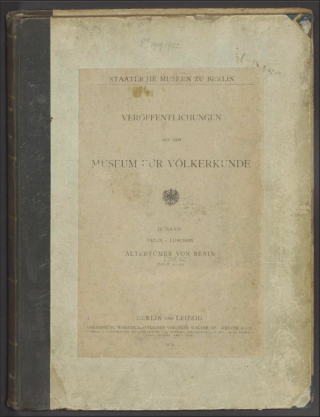
Die Altertümer von Benin
Date
January 1, 1919 at 12:00:00 AM

Institution data

Ethnologisches Museum, Staatliche Museen zu Berlin
The data was transferred directly by the institution.
Last updated: 2021-06-14
Language: german
Institution fieldValue
ID
object id
211940
Sachbegriff
designation
Sachbegriff: Reliefplatte
Titel
designation
Titel: Zwei Pagen
Objektref.
description
E 1151/1898, Erwerbung: I/41/1899: III C 8348-8531, Altertümer (Benin), H. Bey, Hamburg, 1898, Heinrich Bey (1882); III C 8403, Bronzerelief
Texte Online
description
Online Beschreibung, [Benin_Königreich]
Material / Technik
material
Material: Messing; Ausgabe: Messing
Material / Technik // Alle
material
Messing, Messing
Maße
dimensions
H: 45,5 cm B: 29,5 cm
Objekttyp
object type
Allgemein
Sachbegr. Ausgabe
object type
Reliefplatte (Relief plaque)
Anzahl Teile
object count
Datierung
date made
16. Jh.
Geogr. Bezüge
production place
Nigeria ( Land ); Benin ( Königreich )
Geogr. Bezüge // Alle
production place
Nigeria, Benin
Beteiligte
prior source
Heinrich Bey (1882), Sammler
Beteiligte // (Name, Sortierung=kleinste)
prior source
Bey, Heinrich
Veräußerer
prior source
null
Erwerb. Notiz
provenance
Erwerbung von: H. Bey; Notiz: Rückführung Leipzig; Ausgabe: 16. Jh., im Auftrag von Oba Esigie (reg. 1517-1550) oder seines Sohnes Oba Orhogbua (reg. 1550-1570), Königspalast, Benin-Stadt; durch Erbschaft an Oba Ovonramwen (ca. 1857-1914; reg. 1888-97), Königspalast, Benin-Stadt; geplündert im Zusammenhang mit der britischen Eroberung von Benin, 1897; in unbekanntem Besitz nach der Eroberung vom Königreich Benin; gesammelt im Auftrag der Firma Bey & Co., zwischen 1897 und 1898 im Gebiet des späteren kolonialen Nigeria; verkauft an das Königliche Museum für Völkerkunde in Berlin, 1899.
Verw. Institution
department and institution
Ethnologisches Museum, Staatliche Museen zu Berlin
Erwerb. Datum
accession date
1899
Besitzart
accession method
Erwerbungsart
accession method
Ankauf
Digital Assets
images
III C 8403.JPG, Repro Digitalisat
Erwerb. Nr.
I/41/1899
Ident. Nr.
III C 8403
Ident. Nr. // (Sortiernr.)
0003 C 08403
Obj. Status
vorhanden
object_images/creator
license
Martin Franken
Sensitive Content

Digital Benin collates digital material from institutions, and some of this material is inherently colonial and contains words, terms and phrases that are inaccurate, derogatory and harmful towards African and African diasporic communities. Catalogue transcriptions, book titles, exhibition titles and museum titles may contain harmful terms. We recognise the potential for the material to cause physical and mental distress as well as evoke strong emotions. Owing to the scale of the collection’s data, a process to implement sensitive-content warnings in the displayed data is still incomplete. The material within the catalogue does not represent Digital Benin’s views. Digital Benin maintains a strong anti-colonial, anti-racist position and affirms its support for centring the humanity of historically marginalised and disenfranchised communities. Read more about the background of this statement here