


IMDAS ID
3B47A161AA17417A89167DAC22207A51
Edo designations
English designations
Relief Plaque
Categories
Palace Architecture & Ornamentation
Location
Gerberau 32, 79098 Freiburg im Breisgau, Germany
Loading...
Relief Plaque
Relief Plaque

Iconographies

7 annotations
tribal marks
Iwu
Facial and Body Markings

Iwu are facial and body markings (scarifications) that were historically worn by Edo men and women. However, since the 1960s, the practice has been nearly extinct (Aisien 2011). In the past, Iwu were used as a way of proving that one was an Edo citizen, and the ceremony of having Iwu completed was an important rite of passage for men and women. The Osiwu, who also practised circumcision and other surgical procedures, would carry out the procedure of adding Iwu. There are different types of Iwu: ‘blades’ worn on the torso (Iwu-eko), and those worn on the face, such as Ikharo (three or four markings above the eyebrows), Irho (two narrow ‘blades’ worn on each cheek), Ovbihue (nasal ‘blades’), Ovbi-agbanmwen (chin ‘blade’), and Igho-okpa/Ukpgho (three forehead ‘blades’) (Aisien 2011, p. 22).

The number of Iwu also varied depending on the identity of the person wearing them. For example, royal men would wear six ‘blades’ on their torso, whilst men who were not royal would wear seven ‘blades’. Meanwhile, the Ọba’s female children would wear fifteen ‘blades’, and all other women would wear sixteen (Aisien 2011).

1 annotation
Iwu
Igan
Feather

Igan (feathers) are commonly depicted tucked into the headdresses and hats of chiefs represented on Emwin Arre (royal treasures). These feathers are from the Oɛɣohɔ (vulturine fish eagle) and symbolise respected old age and proper chieftaincy ( ).

1 annotation
Igan
Ikoro
Armcuff

Ikoro (armcuffs) are made from different materials using different techniques, including brass sheet, cast bronze, and ivory. They were crafted by different guilds depending on the material used: artists of the Igun-Ẹrọnmwọn cast them in brass or hammered and incised them from brass sheet, whereas artists of the Igbesamwan carved ivory Ikoro. Ikoro were made in different qualities, from rather simple examples with abstract geometric decoration to finely carved ivory examples with brass or copper inlays. Ikoro are worn in pairs on both forearms by chiefs and the Ọba during ceremonies and festivals. Figures depicted on the Emwin Arhe (royal treasures) are often shown wearing such pairs.

1 annotation
Ikoro
Ikharo
Forehead markings

Ikharo are linear keloid markings depicted on the forehead of Uhunmwu-Elao (commemorative heads) in groups of three or four above each eye. The exact meaning of Ikharo is debated; some have argued that they relate to the gender or tribal identification of the person on whom they are depicted. For example, has argued that they were worn only by men; however, their use in depictions is not consistent with this, and the Iy’Ọba are also shown wearing them. argued that they are instead a stylistic feature employed by artists that varied over time.

The naming of these markings differs between publications. For example, describe these markings as “agbaguda n'ehae”, which they write translates literally as “blades of the forehead”. However, later went on to call these “ikharo”, as used here. referred to these forehead markings as ikharo, meaning “tribal mark [of eye]”.

1 annotation
Ikharo
Round Neck Bead
Ikele
Coral bead circlet

Ikele is a single stiff string or circlet of coral beads. It is worn by chiefs, such as senior chiefs who have been made Enigie (Inneh 2007, p.107), and is a sign of nobility and rank. The Ikele may only be worn once the Ọba has conferred a person with the right to wear the beads, and the Ikele must always be worn when appearing before the Ọba. According to Ekhaguosa Aisien (in Plankensteiner 2007, cat. nr. 301, p.512) when a chief is wearing the Ikele, they may not eat nor drink in public, and they “constitute an embassy of the Benin Palace wherever he might be.”

1 annotation
Ikele
Water fern
Ebe Amẹ
Water Fern

Ebe Amẹ refers to a wide variety of plants, particularly the leaves of the water fern or river leaf, found in riverine areas of southern Nigeria ( ). Artists from the Igun-Ẹrọnmwọn used these as a decorative motif in the background of most Ama-Ẹrọnmwọn (bronze relief plaques). The petals of the Ebe Amẹ, like the points of the ἀghàdàgháda (crossroads), represent the four cardinal directions: north, east, south, and west. The number four plays a foundational role in the Edo calendar, which is structured around four market days ( ).

1 annotation
Ebe Amẹ
Ahianmwẹ-Ọrọ
Bird of Prophecy

The Ahianmwẹ-Ọrọ, meaning ‘bird of prophecy’ in English, is a bird with a long beak believed to be a messenger of the spirit world. If it cries ‘OyaO’ (disgrace), it portends danger or disaster. If it cries ‘Oliguegue’ (be grateful), it portends good favour, fortune, or luck. If it persistently cries ‘OyaO, OyaO’ in front of someone, it is prophesying that the person should be cautious and should not undertake a journey, or should return home rather than continue. But if the bird cries ‘Oliguegue’ continuously, the journey will be favourable.

In 1515, as Ọba Ẹsigie passed through the gates of Benin on his way to fight the Attah (king) of Idah, the Ahianmwẹ-Ọrọ made discouraging sounds overhead, ‘OyaO, OyaO’, portending that disaster lay ahead. The Ọba ordered the bird to be killed and went on to win the war. He said, ‘Nẹ O gha yin Agbon, ghẹi daho Ahianmwẹ notiẹ oya’ (whoever wishes to succeed in life should not heed the bird of prophecy). On the Ọba’s triumphant return from battle, he commissioned the Igun-Eronmwon to make an image of the bird on the finial of a battle standard to remind it that the Ọba was not subject to the fate of ordinary spirits (personal communication, Patrick Oronsaye, 2022).

The identification of which bird the Ahianmwẹ-Ọrọ represents has been a subject of scholarly debate throughout the 20th century. Some have suggested that the bird is an African pied wagtail (Melzian 1937, p. 5), an ibis (Dark 1962, p. 46), possibly a kind of kingfisher (Ben-Amos 1976, p. 252), a hornbill (McCall 1975, p. 293), or, lastly, a white-tailed ant thrush (Nevadomsky 1988, pp. 76–77). In the case of the Ahianmwẹ-Ọrọ, however, Joseph Nevadomsky (1988, p. 77) posited that the exact species being represented was in fact less important. Instead, the aim was to “convey certain notions about the supernatural powers of the Ọba” and that the physical attribute (e.g., the long beak) was in fact the Ọba Ẹsigie’s casters’ way of seeking to “emphasise its vocal powers of prophecy, and, perhaps more importantly, the overcoming of these powers by the Ọba.”

1 annotation
Ahianmwẹ-Ọrọ

Provenance

5 events
Production
1504 (approximate) to 1550 (approximate)
The object was produced by Unknown member(s) of the Igun-Ẹrọnmwọn guild in Benin City.
Looted
February 22, 1897 (day approximate) to June 1899 (year approximate)
The object was looted by Unknown member of the British colonial military campaign on Benin - February 1897 from Benin Kingdom.
Unknown
1904 (approximate)
The object is known to have come into contact with Bernhard Adolf Heemke, in Benin City.
Transfer
1904 (approximate)
The object was transferred from Bernhard Adolf Heemke through Bey & Co. from Benin City to Hamburg.
Purchase
October 13, 1904
The object was purchased by the Städtische Museen Freiburg from Bernhard Adolf Heemke from Hamburg to Freiburg im Breisgau.

Related archival documents

2 documents
See all
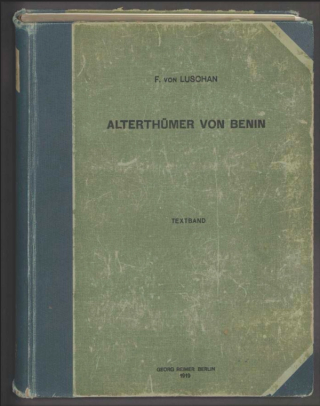
Museum Catalogue
Staatsbibliothek zu Berlin
Die Altertümer von Benin
Date
January 1, 1919 at 12:00:00 AM
An archival document representing a Correspondence of 1 page(s)
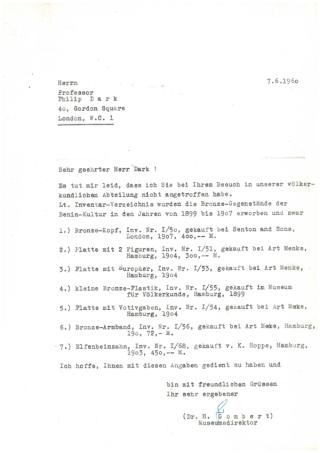
Correspondence
Städtische Museen Freiburg
Letter from the director of the then municipal collections in Freiburg, Dr. Hermann Gombert to Prof. Philip Dark on June 7, 1960, Ethnological Collection, Museum of Nature and Man, Municipal Museums in Freiburg
Date
June 7, 1960

Institution data

Städtische Museen Freiburg
The data was transferred directly by the institution.
Last updated: 2021-05-21
Languages: english, german, french
Institution fieldValue
IMDAS ID
object id
3B47A161AA17417A89167DAC22207A51
Inventarnummer
object id
I/0053
Indigene Bezeichnung (Museumsobjekt)
edo designation
ama
Titel (Museumsobjekt)
designation
object type
Reliefplatte
Titel engl.
designation
object type
Titel franz.
designation
object type
Text kurz Online-Sammlung dt.
description
Das Bronze-Hochrelief zeigt einen hohen Würdenträger, der in der linken Hand einen Stab mit Vogel (Ibis) und in der rechten einen Zweig hält. Es wurde als Erinnerung an einen Sieg der Beninarmee im Wachsausschmelzverfahren gefertigt. 1897 zerstörten britische Truppen die Hauptstadt Benin City im heutigen Nigeria und raubten zahlreiche Bronzen, die anschließend durch Handel in viele europäische Museen gelangten.
Text kurz Online-Sammlung engl.
description
This bronze high relief shows a noble dignitary holding a bird-shaped (ibis) staff in his left hand and a twig in his right. Using the lost-wax casting process, it was made as a commemoration of a victory won by the Benin army. In 1897, British troops destroyed the capital, Benin City, in what is now Nigeria, and looted several bronzes, which subsequently found their way into the collections of European museums via the open market.
Text kurz Online-Sammlung franz.
description
Le haut-relief en bronze présente un haut dignitaire tenant un bâton avec un oiseau (ibis) dans sa main gauche et une branche dans sa main droite. Il a été réalisé en commémoration d’une victoire de l’armée du Bénin en utilisant le procédé de la cire perdue. En 1897, les troupes britanniques ont détruit la capitale de Benin City située dans l’actuel Nigéria et ont volé de nombreux bronzes qui, par la suite, sont parvenus dans de nombreux musées européens par l’intermédiaire du commerce.
Text lang Online-Sammlung dt.
description
Die Platte ist im Wachsausschmelzverfahren gegossen, fein gesäubert, geglättet und poliert. Sie zeigt im Dreiviertelrelief einen hohen Würdenträger, erkenntlich an Haube mit Fischadlerfeder und Korallenkette. Zur Erinnerung an einen Sieg der Beninarmee unter König Essigie schlägt er während der ugie oro-Zeremonie einen Klangstab mit der Figur des prophetischen Unglücksvogels anhianmwen’oro an. Im Hintergrund sind eingravierte ebeame-Motive: eine Wasserpflanze mit Bezug zum Wassergott Olokun. Geschaffen vom 16. bis Anfang des 18. Jahrhunderts zum Gedenken an hochrangige Personen, an religiöse Zeremonien oder Kriege, schmückten die Platten die Pfeiler des Königspalasts in Benin. 1897 zerstörten die Briten die Hauptstadt Benin City im heutigen Nigeria und raubten über tausend Kunstwerke, die zu den bedeutendsten des afrikanischen Kontinents zählen.
Text lang Online-Sammlung engl.
description
The bronze relief was made using the lost-wax casting method; it has been scrupulously cleaned, smoothed and polished. It depicts a noble dignitary in the three-quarter relief, recognisable by the hat with osprey feathers and coral necklace. Commemorating a victory of the Benin army under King Esigie, the figure is striking a bird-shaped idiophone (it is the unlucky anhianmwen'oro bird of prophesy) during the Ugie Oro ceremony. The background has been incised with foliate patterns or motifs referred to as ebe-ame or the »river-leaf« design: an aquatic plant related to the water deity Olokun. Made during the period stretching from the 16th to the beginning of the 18th century to commemorate high-ranking people, religious ceremonies or wars, the plates adorned the pillars of the Royal Palace in Benin. In 1897, the British launched its punitive Benin , which resulted in the destruction of the capital, Benin City, in what is now Nigeria, and the theft of more than a thousand works of art, which are among the most important from the African continent.
Text lang Online-Sammlung franz.
description
La plaque a été coulée en utilisant le procédé de la cire perdue, puis nettoyée avec soin, lissée et polie. Elle présente un relief en trois-quart d‘un haut dignitaire, reconnaissable à sa hotte ornée d’une plume de balbuzard pêcheur et d’un collier de corail. En commémoration d’une victoire de l’armée du Bénin sous le roi Essigie, pendant la cérémonie ugie oro, il frappe un bâton sonore sur lequel se tient la figure de l’oiseau prophétique de malchance anhianmwen’oro. En arrière-plan, on note des motifs gravés de l’ebeame, une plante aquatique liée au dieu de l’eau Olokun. Créées du XVIe au début du XVIIIe siècle en commémoration de personnalités de haut rang, de cérémonies religieuses ou de guerres, ces plaques de bronze ornaient les piliers du palais royal au Bénin. En 1897, lorsque les Britanniques détruisirent la capitale Benin City de l’actuel Nigéria, ils dérobèrent plus d’un millier d’œuvres d’art qui comptaient parmi les plus remarquables du continent africain.
Trägermaterial
material
Bronze
Maße zum Objekt
dimensions
Breite: 190,00 mm; Höhe: 450,00 mm; Tiefe: 100,00 mm
Objektbezeichnung
object type
Relief
Objektbezeichnung engl.
object type
Bronze plate
Objektbezeichnung franz.
object type
Plaque de bronze
Datierung
date made
16. Jahrhundert; 17. Jahrhundert
Datierung bis
date made
31.12.1699
Datierung von
date made
01.01.1500
Entstehungszeit
date made
16. - 17. Jahrhundert
Technik
production technique
Gelbguss
Fundort/Herkunft
production place
Benin <Königreich>; Nigeria; Westafrika
Sammler/in öffentlich
prior source
Heemke, Bernhard Adolf
Voreigentümer
prior source
Heemke, Bernhard Adolf
Objektgeschichte
provenance
Ausstellungsbereich
Ethnie
ethnic attribution
Edo
Institution
department and institution
Ethnologische Sammlung MNM
Eingangsdatum
accession date
13.10.1904
Eingangsart
accession method
Kauf
Digitaler Katalog Standort
display status
Nicht ausgestellt
Nutzungsrechte (Medienobjekt)
license
CC BY-NC-SA 4.0
URL-Digitalisat
weblink
https://onlinesammlung.freiburg.de/de/object/3B47A161AA17417A89167DAC22207A51
Fotograf (Medienobjekt)
Killian, Axel
Sammlung
Afrika
Schlagworte
Ethnologie (außereuropäische); Benin-Bronze
Sensitive Content

Digital Benin collates digital material from institutions, and some of this material is inherently colonial and contains words, terms and phrases that are inaccurate, derogatory and harmful towards African and African diasporic communities. Catalogue transcriptions, book titles, exhibition titles and museum titles may contain harmful terms. We recognise the potential for the material to cause physical and mental distress as well as evoke strong emotions. Owing to the scale of the collection’s data, a process to implement sensitive-content warnings in the displayed data is still incomplete. The material within the catalogue does not represent Digital Benin’s views. Digital Benin maintains a strong anti-colonial, anti-racist position and affirms its support for centring the humanity of historically marginalised and disenfranchised communities. Read more about the background of this statement here