
Object Number
1991.17.68a, b
Edo designations
English designations
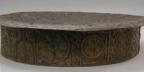
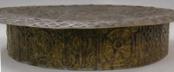
Chest
Categories
Ceremonial Objects
Containers
Location
1000 5th Ave, New York, NY 10028, United States
Loading...
Box
Box
Box
Box
Box
Box
Box

Iconographies

6 annotations
Owẹn iba ẹdẹ ku
Rosette - 'The Sun Never Misses a Day'

This rosette design, usually found in the corners of Ama-Ẹrọnmwọn (bronze relief plaques), is one of two motifs representing the sun and one of a number of motifs in Edo art that are also connected with Olokun. The association between the sun and Olokun refers to the way in which the sun descends into the sea each day—hence the proverb ‘the sun never misses a day’—and the sea is where the deity Olokun lives ( ).

1 annotation
Owẹn iba ẹdẹ ku
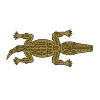
alligator
Ẹghughu
Crocodile

In the riverine area surrounding Benin City, there are two types of crocodile. The Ẹghughu, known in English as the dwarf or bush crocodile, is believed to be more docile ( ; Ọbazee 2025, p. 133). The second type is the Àgbákà, the aggressive Nile crocodile ( ; Ọbazee 2025, p. 11).

Crocodiles are one of the important animals represented in the historical Emwin Arhe, and they are known as Olokun’s guards or the “policemen” of the waters. The powerful and ferocious qualities of these animals might explain why warrior figures are often depicted wearing Uhunmwu-Ẹkuẹ (pendant masks) in the shape of crocodile heads on Ama-Ẹrọnmwọn (bronze relief plaques) ( ). Olokun devotees use crocodiles as sacrificial animals in offerings during the worship of Olokun.

1 annotation
Ẹghughu
Ewi
Mudfish

Depictions of Ewi (mudfish) are among the most frequent motifs in the Emwin Arhe (royal treasures). Mudfish hold an important place in Edo belief, both as representations of the god Olokun and as symbols of royalty (Plankensteiner 2007, p. 410), as well as of “prosperity, peace, well-being and fertility” (Ben-Amos 1976, p. 245). Mudfish are also particularly common animals for sacrifice, and mudfish-shaped Orhiẹvbẹ (kola-nut boxes) were used to make offerings or store kola nuts.

Yet, the appearance of Ewi across the Emwin Arhe is not consistent, and it has been argued that different species of mudfish were depicted by Edo artists, each with different qualities and capabilities. For example, the electric shock of Malapterurus electricus resembles the fierceness of the Ọba, while the liminal qualities of the Synodontis clarias mudfish, which lives both on land and in water, similarly reflect the Ọba’s rule over land and sea (Gallagher 1983, p. 93). With these different qualities in mind, the mudfish is an important symbol of Benin kingship and royalty.

Sometimes the Ọba was depicted by artists with mudfish rather than legs (see Ọba with Mudfish Legs).

1 annotation
Ewi
king with mudfish legs
TBC_Ọba Ohẹn
King with Mudfish Legs

This motif of an Ọba with legs represented as two mudfish is often interpreted as Ọba Ohẹn, who reigned c. 1334–1370. According to oral traditions, Ohẹn suffered from paralysis of the legs and unsuccessfully attempted to conceal his condition from the chiefs and members of the royal court. The Iyasẹ Emuze eventually hid in the Ọba’s chambers to discover his secret ( ). When Ohẹn discovered this, he ordered the Iyasẹ to be executed. However, the people learned of the order and turned against the Ọba. According to the tradition, they plotted to kill him ritually by digging a hole beneath his throne and stoning him with Orhue (white kaolin chalk) when he fell into it ( ; ).

Not all representations of an Ọba with mudfish legs, however, are understood to refer to Ohẹn. Variations in the objects and animals carried by the figure are thought to indicate different meanings ( ; ). Members of the Igbesamwan and Igun-Ẹrọnmwọn have emphasised the significance of these accompanying motifs (Blackmun 1984, pp.249–255). When the mudfish-legged Ọba is shown holding aquatic creatures such as crocodiles, for example, the image has been interpreted as a “cosmological image” representing the correspondence between the two monarchs: the Ọba of Benin, ruler of the land, and Olokun, ruler of the waters ( ). By contrast, representations in which the Ọba holds swords or staffs have been interpreted specifically as depictions of Ọba Ohẹn.

1 annotation
TBC_Ọba Ohẹn
Ubanu'hi / Obanu'hi
Ubanu'hi / Obanu'hi
Inifinity Symbol

The Ubanu'hi (infinity symbol) is a kind of guilloche or interlaced strapwork motif that can be angular or rounded. It was used by Edo artists in the decoration of many Emwin Arhe (royal treasures) and is ubiquitous in Benin royal arts. Ubanu'hi is a shortened form of “uba no Ọba ya de agbon ke ehimwin yi”, which means “the rope with which the Ọba ties the heaven and earth together” (pers. comm. Chief John Igbineweka Inneh n’Igbesawman, 2022). Similarly, Paula Ben-Amos Girshick (in Plankensteiner 2007, pp. 339, 341) described this as “Ọba n’iri agbon”, or the “rope of the world” pattern.

According to Ọbabanmu Ineh (in Blackmun 1984, p. 51), the use of this motif indicates that objects were carved by members of the Igbesanmwan. However, the motif is found on all types of Emwin Arhe (royal treasures), not only those made of ivory or wood. On the flanges of the Ama (relief plaques) alone, Kathryn Gunsch (2018, pp. 75–77) identified three different versions of the Ubanu'hi and, through her analysis of over 850 plaques, found that these different Ubanu'hi forms align with other characteristics, such as dimensions, the prevalence of ornamental motifs, and stylistic qualities. Together, these provide evidence, she argues, of different production groups among the plaque makers .

Kate Ezra (1992, pp. 209, 264) went on to argue that the use of these motifs indicates that certain objects were used in a “royal context” and were associated with “royal patronage”.

2 annotations
Ubanu'hi / Obanu'hi
Ubanu'hi / Obanu'hi

Provenance

6 events
Production
unknown to February 22, 1897 (day approximate)
The object was produced by Unknown member(s) of the Igun-Ẹrọnmwọn guild in Benin City.
Looted
February 22, 1897 (day approximate) to June 1899 (year approximate)
The object was looted by Unknown member of the British colonial military campaign on Benin - February 1897 from Benin Kingdom.
Unknown
1898
The object is known to have come into contact with William Downing Webster, later in Bicester.
Purchase
1898 to 1900
The object was purchased by Augustus Henry Pitt-Rivers (Lane Fox) from William Downing Webster from Bicester to Farnham.
Auction
June 13, 1978
The object was auctioned to Klaus Gunther & Amelia 'Dolly' Perls through Christie's in London.
Gift
1991
The object was given as a gift by Klaus Gunther & Amelia 'Dolly' Perls to the Metropolitan Museum of Art in New York City.

Related archival documents

1 documents
See all
Museum Catalogue
Staatsbibliothek zu Berlin
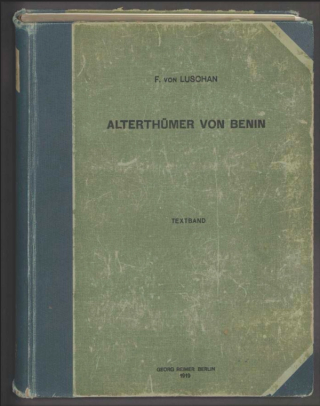
Die Altertümer von Benin
Date
January 1, 1919 at 12:00:00 AM

Institution data

Metropolitan Museum of Art
The data was transferred directly by the institution.
Last updated: 2021-07-30
Language: english
Institution fieldValue
Object Number
object id
1991.17.68a, b
Object Sort Number
object id
1991 17 68a b
Primary Rendition No
object id
DP140944
Title
designation
object type
Lidded Box (ekpoki)
Medium
material
Brass
Dimensions
dimensions
D. 3 3/4 x Diam. 18 in. (9.5 x 45.7 cm)
Classification
object type
Metal-Containers
Date
date made
16th–19th century
Geo: City
production place
Court of Benin
Geo: Country
production place
Nigeria
Credit Line
prior source
Gift of Mr. and Mrs. Klaus G. Perls, 1991
Provenance
provenance
Court of Benin, taken from the Royal Palace in 1897 during the British military occupation of Benin; [W.D. Webster, London, from 1898]; Augustus Lane-Fox Pitt-Rivers, Farnham, Dorset, UK, acquired before 1900; (Christie's, London, June 13, 1978, no. 263); Mr. and Mrs. Klaus G. Perls, New York, until 1991
Dynasty
reign associated name
Oranmiyan
Culture
ethnic attribution
Edo peoples
ExhibitionHistory
exhibition history
Royal Art of Benin from the Perls Collection The Metropolitan Museum of Art, January 16, 1992–September 13,1992 Benin Kings and Rituals: Court Arts fromNigeria Museum für Völkerkunde, Vienna, May 9, 2007–September 3,2007 Musée du Quai Branly, October 2, 2007–January 6,2008 Ethnologisches Museum, Staatliche Museen zu Berlin, February 7,2008–May 25, 2008 Art Institute of Chicago, June 27, 2008–September 21,2008
Bibliography
bibliography
Ezra, Kate. Royal Art of Benin: The Perls Collection in the Metropolitan Museum of Art. New York: The Metropolitan Museum of Art, 1992, p. 239, no. 112.
Published References
bibliography
von Luschan, F. 1901. Die Karl Knorr'sche Sammlung von Benin-Altertümern im Museum für Volkerkunde in Stuttgart. Stuttgart: pl. 21, figs. 122-3. Christe's, London. 1978. African Art from the Collection of the Late Josef Mueller. Sale catalogue of June 13, 1978: lot 263. "ROYAL ART OF BENIN. The Perls Collection in The Metropolitan Museum of Art." Kate Ezra. The Metropolitan Museum of Art and Harry N. Abrams Inc., New York 1992 Fig. 112 Plankensteiner, B. (Ed) "Benin Kings and Rituals. Court Arts from Nigeria" Exhibition Catalogue Museum fur Volkerkunde Wien. Wien: Snoeck Publishers, 2007, p. 337, Cat. 84
Sensitive Content

Digital Benin collates digital material from institutions, and some of this material is inherently colonial and contains words, terms and phrases that are inaccurate, derogatory and harmful towards African and African diasporic communities. Catalogue transcriptions, book titles, exhibition titles and museum titles may contain harmful terms. We recognise the potential for the material to cause physical and mental distress as well as evoke strong emotions. Owing to the scale of the collection’s data, a process to implement sensitive-content warnings in the displayed data is still incomplete. The material within the catalogue does not represent Digital Benin’s views. Digital Benin maintains a strong anti-colonial, anti-racist position and affirms its support for centring the humanity of historically marginalised and disenfranchised communities. Read more about the background of this statement here