


Iconographies










Provenance
Institution data
| Institution field | Value |
|---|---|
Identifikationsnummer object id | 2021.22:1 |
Titel designation | Reliefplatte: Kriegsszene, des Idah-Krieges |
Materialien material | ANORGANISCH/Metall/Gelbguß |
Heutiges Staatsgebiet des Herstellungsortes production place | Benin |
Provenienz/Name prior source provenance | Maschmann |
Provenienz Objektitinerar Akteure Orte Daten provenance | Museum für Kunst und Gewerbe Hamburg |
Provenienz/Affiliation provenance | |
Provenienz/Country provenance | |
Provenienz/Date of Birth provenance | |
Provenienz/Date of Death provenance | |
Provenienz/First Name provenance | A. |
Provenienz/No provenance | |
Provenienz/Place of Birth provenance | |
Provenienz/Place of Death provenance | |
Provenienz/Profession provenance | |
Provenienz/Role-Function/0 provenance | |
Provenienz/Role-Function/1 provenance | |
Provenienz/Sex provenance | |
Provenienz/Short Biography provenance | |
Provenienz/Street provenance | |
Provenienz/Town provenance | |
Hersteller kulturhist. Herkunftsgesellschaft ethnic attribution | |
Heutiger Aufbewahrungsort Sammlung department and institution | Museum am Rothenbaum. Kulturen und Künste der Welt (MARKK) |
Akquisitionsdatum accession date | 2021 |
Alte Inventarnummer | 1899.75 |
Inventurdatum | |
Label Text (deu) | Reliefplatte: Szene des Idah-Krieges Meister der Schlachten, Unbekannte Werkstatt der Bronzegießergilde Igun Eronmwon / Königreich Benin, Nigeria, 16./17. Jh. / Gelbguss / Übernahme vom Museum für Kunst und Gewerbe Hamburg, 2021, Inv. Nr. 2021.22:1 Der Überlieferung zufolge soll Oba Orhogbua im 16. Jh. einem Weißen namens Ahammangiwa den Auftrag erteilt haben, erfolgreiche Feldzüge in Bronze festzuhalten. Sechs Platten, die Schlachten dokumentieren, werden ihm zugeschrieben. Bei dem vom Pferd gezogenen Feind handelt es sich vermutlich um den Attah von Idah, König eines benachbarten Reiches, das von strategischer Bedeutung für die Kontrolle des unteren Niger war. Dieses herausragende, zur Schlachten-Serie gehörende Relief gilt wegen der detailreichen und komplexen Darstellung in höchster Qualität als eines der bedeutendsten BeninWerke überhaupt. |
Label Text (eng) | Relief Plaque: Idah War Scene Master of the Battles, Unidentified workshop of the Bronze Casters Guild Igun Eronmwon / Benin Kingdom, Nigeria, 16th/17th century / Brass / Transfer from the Museum für Kunst und Gewerbe Hamburg, 2021, Inv. no. 2021.22:1 According to tradition, Oba Orhogbua allegedly commissioned a white man named Ahammangiwa in the 16th century to record successful campaigns in bronze. Six plaques documenting battle scenes are attributed to him. The enemy drawn from the horse is presumably the Attah of Idah, king of a neighbouring kingdom whose location was of strategic importance in controlling the lower Niger. This outstanding relief plaque, which is part of the battle series, is considered to be one of the most important Benin works, because of its detailed and complex representation in the highest quality. |
Maße | Höhe: 55,00 cm; Breite: 39,00 cm |
| Institution field | Value |
|---|---|
Inventarnummer object id | 1899.75 |
Titel designation | Reliefplatte (Schlachtenszene) |
Beschreibung description | Die Reliefplatte gehört zu einer Serie von insgesamt sechs Platten, die vermutlich unterschiedliche Schlachten dokumentieren.Im Zentrum steht ein in der Größe alle anderen überragender Benin-Feldherr, der einen entzweigeteilten Gegner am Schopf von dessen Helm packt und ihn vom Pferd zerrt, während er mit der anderen, seiner rechten Hand ein Schwert hoch erhebt. In der oberen linken Ecke hat ein zweiter Krieger in der gleichen Haltung einen weiteren Feind zerhackt, hinter ihm bläst ein Krieger in ein Horn. Entlang des rechten Plattenrandes sind übereinander zwei Benin-Krieger abgebildet, wobei der untere das Haupt eines Feindes hält. Zwei weitere stark bewaffnete Krieger werden unterhalb des vom Pferd gezogenen Mannes gezeigt. Am unteren rechten Rand liegen zwei kleine Figuren, die offenbar von einem entlang des unteren Plattenrandes liegenden Baum erschlagen wurden. |
Beschreibung Veröffentlichung description | Die Reliefplatte gehört zu einer Serie von insgesamt sechs Platten, die vermutlich unterschiedliche Schlachten dokumentieren. Im Zentrum steht ein in der Größe alle anderen überragender Benin-Feldherr, der einen entzwei geteilten Gegner am Schopf von dessen Helm packt und ihn vom Pferd zerrt, während er mit der anderen, seiner rechten Hand ein Schwert hoch erhebt. In der oberen linken Ecke hat ein zweiter Krieger in der gleichen Haltung einen weiteren Feind zerhackt, hinter ihm bläst ein Krieger in ein Horn. Entlang des rechten Plattenrandes sind übereinander zwei Benin-Krieger abgebildet, wobei der untere das Haupt eines Feindes hält. Zwei weitere stark bewaffnete Krieger werden unterhalb des vom Pferd gezogenen Mannes gezeigt. Am unteren rechten Rand liegen zwei kleine Figuren, die offenbar von einem entlang des unteren Plattenrandes liegenden Baum erschlagen wurden. Die Provenienzforschung am MK&G zu den Benin- Bronzen führte im Jahr 2016 zur Erkenntnis, dass es sich um Raubkunst handelt. 2018 wurde in Absprache mit der Hamburger Behörde für Kultur und Medien beschlossen, die Benin- Bronzen an das Museum am Rothenbaum – Kulturen und Künste der Welt (MARKK) zu übergeben. Gemeinsam mit vielen weiteren Kunstwerken aus Benin sind sie Teil der aktuellen Rückgabeverhandlungen mit Nigeria, die dort koordiniert werden. |
Material material | Gelbguss, Bronze |
Maße dimensions | Gesamt Höhe: 55,5 cm Breite: 40 cm Tiefe: 12 cm Gewicht: 26 kg |
Gewicht weight | 26 kg |
Objektbezeichnung object type | Relief |
Anzahl object count | 1 |
Darstellung/Ikonographie iconography | Krieg (Krieger), Kampf (Duell), Hieb- und Stichwaffen |
Anzeige Datierung date made | frühes 17. Jahrhundert |
Datierung von date made | 1600 |
Anzeige Material/Technik production technique | Bronze, gegossen |
Technik production technique | gegossen |
Ort production place | Benin |
Zugang von prior source | Maschmann, Albert, |
erworben durch prior source | |
Beteiligte provenance | (Meister des Krieges (namensgebendes Stück)) |
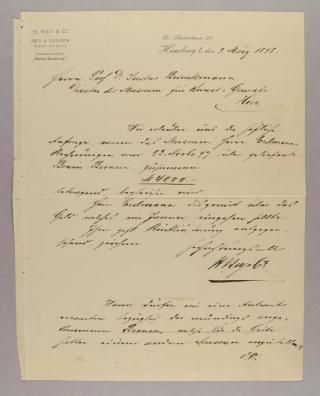
Provenienz provenance | Erdmann, Friedrich von: 1897 bis: 23.11.1897 (Friedrich Erdmann verkaufte Brinckmann mit Rechnung vom 23.11.1897 fünf Benin-Reliefs, Köpfe etc. für insgesamt 2000 Mark. Da Brinckmann bei seinem Vortrag in Lübeck über die "Alterthümer von Benin" am 10.11.1897 zahlreiche Anschauungsobjekte - nachweislich auch dieses Relief - zeigte, ist zu vermuten, dass Erdmann ihm viel Material überließ. Ende November fiel die Kaufentscheidung. Da sich die Finanzierung als problematisch erwies, konnte Brinckmann die Rechnung erst 1899 aus den Provisionen seiner Vermittlung von Benin-Objekten abschließend bezahlen. So wurde der faktische Geschäftsabschluss als datierter Ankauf in die Lager- und Inventarbücher übernommen. ) |
Ereignis(se) event | Herstellung |
Zugangsdatum accession date | 1899 |
Zugangsart accession method | Ankauf |
Interne Bemerkung notes | Lgb.-Nr. I b 844 / 1949 |
Objektgeschichte exhibition history | 29.03. - 08.09.2019 Sonderausstellung Ex Africa (Bologna, Museo Civico Archeologico) |
Status display status | ausgeschieden |
Literatur bibliography | Museum für Kunst und Gewerbe Hamburg: Jahrbuch des Museums für Kunst und Gewerbe Hamburg, Hamburg, [Jahr] |
Werkrecht legal status | gemeinfrei |
URL weblink | https://sammlungonline.mkg-hamburg.de/de/object/Reliefplatte-Schlachtenszene/1899.75/dc00123548?s=Benin&h=0 |
Datierung bis | 1625 |
Epoche/Stil | (afrikanisch), (Benin) |
Freigabe Portal | freigegeben |
Relationen | |
Sachgruppe | Reliefs |
Sammlung | Antike |
Standort (perm.) | (abgegeben an MARKK am 30.09.2021) |
Zugang Bemerkung | Justus Brinckmann erwarb das Relief bereits im Herbst 1897 von Friedrich Erdmann und finanzierte diesen Ankauf über Provisionen aus dem Verkauf der Sammlung Maschmann. |
Digital Benin collates digital material from institutions, and some of this material is inherently colonial and contains words, terms and phrases that are inaccurate, derogatory and harmful towards African and African diasporic communities. Catalogue transcriptions, book titles, exhibition titles and museum titles may contain harmful terms. We recognise the potential for the material to cause physical and mental distress as well as evoke strong emotions. Owing to the scale of the collection’s data, a process to implement sensitive-content warnings in the displayed data is still incomplete. The material within the catalogue does not represent Digital Benin’s views. Digital Benin maintains a strong anti-colonial, anti-racist position and affirms its support for centring the humanity of historically marginalised and disenfranchised communities. Read more about the background of this statement here