
Inventarisnummer
RV-1243-16
Edo designations
English designations
Relief Plaque
Categories
Palace Architecture & Ornamentation
Location
1 Adesogbe (Plymouth) Road, P.M.B. 1115, Benin City , Edo State
Loading...

Iconographies

8 annotations
Asa
Shield

Asa (shields) are a crucial attribute of warriors and warrior chiefs, forming part of their ceremonial and battle attire as represented on the Emwin Arhe (royal treasures). Asa were usually made from elephant or crocodile skin and used by warriors for protection during hand-to-hand combat (Osadolor 2001, p. 102). Interestingly, the form of Asa depicted on historic royal artefacts differs from those found in museum collections today, reflecting changes in shield shapes and designs over time.

1 annotation
Asa
Ẹroro
Bell

Ẹroro (bells) frequently appear as ornaments worn by figures depicted on the Emwin Arhe, particularly on Ama-Eronmwon (bronze relief plaques) and Aken’ni Elao (carved tusks). These Ẹroro are most commonly quadrangular in form or, less commonly, cylindrical with rounded tops. Quadrangular Ẹroro worn around the neck are often part of the attire that indicates that figures can be interpreted as warriors, alongside the Akọn Ẹkpẹn (leopard tooth neck ornament) and the Ohian Ẹkpẹn (leopard tunics).

1 annotation
Ẹroro
Asoro
Spears

Asoro (spears) were used as weapons in battle and for hunting ( ; Ọbazee 2025, p. 37). According to , there were two types: long and short. Figures holding Asoro are often depicted on Ama-Ẹrọnmwọn (bronze relief plaques), sometimes in battle scenes and at ceremonies and festivals.

1 annotation
Asoro
Ẹrhu
Headwear

Many different kinds of Ẹrhu (headwear) are worn by the various figures depicted in the imagery of Benin royal artefacts. Through comparisons with ceremonial regalia still worn by chiefs and members of the royal court, including the Ọba himself, some Ẹrhu have been used to identify the different figures depicted. For example, the conical hat worn by high-ranking town chiefs as part of the pangolin regalia, still worn at ceremonies, is also visible on figures on some Ama-Ẹrọnmwọn (bronze relief plaques) ( ). Other examples include the distinctive bell-shaped helmet associated with the Iyasẹ ( ). Figures who wear a shallow-brimmed hat and a cross have been identified as Ewua or Ohensa priests ( ).

Different kinds of helmets and headwear were worn by warriors, reflecting the many different ranks and roles in the army at any given time, as well as developing trends that were in turn represented on Emwin Arhe created at different points in time. Warrior figures wearing helmets covered in cowrie shells were carved on the Aken'ni Elao (carved tusks) (Blackmun 1984, p. 330), yet on the brass Ama, warriors are sometimes depicted wearing helmets made from crocodile hide or horsehair with a front plate (Osadolor in Plankensteiner 2007, cat. no. 238, p. 457). Helmets made from horsehair with a front plate are one of the more common types represented on the Ama-Ẹrọnmwọn, and the demand for black horse tails was noted by both Portuguese and British traders during the late 17th and 18th centuries (Osadolor in Plankensteiner 2007, cat. no. 238, p. 457). Other warriors depicted on Ama-Ẹrọnmwọn wear helmets with a rounded top, chinstrap, and sometimes also a feather tucked into the left side. These types of headwear are known as Ẹrhu Iyokuo.

Attire worn for battle also differed from that worn for ceremonial occasions, such as the pointed headwear worn in combination with an ornate leopard-head tunic by war chiefs. Depictions of figures wearing this attire on brass Ama-Ẹrọnmwọn (bronze relief plaques) have been interpreted as representing the war chiefs’ participation in the war-ritual Isiokuo festival (Osadolor in Plankensteiner 2007, cat. no. 238, p. 457).

Another distinctive form of headwear is that worn by figures identified as leopard hunters on the brass Ama-Ẹrọnmwọn (relief plaques). These large helmets cover almost all of the leopard hunters’ faces except for their noses, eyes, and upper lips, and are made of an unusual material that remains unidentifiable (Plankensteiner 2007, cat. nos. 68–69, p. 322).

European figures are also portrayed with distinctive hats, such as Portuguese three-cornered hats. These depictions reflect the artists’ keen observation and highlight the impact of European trade and military assistance (Ezra 1992).

1 annotation
Ẹrhu
leopard teeth
Akọn Ẹkpen
Leopard Teeth Neck Ornament

Akọn Ẹkpẹn are necklaces or neck ornaments made of strung leopard’s teeth. They are worn by figures to signify their high rank and military prowess, as well as by their leaders, the Ezọmọ or Iyasẹ. They are often worn alongside quadrangular Ẹroro (bells) and Ohian Ẹkpẹn (leopard tunics).

The Akọn Ẹkpẹn is clearly and profoundly related to the symbolism of the Ẹkpẹn (leopard) and its association with the Ọba (king), who is metaphorically referred to as ‘ẹkpẹn ne owa’, the ‘leopard of the home’. On the other hand, the Ẹkpẹn is often referred to as the ‘king of the bush’, embodying ferocity, aggression, strength, and leadership—qualities attributed to the Ọba (Nevadomsky 1988). This intricate link between the leopard, the monarch, and his military leaders reinforces the complex hierarchy and spiritual authority central to Benin’s courtly art.

1 annotation
Akọn Ẹkpen
Ukpọn
Wrapper

Ukpọn is the Edo term for cloth (Aigbe 1985, p. 55; Ọbazee 2025, p. 542) and is used here to refer to the wrappers or kilts worn by many of the figures depicted on the Emwin Arre (royal treasures). The cloth worn around the waist may be plain, but it is more commonly richly decorated with motifs associated with the monarchy, power, and wealth, such as the Ọba'nui (infinity symbol) and Uhunme Ikpotoki (Portuguese heads).

The Benin Kingdom was renowned for its textile production, both for local use and for trade ( ). Within the royal court, members of the Owina n’Ido produced ukhuen cloth for the Ọba and other members of the court, who wore it as wrappers during festivals and ceremonies ( ).

Alongside locally produced textiles, imported cloth was also an important commodity in the Benin Kingdom’s trade networks. Textiles were exchanged with neighbouring production centres, particularly Ijebu ( ), while European traders brought silks, woollens, linens, and cotton from Europe and Asia from the 15th century onwards ( ).

1 annotation
Ukpọn
Ohian Ẹkpẹn
Leopard tunic

The Ohian Ẹkpẹn is a significant ceremonial garment in Benin royal court art, primarily associated with warriors and military officials, underscoring their delegated authority and ferocious skill as warriors (Ben-Amos 1995, fig. 93).

The leopard tunic is typically made from leather and cloth decorated to imitate leopard skin, usually with the face of a leopard emblazoned on the chest using appliqué. An Akọn Ẹkpẹn (leopard tooth neck ornament) and quadrangular Ẹroro (bells) are often worn on top of the Ohian Ẹkpẹn. This tunic would be worn by the Ọba’s military chiefs (Blackmun 1984, p. 323).

In historical Benin, the Ọba held the exclusive right to distribute leopard skins to those officials to whom he delegated the power to take human life. This made the leopard tunic a potent symbol of delegated authority over life and death. Osarhieme Benson Osadolor (in Plankensteiner 2007, cat. no. 244, p. 459) recalled an Edo proverb: “It is the head of the leopard that accomplishes things for the leopard,” which is particularly significant for warrior chiefs, as this proverb indicates that the Ọba, known as the “Leopard of the Home,” relied on them to carry out his military campaigns.

1 annotation
Ohian Ẹkpẹn
Water fern
Ebe Amẹ
Water Fern

Ebe Amẹ refers to a wide variety of plants, particularly the leaves of the water fern or river leaf, found in riverine areas of southern Nigeria ( ). Artists from the Igun-Ẹrọnmwọn used these as a decorative motif in the background of most Ama-Ẹrọnmwọn (bronze relief plaques). The petals of the Ebe Amẹ, like the points of the ἀghàdàgháda (crossroads), represent the four cardinal directions: north, east, south, and west. The number four plays a foundational role in the Edo calendar, which is structured around four market days ( ).

1 annotation
Ebe Amẹ

Provenance

5 events
Production
1504 (approximate) to 1550 (approximate)
The object was produced by Unknown member(s) of the Igun-Ẹrọnmwọn guild in Benin City.
Looted
February 22, 1897 (day approximate) to June 1899 (year approximate)
The object was looted by Unknown member of the British colonial military campaign on Benin - February 1897 from Benin Kingdom.
Auction
February 22, 1897 (day approximate) to December 7, 1899
The object was auctioned to William Downing Webster through Stevens Auction Rooms in London.
Purchase
February 1900
The object was purchased by the Nationaal Museum van Wereldculturen and Wereldmuseum from William Downing Webster through Johannes Dietrich Eduard Schmeltz, Wilhelmina of the Netherlands and Adelheid Emma Wilhelmina Theresia van Waldeck-Pyrmont from London to Leiden.
Restitution
June 21, 2025
The object was restituted by the Nationaal Museum van Wereldculturen and Wereldmuseum to the Omo n'Oba n'Edo Uku Akpolokpolo, Ọba of Benin & National Commission for Museums and Monuments, Nigeria through Olugbile Holloway and Eppo Bruins from Netherlands to Nigeria.

Related archival documents

3 documents
See all
Museum Catalogue
Staatsbibliothek zu Berlin
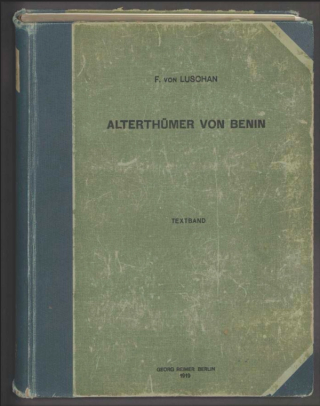
Die Altertümer von Benin
Date
January 1, 1919 at 12:00:00 AM
An archival document representing a Scans of published works of 529 page(s)
Scan of published worksMuseum Catalogue
Nationaal Museum van Wereldculturen and Wereldmuseum
Die Benin-Sammlung des Reichsmuseums für Volkenkünde in Leiden
Date
January 1, 1913
An archival document representing a Photograph Album of 2 page(s)
Photograph Album
British Museum
W. D. Webster photograph album
Date
January 1, 1898 to December 31, 1899

Institution data

Nationaal Museum van Wereldculturen and Wereldmuseum
The data was transferred directly by the institution.
Last updated: 2022-07-19
Language: dutch
Institution fieldValue
Inventarisnummer
object id
RV-1243-16
Objectnaam
designation
object type
Reliëfplaat
Titel
designation
object type
Reliëfplaat met hofdignitaris
Associatie/beschrijving (online getoond)
description
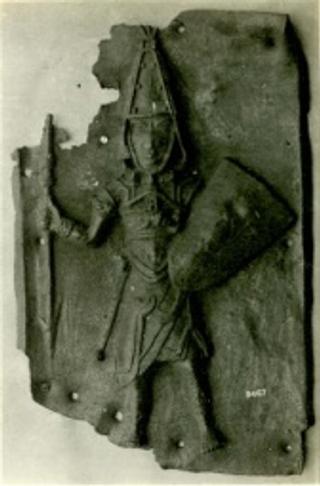
Reliëfplaat van een krijger met uitvoerige wapenrusting; hij draagt een schild, helm en speer. De pilaren van het paleis van de koning, de Oba, waren van onder tot boven met bronzen reliëfplaten bekleed. Deze werden met grote spijkers vastgezet. Nederl
Materiaal en techniek (NB: ook thesaurustermen aanpassen!)
material
Brons ; verlorenwastechniek
Afmetingenlabel (H x B x D)
dimensions
45,3 x 30,3 cm 46 x 30,3 x 5,5 cm
Datering
date made
17e eeuw
Verzamelgeschiedenis (toelichting)
provenance
The acquisition of 53 Benin objects (RV-1243-1 to -46 and RV-1295-2 to -7) from William Downing Webster (1868-1913), a British ethnographic art dealer and collector, known to have assembled a large collection from the Benin military campaign of 1897, is characterised by budgeting issues (Waterfield & King 2006: 55-63). When Johannes Schmeltz received a first letter from Webster on 7 December 1899 with a list of Benin objects offered for sale, he realised it would need fundraising on his part to acquire this important collection (NL-LdnRMV-A1-30-542/545). Schmeltz managed to secure funds from, amongst others, Her Majesty the Queen of the Netherlands, Queen Wilhelmina, and the Queen Mother, Princess Emma van Waldeck-Pyrmont. The Queen Mother’s secretary sent a letter to Schmeltz confirming the donation for the purchase of the Benin objects on 8 June 1900 (NL-LdnRMV-A1-31-344/345; CL-L: Nl- LdnRMV_A01_277_00109; AR-L 1899-1900: 13; MR-L: NL-LdnRMV_A03_007_0237). All the financial donors were listed in the Nederlandsche Staatscourant, the Dutch national state newspaper on 25 April 1902. While on 16 February 1900 Schmeltz writes to Webster that he wants ‘the greatest part’ of the objects offered to him but that he has not yet found the money to pay for them (NL-LdnRMV-A1-210-531/534), the first purchase of 30 objects was confirmed in the day book on 26 February 1900 and included one object from the Admiralty Islands (DB-L: NL-LdnRMV-A3-7-237). In a letter to Schmeltz dated 17 February 1900, Webster includes a newspaper clipping mentioning that he bought the objects at the J.C. Stevens auction. By doing this, he also gives evidence of the current prices of Benin objects (NL-LdnRMV-A1-31-505/506). All the objects that had been sent to the Netherlands for viewing and had not been selected were sent back. Also, some of the objects were first registered as loans, allowing Schmeltz to secure the funds to buy them as they were considered important: ‘From the objects still on loan some deserve to be mentioned here already as especially noteworthy.’ Two men, Elco M. Vis and R. Langenbach enabled the procurement of some loan objects: ‘Because of the gentlemen Elco M. Vis in Amsterdam and R. Langenbach in Worms, yours truly was able to once more purchase one of the objects on loan from the Kingdom of Benin [serie 1243].’ The plates in the annual report show that Schmeltz, used the donations to acquire Webster collections (series RV-1243) and Umlauff collections (series RV-1286, series RV-1310) as the money became available, irrespective of which artworks he had received on view first. (Excerpt from Provenance no. 2 'The Benin collections at the National Museum of World Cultures' written by Rosalie Hans with Annette Schmidt, 05-01-2021)
Cultuur (NB: ook thesaurusterm aanpassen!)
ethnic attribution
Bini
Deelcollectie
department and institution
Materiële cultuurcollectie
Verwervingsdatum
accession date
1900-02-01
Wijze van verwerving
accession method
Aankoop
Literatuur
bibliography
Ezra, K., 'Royal Art of Benin; the Perls collection in the Metropolitan Museum of Art'. New York, 1992.
Publicaties over het object
bibliography
Bedaux, R.M.A. 1990 De geschiedenis van de Leidse Benin-verzameling. In: A. Duchâteau, Benin: vroege hofkunst uit Afrika. Brussel: 14 en 161. Marquart, J., 'Die Benin-Sammlung des Reichsmuseums für Völkerkunde in Leiden'. Veroffentlichungen des Reichsmuseums für Völkerkunde in Leiden. Serie II nr. 7. Leiden: Brill, 1913. For more information about the provenance, see <a href="https://issuu.com/tropenmuseum/docs/2021_provenance_2__benin__e-book" target="_blank"> Provenance #2 – the Benin collections at the National Museum of World Cultures </a> (NB: Issuu uses cookies).
Objectstatus
legal status
Eigendom
Met dank aan (online getoond)
Periode (NB: ook thesaurusterm aanpassen!)
Benin
Verkorte naam
AFRIK
Sensitive Content

Digital Benin collates digital material from institutions, and some of this material is inherently colonial and contains words, terms and phrases that are inaccurate, derogatory and harmful towards African and African diasporic communities. Catalogue transcriptions, book titles, exhibition titles and museum titles may contain harmful terms. We recognise the potential for the material to cause physical and mental distress as well as evoke strong emotions. Owing to the scale of the collection’s data, a process to implement sensitive-content warnings in the displayed data is still incomplete. The material within the catalogue does not represent Digital Benin’s views. Digital Benin maintains a strong anti-colonial, anti-racist position and affirms its support for centring the humanity of historically marginalised and disenfranchised communities. Read more about the background of this statement here