

OBJEKTE_ID
1713225
Edo designations
English designations
Relief Plaque
Categories
Palace Architecture & Ornamentation
Location
Johannispl. 5-11, 04103 Leipzig, Germany
Loading...

Iconographies

11 annotations
leopard teeth
Akọn Ẹkpen
Leopard Teeth Neck Ornament

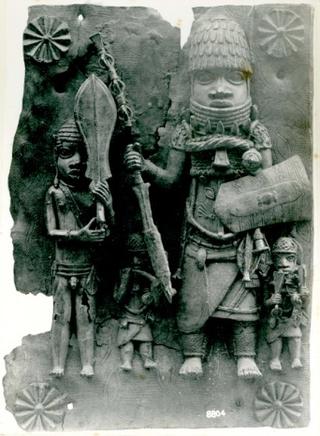
Akọn Ẹkpẹn are necklaces or neck ornaments made of strung leopard’s teeth. They are worn by figures to signify their high rank and military prowess, as well as by their leaders, the Ezọmọ or Iyasẹ. They are often worn alongside quadrangular Ẹroro (bells) and Ohian Ẹkpẹn (leopard tunics).

The Akọn Ẹkpẹn is clearly and profoundly related to the symbolism of the Ẹkpẹn (leopard) and its association with the Ọba (king), who is metaphorically referred to as ‘ẹkpẹn ne owa’, the ‘leopard of the home’. On the other hand, the Ẹkpẹn is often referred to as the ‘king of the bush’, embodying ferocity, aggression, strength, and leadership—qualities attributed to the Ọba (Nevadomsky 1988). This intricate link between the leopard, the monarch, and his military leaders reinforces the complex hierarchy and spiritual authority central to Benin’s courtly art.

1 annotation
Akọn Ẹkpen
Iviawẹ
Stacked Beaded Anklet

Ọba gha ye Ivie gie ọwan, ẹ ghi tama rẹn ehe nọ gha bae yi (When the Ọba gifts you a bead, he doesn’t tell you how to wear it) (Daniel Inneh, pers. comm., 27 September 2025).

Iviawẹ (also spelled ĺvîowẹ) are coral-beaded anklets, often worn stacked together (Aigbe 1985, p. 28; Okpokunu, Agbontaen-Eghafona & Ojo 2005, p. 162; Ọbazee 2025, p. 279). Many of the figures depicted on the Emwin Arhe (royal treasures) in brass, bronze, ivory, and wood are shown wearing these. According to Daniel Inneh (pers. comm., 27 September 2025), beads were sent to people whom the Ọba wished to honour, although there was no directive on how to wear them.

Mostly, people who wear Iviawẹ are identified as palace chiefs or priests and priestesses. However, today anyone can wear them as cultural identifiers or fashion pieces.

1 annotation
Iviawẹ
Ẹroro
Bell

Ẹroro (bells) frequently appear as ornaments worn by figures depicted on the Emwin Arhe, particularly on Ama-Eronmwon (bronze relief plaques) and Aken’ni Elao (carved tusks). These Ẹroro are most commonly quadrangular in form or, less commonly, cylindrical with rounded tops. Quadrangular Ẹroro worn around the neck are often part of the attire that indicates that figures can be interpreted as warriors, alongside the Akọn Ẹkpẹn (leopard tooth neck ornament) and the Ohian Ẹkpẹn (leopard tunics).

1 annotation
Ẹroro
Asa
Shield

Asa (shields) are a crucial attribute of warriors and warrior chiefs, forming part of their ceremonial and battle attire as represented on the Emwin Arhe (royal treasures). Asa were usually made from elephant or crocodile skin and used by warriors for protection during hand-to-hand combat (Osadolor 2001, p. 102). Interestingly, the form of Asa depicted on historic royal artefacts differs from those found in museum collections today, reflecting changes in shield shapes and designs over time.

1 annotation
Asa
Ẹbẹn
Ceremonial Sword

Ẹbẹn are a type of ceremonial sword of significant importance in the Benin Kingdom. During ceremonies, titled chiefs would hold them or toss them during dances, thereby paying homage to the Ọba at these public events, particularly when a chief receives a certain status. It is forbidden for Ẹbẹn to touch the ground, so the chief must take extra precautions to avoid dropping the Ẹbẹn during the dance. Therefore, the Okae-Odionmwan (head of executioners) dances with the Umozo (warfare or executioner’s sword) behind the dancing chief.

There are two central ceremonial swords used in the royal court of the Benin Kingdom, one of which is the Ẹbẹn, along with the Ada (ceremonial swords). They are distinguished by their blades: the Ẹbẹn blade reflects the shape of a leaf or an oar. Sometimes, it is decorated with openwork designs and/or brass inlays, most commonly shaped as small Ẹbẹn and Ẹkpẹn (leopards). The handle of the Ẹbẹn also has an unusual ring-shaped form, which further differentiates it from the Ada.

1 annotation
Ẹbẹn
Colar Bead
Odigba
Coral beaded collar

Odigba (coral-beaded collar) is a rigid neck collar made of coral beads, worn as part of ceremonial attire only by senior princes who have been made Enigie (Inneh 2007, p. 107). Although Ibafe (2007, p. 43) argued that the Odigba was introduced during the Ogiso period (c. 900–c. 1170 AD) by Ogiso Ere, along with other symbolically important Emwin Arhe, such as the Ada (ceremonial sword) and the Ẹbẹn (ceremonial sword), this seems unlikely, as coral was only introduced in the late 15th century through trade with Portuguese merchants.

1 annotation
Odigba
Uko ugbo-ohamwen
Fortified chest band

Uko ugbo-ohamwen is a chest band often worn around the chests of warriors depicted on the Ama-Ẹrọnmwọn (relief plaques) and is fortified with charms. The band was worn to increase the strength and endurance of warriors ( ). This fortified chest band has also been referred to as ukugba olila (Ine n’Igun in Bradbury 1959, B.S. 245; ; ).

1 annotation
Uko ugbo-ohamwen
Owẹn iba ẹdẹ ku
Rosette - 'The Sun Never Misses a Day'

This rosette design, usually found in the corners of Ama-Ẹrọnmwọn (bronze relief plaques), is one of two motifs representing the sun and one of a number of motifs in Edo art that are also connected with Olokun. The association between the sun and Olokun refers to the way in which the sun descends into the sea each day—hence the proverb ‘the sun never misses a day’—and the sea is where the deity Olokun lives ( ).

1 annotation
Owẹn iba ẹdẹ ku
Water fern
Ebe Amẹ
Water Fern

Ebe Amẹ refers to a wide variety of plants, particularly the leaves of the water fern or river leaf, found in riverine areas of southern Nigeria ( ). Artists from the Igun-Ẹrọnmwọn used these as a decorative motif in the background of most Ama-Ẹrọnmwọn (bronze relief plaques). The petals of the Ebe Amẹ, like the points of the ἀghàdàgháda (crossroads), represent the four cardinal directions: north, east, south, and west. The number four plays a foundational role in the Edo calendar, which is structured around four market days ( ).

1 annotation
Ebe Amẹ
Asoro
Spears

Asoro (spears) were used as weapons in battle and for hunting ( ; Ọbazee 2025, p. 37). According to , there were two types: long and short. Figures holding Asoro are often depicted on Ama-Ẹrọnmwọn (bronze relief plaques), sometimes in battle scenes and at ceremonies and festivals.

1 annotation
Asoro
Ẹgogo
Gong

Ẹgogo (gongs) hold significant importance in Benin art and ritual, serving as powerful instruments with both practical and symbolic roles. Ivory gongs, especially “double-bell” types, were highly prized and reserved for the royal court, particularly those made entirely of ivory, which were used exclusively by the Ọba. The whiteness of ivory Ẹgogo symbolises purity and peace and is linked to sacred Orhue (white kaolin chalk) and the deity Olokun (Blackmun 2007, cat. no. 60, p. 315).

When depicted in the imagery of the Emwin Arhe (royal treasures), Ẹgogo are usually held by figures such as the Ọba or high-ranking chiefs, illustrating their historical and ongoing use as idiophones during ceremonies and festivals. The Ọba dances with an ornately carved ivory Ẹgogo during the Emobo festival, which takes place three days after the Iguẹ festival (Ben-Amos 1995, p. 108).

1 annotation
Ẹgogo

Provenance

5 events
Production
1504 (approximate) to 1550 (approximate)
The object was produced by Unknown member(s) of the Igun-Ẹrọnmwọn guild in Benin City.
Looted
February 22, 1897 (day approximate) to June 1899 (year approximate)
The object was looted by Unknown member of the British colonial military campaign on Benin - February 1897 from Benin Kingdom.
Unknown
February 22, 1897 (day approximate) to 1899
The object is known to have come into contact with William Downing Webster, later in Bicester.
Purchase
1899
The object was purchased by Arthur Baessler from William Downing Webster from Bicester to Berlin.
Donation
1899
The object was donated by Arthur Baessler to the Staatliche Ethnographische Sammlungen Sachsen und Staatliche Kunstsammlungen Dresden from Berlin to Dresden.

Related archival documents

3 documents
See all
Museum Catalogue
Staatsbibliothek zu Berlin
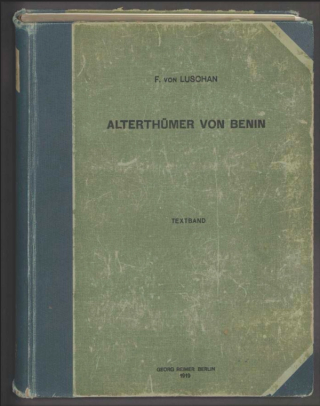
Die Altertümer von Benin
Date
January 1, 1919 at 12:00:00 AM
An archival document representing a Inventories of 404 page(s)
Inventory
Museum of New Zealand Te Papa Tongarewa
Stock books
Date
January 18, 1897 to March 26, 1900
An archival document representing a Photograph Album of 2 page(s)
Photograph Album
British Museum
W. D. Webster photograph album
Date
January 1, 1898 to December 31, 1899

Institution data

Staatliche Ethnographische Sammlungen Sachsen und Staatliche Kunstsammlungen Dresden
The data was transferred directly by the institution.
Last updated: 2021-09-28
Language: german
Institution fieldValue
INV_NR
object id
16137
OBJEKTE_ID
object id
1713225
KURZTITEL
designation
Reliefplatte Militärischer Anführer
Object-name-and-materials
designation
material
Reliefplatte Militärischer Anführer mit Begleitern Gelbguss
TITEL
designation
Reliefplatte Militärischer Anführer mit Begleitern;Bronzeplatte mit 2 Figuren, Krieger mit Federhelm und Begleiter
INTERNETKOMMENTAR
description
notes
Hohe militärische Anführer zeichnen sich durch eine zeremonielle Ausrüstung und spezielle Insignien aus. Sie tragen als Kennzeichen ihres Ranges eine rechteckige Glocke als Schutzsymbol und zur Signalgebung auf der Brust, außerdem einen Schurz mit Leopardenabbild oder eine Halskette mit Leopardenzähnen, die Zeichen von Aggressivität zur Abschreckung des Feindes und zugleich magische Schutzmittel sind. (MVD, S. D.)
KATALOGTEXT
description
MATERIAL
material
Metall;Bronze
MASSEBEMERKUNG
dimensions
47,5 x 33,0 x 8,0 cm; 9750 g|47,5 x 33 cm (lt. Karteikarte)
MASSETABANGABE
dimensions
Gesamt
MASSETABBEMERKUNG
dimensions
MASSETABBREITE
dimensions
34,5
MASSETABDURCHMESSER
dimensions
MASSETABEINHEITLAENGE
dimensions
cm
MASSETABEINHEITLAENGE_IDS
dimensions
1
MASSETABHOEHE
dimensions
47,5
MASSETABTIEFE
dimensions
8
Dimensions_weight
weight
H: 47,5 cm W: 33 cm
MASSETABEINHEITGEWICHT
weight
g
MASSETABEINHEITGEWICHT_ID
weight
8
MASSETABGEWICHT
weight
9750
OBJEKTBEZ
object type
Plastik
KONVOLUT
provenance
object count
Sammlung Arthur Baessler; SES Benin-Objekte; William D. Webster, London; SES Dossier Benin-Objekte, Überlieferung an die Kontaktstelle für Sammlungsgut aus kolonialen Kontexten
ORT_DATUM_BIS
date made
1897;1899
ORT_DATUM_KONKRET
date made
';'
ORT_DATUM_VON
date made
;
MATTECHBEMERKUNG
production technique
Gelbguss
TECHNIK
production technique
gegossen
ORTE
production place
Federal Republic of Nigeria;Benin City
ORTZEITBEMERKUNG
production place
Königreich Benin, vor 1897
Ort_Zeit-Bemerkung
production place
Königreich Benin, vor 1897
REGIONEN
production place
Benin
Collector/Previous-owner
prior source
Arthur Baessler, Berlin, purchased from William D. Webster, London, in 1899
ERWERBUNG
prior source
Schenkung 1899 von Arthur Baessler, Berlin
PERSON
prior source
unbekannt;Baessler, Arthur;Webster, William Downing
Acquisition-Details
provenance
Donated by Arthur Baessler, Berlin
EIGENTUEMER
provenance
SES/Freistaat Sachsen
PROVENIENZ
provenance
William D. Webster, London (bis 1899); Arthur Baessler, Berlin (erworben 1899 von William D. Webster, bis 1899)
PROVENIENZSTATUS
provenance
SKD-Eigentum
EREIGNISSE
event
Herstellung;Provenienz;Provenienz
ETHNIEN
ethnic attribution
Institution
department and institution
Staatliche Ethnographische Sammlungen Sachsen - Museum für Völkerkunde Dresden
MUSEUM
department and institution
MVD
Institutional-acquisition-date
accession date
1899
Comments
notes
Arthur Baessler, 1857-1907, German Ethnologist and Athropologist; William Downing Webster, 1868-1913, English Dealer and Collector of Ethnographica
PRAESENZ
display status
nicht ausgestellt
BIBLIOGRAPHIE
bibliography
Silvia Dolz: Schätze aus Afrika: Benin. Die Schenkung Baessler [Ausst.Kat.]. Dresden, 2006|Luschan, Felix von: Die Altertümer von Benin. 3 Bd. In: Veröffentlichungen aus dem Museum für Völkerkunde, Staatliche Museen zu Berlin, Bd. VIII-X. Berlin/Leipzig, 1919
ERWAEHNTIN
bibliography
MVD, 2006, S. 23 u. Abb. 33|Luschan, 1919, S. 102 Abb. 184
LITERATUR
bibliography
Gunsch, K.W.: The Benin Plaques: A Singular Monument. in: Art. N° 88 Summer 2018. S. 98-113|
LIT_LITERATUR
bibliography
Deimel 2006 [Schätze aus Afrika, ...];Luschan 1919;Wysocki Gunsch 2018;Gunsch 2018
BILDUNTERSCHRIFT
images
Übernahme Altdaten|Region original: Großregion => Westafrika; Land => Nigeria; Gebiet => Benin|Ethnie original: kein Eintrag|Region bei Datenübergabe: Afrika>Westafrika>Nigeria>Benin
ALTINVENTARE
AUTHENTIZITAETSZUSATZ
;;
AUTHZUSAETZE_IDS
;;
Additional-IDs
8804 (original number)
Dokumentname
16137_2
EREIGNISSE_IDS
12;15;15
ETHNIEN_IDS
ETH_AUTHZUSAETZE
ETH_AUTHZUSAETZE_IDS
ETH_EREIGNISSE
ETH_EREIGNIS_IDS
FERTIG
1
FLAG
EXP
FOTOFELD
ja|Neg.Tasche Nr. 323/7,8
FUNKTION
Hersteller;Schenker;Händler
GEAENDERT_AM
14.06.2021
GLEICHRANGIG
GND_ID_OBEZ
22955
GND_ID_SCHLAGWORT
118242;22976;24148;94811
GRUNDDATEN
1
INTERNETFREIGABE
1
INVENTURDATUM
INVNR_MERKMALE_IDS
581
KONVOLUTE_IDS
582;959;1409;1191
KOORDINATEN
(10 8);(6,33504 5,62749)
LEIHVERKEHR
LIT_ABBILDUNG
33;184;Fig. 6.34; 6.67 3A;
LIT_BAND_SEITE
Seite 42;S. 102;S. 138, S. 178;S. 98-113
LIT_BEMERKUNG
farbig;;s/W;
LIT_LITERATUR_IDS
821;703;3121;2783
LIT_NUMMERE
;;;
LIT_STA_INETFREIGABE
1;1;1;1
MAND_ID
1
MATERIALIEN_IDS
1233;1116
MERKMAL
Originalnummer
MUSEEN_ID
35
ORTE_IDS
2328926;2347283
ORT_AUTHZUSAETZE
;
ORT_AUTHZUSAETZE_IDS
;
ORT_BEZUG
;
ORT_EREIGNISSE
Herstellung;Erwerbung
ORT_EREIGNISSE_IDS
12;9
PND_BEZUG
;;
PND_FUNKTIONEN_IDS
-2;133;645
PND_INETFREIGABE
1;0;1
PND_PERSONEN_IDS
12797488;12106249;12821279
PRAESENZEN_WERT_ID
-67
PROVSTATUS_WERT_ID
-43
REGIONEN_IDS
612
REG_EREIGNISSE
Erwerbung
REG_EREIGNIS_IDS
9
SAMMLUNG
Afrika
SAMMLUNGEN_ID
535
SCHLAGWORT
Krieger;Platte;Relief;Waffe <Motiv>
TECHNIKEN_IDS
75
UNTERGEORDNET
VORLAGEN
WEITERE_NUMMERN
8804
WISSENSCHAFT
1
XRAY
###
Sensitive Content

Digital Benin collates digital material from institutions, and some of this material is inherently colonial and contains words, terms and phrases that are inaccurate, derogatory and harmful towards African and African diasporic communities. Catalogue transcriptions, book titles, exhibition titles and museum titles may contain harmful terms. We recognise the potential for the material to cause physical and mental distress as well as evoke strong emotions. Owing to the scale of the collection’s data, a process to implement sensitive-content warnings in the displayed data is still incomplete. The material within the catalogue does not represent Digital Benin’s views. Digital Benin maintains a strong anti-colonial, anti-racist position and affirms its support for centring the humanity of historically marginalised and disenfranchised communities. Read more about the background of this statement here