

OBJEKTE_ID
1800230
Edo designations
English designations
Relief Plaque
Categories
Palace Architecture & Ornamentation
Location
Johannispl. 5-11, 04103 Leipzig, Germany
Loading...
Relief Plaque
Relief Plaque

Iconographies

10 annotations
Ikharo
Forehead markings

Ikharo are linear keloid markings depicted on the forehead of Uhunmwu-Elao (commemorative heads) in groups of three or four above each eye. The exact meaning of Ikharo is debated; some have argued that they relate to the gender or tribal identification of the person on whom they are depicted. For example, has argued that they were worn only by men; however, their use in depictions is not consistent with this, and the Iy’Ọba are also shown wearing them. argued that they are instead a stylistic feature employed by artists that varied over time.

The naming of these markings differs between publications. For example, describe these markings as “agbaguda n'ehae”, which they write translates literally as “blades of the forehead”. However, later went on to call these “ikharo”, as used here. referred to these forehead markings as ikharo, meaning “tribal mark [of eye]”.

1 annotation
Ikharo
Asa
Shield

Asa (shields) are a crucial attribute of warriors and warrior chiefs, forming part of their ceremonial and battle attire as represented on the Emwin Arhe (royal treasures). Asa were usually made from elephant or crocodile skin and used by warriors for protection during hand-to-hand combat (Osadolor 2001, p. 102). Interestingly, the form of Asa depicted on historic royal artefacts differs from those found in museum collections today, reflecting changes in shield shapes and designs over time.

1 annotation
Asa
Ẹbẹn
Ceremonial Sword

Ẹbẹn are a type of ceremonial sword of significant importance in the Benin Kingdom. During ceremonies, titled chiefs would hold them or toss them during dances, thereby paying homage to the Ọba at these public events, particularly when a chief receives a certain status. It is forbidden for Ẹbẹn to touch the ground, so the chief must take extra precautions to avoid dropping the Ẹbẹn during the dance. Therefore, the Okae-Odionmwan (head of executioners) dances with the Umozo (warfare or executioner’s sword) behind the dancing chief.

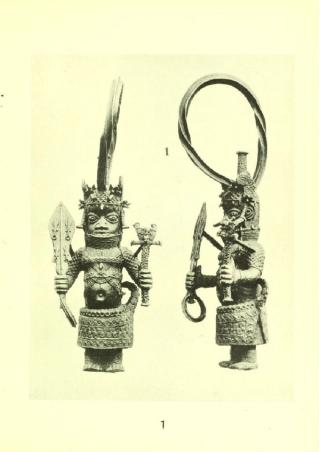
There are two central ceremonial swords used in the royal court of the Benin Kingdom, one of which is the Ẹbẹn, along with the Ada (ceremonial swords). They are distinguished by their blades: the Ẹbẹn blade reflects the shape of a leaf or an oar. Sometimes, it is decorated with openwork designs and/or brass inlays, most commonly shaped as small Ẹbẹn and Ẹkpẹn (leopards). The handle of the Ẹbẹn also has an unusual ring-shaped form, which further differentiates it from the Ada.

1 annotation
Ẹbẹn
hairstyles
Eto
hairstyles

Hairstyles are used to determine a person's status in the society, as chiefs, common folks, chief's wives and the wives of the Ọba all wear different hairstyles. We have Okuku, Ikpe~okhokho, Idu~akpata

1 annotation
Eto
leopard teeth
Akọn Ẹkpen
Leopard Teeth Neck Ornament

Akọn Ẹkpẹn are necklaces or neck ornaments made of strung leopard’s teeth. They are worn by figures to signify their high rank and military prowess, as well as by their leaders, the Ezọmọ or Iyasẹ. They are often worn alongside quadrangular Ẹroro (bells) and Ohian Ẹkpẹn (leopard tunics).

The Akọn Ẹkpẹn is clearly and profoundly related to the symbolism of the Ẹkpẹn (leopard) and its association with the Ọba (king), who is metaphorically referred to as ‘ẹkpẹn ne owa’, the ‘leopard of the home’. On the other hand, the Ẹkpẹn is often referred to as the ‘king of the bush’, embodying ferocity, aggression, strength, and leadership—qualities attributed to the Ọba (Nevadomsky 1988). This intricate link between the leopard, the monarch, and his military leaders reinforces the complex hierarchy and spiritual authority central to Benin’s courtly art.

1 annotation
Akọn Ẹkpen
tribal marks
Iwu
Facial and Body Markings

Iwu are facial and body markings (scarifications) that were historically worn by Edo men and women. However, since the 1960s, the practice has been nearly extinct (Aisien 2011). In the past, Iwu were used as a way of proving that one was an Edo citizen, and the ceremony of having Iwu completed was an important rite of passage for men and women. The Osiwu, who also practised circumcision and other surgical procedures, would carry out the procedure of adding Iwu. There are different types of Iwu: ‘blades’ worn on the torso (Iwu-eko), and those worn on the face, such as Ikharo (three or four markings above the eyebrows), Irho (two narrow ‘blades’ worn on each cheek), Ovbihue (nasal ‘blades’), Ovbi-agbanmwen (chin ‘blade’), and Igho-okpa/Ukpgho (three forehead ‘blades’) (Aisien 2011, p. 22).

The number of Iwu also varied depending on the identity of the person wearing them. For example, royal men would wear six ‘blades’ on their torso, whilst men who were not royal would wear seven ‘blades’. Meanwhile, the Ọba’s female children would wear fifteen ‘blades’, and all other women would wear sixteen (Aisien 2011).

1 annotation
Iwu
TBC_Warrior figure
Warrior

The frequency with which Benin warriors are depicted in Emwin Arhe (royal treasures) reflects the importance of the army and military to the Kingdom, as well as the role of royal art as an archive in which artists from the palace guilds recorded important people, events, and institutions. The army was organised into a number of regiments, with soldiers grouped according to the weapons they used, including archers, swordsmen, crossbowmen, and spearmen ( ).

Warrior figures are frequently shown carrying weapons such as Asa (shields), Asoro (spears), warfare swords such as the Umozo or Ọhọ (executioners’ or warfare swords), Uhanbọ (bows), Ẹkpẹde (crossbows), and Ifẹnmwẹ (arrows), which were sometimes poisoned, as well as Osisi (firearms). Their dress also provides important indications of their military role. On both the Aken'ni Elao (carved tusks) and Ama-Ẹrọnmwọn (bronze relief plaques), warriors are depicted in a relatively standardised form, typically wearing an Ohian Ẹkpẹn (leopard tunic), Akọn Ẹkpen (leopard’s tooth neck ornament), an Ẹroro pendant around the neck, and the Uko ugbo-ohamwen (fortified chest band) ( ).

Differences are particularly apparent in the warriors’ headwear, both between individual figures and between representations on Aken'ni Elao and Ama-Ẹrọnmwọn. On the Ama - Eronmwon, the most common forms of headwear are crocodile-hide helmets and horsetail helmets with a front plate ( ). On the Aken'ni Elao, some warriors wear double-horned helmets ( ), while others wear simple rounded hats or helmets ( ). The most frequently represented warrior type on the tusks, however, wears a helmet with cowries sewn onto a front panel ( ).

1 annotation
TBC_Warrior figure
Owẹn iba ẹdẹ ku
Rosette - 'The Sun Never Misses a Day'

This rosette design, usually found in the corners of Ama-Ẹrọnmwọn (bronze relief plaques), is one of two motifs representing the sun and one of a number of motifs in Edo art that are also connected with Olokun. The association between the sun and Olokun refers to the way in which the sun descends into the sea each day—hence the proverb ‘the sun never misses a day’—and the sea is where the deity Olokun lives ( ).

1 annotation
Owẹn iba ẹdẹ ku
Water fern
Ebe Amẹ
Water Fern

Ebe Amẹ refers to a wide variety of plants, particularly the leaves of the water fern or river leaf, found in riverine areas of southern Nigeria ( ). Artists from the Igun-Ẹrọnmwọn used these as a decorative motif in the background of most Ama-Ẹrọnmwọn (bronze relief plaques). The petals of the Ebe Amẹ, like the points of the ἀghàdàgháda (crossroads), represent the four cardinal directions: north, east, south, and west. The number four plays a foundational role in the Edo calendar, which is structured around four market days ( ).

1 annotation
Ebe Amẹ
Ukpan obọ ọkpa
Single Beaded Baldric

Ukpan obọ ọkpa is a single baldric worn diagonally across the torso, from the left shoulder to the right hip. Barbara Blackmun described these baldrics as an “Ẹkpẹn band,” worn by figures as “a sign of distinction” ( ).

1 annotation
Ukpan obọ ọkpa

Provenance

9 events
Production
1504 (approximate) to 1550 (approximate)
The object was produced by Unknown member(s) of the Igun-Ẹrọnmwọn guild in Benin City.
Looted
February 22, 1897 (day approximate) to June 1899 (year approximate)
The object was looted by Unknown member of the British colonial military campaign on Benin - February 1897 from Benin Kingdom.
Unknown
February 22, 1897 (day approximate) to 1913
The object is known to have come into contact with William Downing Webster, later in London.
Purchase
February 22, 1897 (day approximate) to 1913
The object was purchased by Hans Meyer from William Downing Webster from London to Leipzig.
Loan
1900s to 1929
The object was loaned by Hans Meyer to the Staatliche Ethnographische Sammlungen Sachsen und Staatliche Kunstsammlungen Dresden in Leipzig.
Inheritance
1929
The object was inherited by Elisabeth Meyer from Hans Meyer in Leipzig.
Long-term loan
1929 to 2001
The object was placed on long-term loan from Elisabeth Meyer to the Staatliche Ethnographische Sammlungen Sachsen und Staatliche Kunstsammlungen Dresden in Leipzig.
Inheritance
1946
The object was inherited by Meyer community of heirs from Elisabeth Meyer in Leipzig.
Purchase
2001
The object was purchased by the Staatliche Ethnographische Sammlungen Sachsen und Staatliche Kunstsammlungen Dresden from Meyer community of heirs through Ernst von Siemens Kunststiftung, City of Leipzig, Free State of Saxony and Kulturstiftung der Länder in Leipzig.

Related archival documents

4 documents
See all
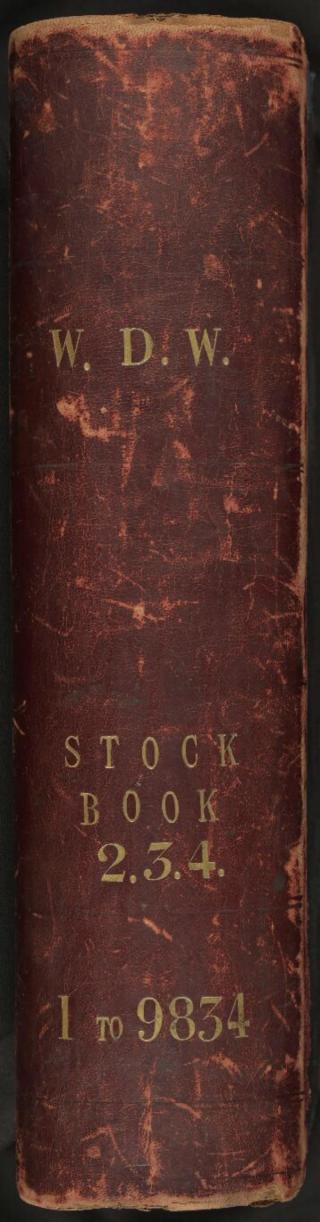
An archival document representing a Inventories of 404 page(s)
Inventory
Museum of New Zealand Te Papa Tongarewa
Stock books
Date
January 18, 1897 to March 26, 1900
An archival document representing a Photograph Album of 2 page(s)
Photograph Album
British Museum
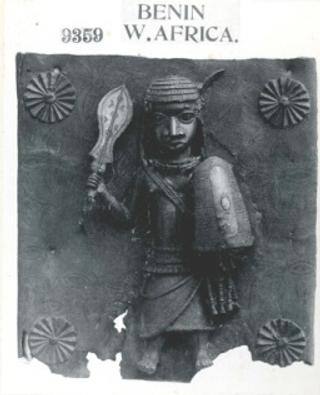
W. D. Webster photograph album
Date
January 1, 1898 to December 31, 1899
An archival document representing a Sales Catalogs of 46 page(s)
Sales Catalogue
Wellcome Collection
Catalogue of ethnological specimens : European and Eastern arms & armour, Prehistoric and other curiosities / W.D. Webster, Oxford House, Bicester, Oxon., England.
Date
January 1, 1900 to December 31, 1900

Institution data

Staatliche Ethnographische Sammlungen Sachsen und Staatliche Kunstsammlungen Dresden
The data was transferred directly by the institution.
Last updated: 2021-09-28
Language: german
Institution fieldValue
INV_NR
object id
MAf 34588
OBJEKTE_ID
object id
1800230
KURZTITEL
designation
Reliefplatte
Object-name-and-materials
designation
material
Reliefplatte: Chief Gelbguss
TITEL
designation
Reliefplatte: Chief
INTERNETKOMMENTAR
description
notes
Die Reliefplatte ist Bestandteil des kulturellen und künstlerischen Erbe des vermutlich 800jährigen Königreiches von Benin. Das Königreich, welches auf dem Gebiet des heutigen südwestlichen Nigeria gelegen hat, wurde 1897 von den Briten erobert und die höfischen Kunstwerke gelangten als Kriegsbeute nach Europa. Bronzene Reliefplatten überzogen die Säulen des Palastes des Oba in Benin City. Die Tafeln zeigen Aspekte des höfischen Lebens und sind Zeugen der Geschichte des Königreiches. Dargestellt ist hier ein Krieger, der in seiner rechten Hand das Zeremonialschwert eben hält und in seiner linken ein Schild. Sein Schurz ist mit geometrischen Mustern sowie mit Mond-, Blüten- und Tierkopfmotiven versehen. Er trägt einen breiten Hüftgürtel, der an seiner linken Hüftseite in drei Quasten mündet. Weitere Elemente des Körperschmucks sind eine Schärpe, eine Kette aus Leopardenzähnen um den Hals sowie der Perlenabschluss der Zöpfe seiner Frisur, wie auch eine Feder am Kopf. Den Hintergrund der Platte zieren florale Ornamente sowie vier Rosetten in den Ecken. Diese Kombination weist auf Olokun, den Gott des Wassers, hin. |(SB)
KATALOGTEXT
description
MATERIAL
material
Metall
MASSEBEMERKUNG
dimensions
42 x 38,5 x 8,5 cm
MASSETABANGABE
dimensions
MASSETABBEMERKUNG
dimensions
MASSETABBREITE
dimensions
38,5
MASSETABDURCHMESSER
dimensions
MASSETABEINHEITLAENGE
dimensions
cm
MASSETABEINHEITLAENGE_IDS
dimensions
1
MASSETABHOEHE
dimensions
42
MASSETABTIEFE
dimensions
8,5
Dimensions_weight
weight
H: 42 cm W: 38,5 cm X: 8,5 cm
MASSETABEINHEITGEWICHT
weight
MASSETABEINHEITGEWICHT_ID
weight
MASSETABGEWICHT
weight
OBJEKTBEZ
object type
Plastik
KONVOLUT
provenance
object count
SES Benin-Objekte; SES Dossier Benin-Objekte, Überlieferung an die Kontaktstelle für Sammlungsgut aus kolonialen Kontexten
ORT_DATUM_BIS
date made
1699;1897
ORT_DATUM_KONKRET
date made
';'
ORT_DATUM_VON
date made
1501;
MATTECHBEMERKUNG
production technique
Gelbguss
TECHNIK
production technique
gegossen
ORTE
production place
Federal Republic of Nigeria;Benin City
ORTZEITBEMERKUNG
production place
Königreich Benin, vor 1897, wohl 16./17. Jh.
Ort_Zeit-Bemerkung
production place
Königreich Benin, vor 1897, wohl 16./17. Jh.
REGIONEN
production place
Benin
Collector/Previous-owner
prior source
Hans Meyer
ERWERBUNG
prior source
Ankauf 2001 von Erbengemeinschaft Meyer mittels Finanzierungsverbund (u. a. Kulturstiftung der Länder, Freistaat Sachsen, BKM, Ernst von Siemens-Stiftung und Stadt Leipzig)
PERSON
prior source
unbekannt;Webster, William Downing;Meyer, Hans
Acquisition-Details
provenance
Purchased by Finanzierungsverbund (Kulturstiftung der Länder, der Freistaat Sachsen, usw.)
EIGENTUEMER
provenance
PROVENIENZ
provenance
Händler: W. D. Webster (bis ?); Sammler: Hans Meyer (bis 1929); Elisabeth Meyer (bis 1946); Erbengemeinschaft Meyer (bis 2001)
PROVENIENZSTATUS
provenance
EREIGNISSE
event
;;
ETHNIEN
ethnic attribution
Institution
department and institution
Staatliche Ethnographische Sammlungen Sachsen - GRASSI Museum für Völkerkunde Leipzig
MUSEUM
department and institution
MVL
Institutional-acquisition-date
accession date
2001
Comments
notes
Hans Heinrich Joseph Meyer, 1858-1929, German Explorer, Editor, Africanist, professor of colonial history in Leipzig
PRAESENZ
display status
ausgestellt
BIBLIOGRAPHIE
bibliography
'- Ben-Amos, 1980, S. 28-29; |- Duchâteau, 1993, 11b H. Meyer; |- Ezra, 1992, S. 127; |- Kecskési, 1982, S. 158; |- Nevadomsky, 1988, S. 75; |- Wolf, 1965, Tafel 15; |- Patrimonia 220, 2002, S. 118f.
ERWAEHNTIN
bibliography
'- Katalog Kunst aus Benin 1994, S. 81; |- KulturStiftung der Länder, Patrimonia 220, 2002, S. 118f.
LITERATUR
bibliography
Gunsch, K.W.: The Benin Plaques: A Singular Monument. in: Art. N° 88 Summer 2018. S. 98-113
LIT_LITERATUR
bibliography
Göbel 2002 [Kunst aus Benin - Sa...];Meyer 1994
BILDUNTERSCHRIFT
images
ALTINVENTARE
lfd. Nr. Leihliste: 53; Hans Meyer (s. L 1929/2)
AUTHENTIZITAETSZUSATZ
;;
AUTHZUSAETZE_IDS
;;
Additional-IDs
9359, 11 b (H. Meyer number)
Dokumentname
MAf 34588 Vorderseite
EREIGNISSE_IDS
;;
ETHNIEN_IDS
ETH_AUTHZUSAETZE
ETH_AUTHZUSAETZE_IDS
ETH_EREIGNISSE
ETH_EREIGNIS_IDS
FERTIG
0
FLAG
EXP
FOTOFELD
Neg.Af.Obj. 551 (mit Rahmen von Hans Meyer), 5842
FUNKTION
Hersteller;Händler;Sammler
GEAENDERT_AM
GLEICHRANGIG
GND_ID_OBEZ
22955
GND_ID_SCHLAGWORT
9470;118242;42159;20280;22955;24148
GRUNDDATEN
1
INTERNETFREIGABE
1
INVENTURDATUM
15.05.01;19.03.18
INVNR_MERKMALE_IDS
577;581;581;581;577;577
KONVOLUTE_IDS
959;1409
KOORDINATEN
(10 8);(6,33504 5,62749)
LEIHVERKEHR
LIT_ABBILDUNG
Tafel XXVIII;
LIT_BAND_SEITE
Bd.220/S.119;Seite 81
LIT_BEMERKUNG
schwarz-weiss;schwarz-weiss
LIT_LITERATUR_IDS
184;681
LIT_NUMMERE
;
LIT_STA_INETFREIGABE
1;1
MAND_ID
1
MATERIALIEN_IDS
1233
MERKMAL
Aktenstück;Originalnummer;Originalnummer;Originalnummer;Aktenstück;Aktenstück
MUSEEN_ID
34
ORTE_IDS
2328926;2347283
ORT_AUTHZUSAETZE
;
ORT_AUTHZUSAETZE_IDS
;
ORT_BEZUG
;
ORT_EREIGNISSE
Herstellung;Sammelereignis
ORT_EREIGNISSE_IDS
12;17
PND_BEZUG
;;
PND_FUNKTIONEN_IDS
-2;645;642
PND_INETFREIGABE
1;1;1
PND_PERSONEN_IDS
12797488;12821279;11145307
PRAESENZEN_WERT_ID
-38
PROVSTATUS_WERT_ID
REGIONEN_IDS
612
REG_EREIGNISSE
Sammelereignis
REG_EREIGNIS_IDS
17
SAMMLUNG
Afrika
SAMMLUNGEN_ID
534
SCHLAGWORT
Architektur;Krieger;Kunst;Mann;Plastik;Relief
TECHNIKEN_IDS
75
UNTERGEORDNET
VORLAGEN
WEITERE_NUMMERN
2001/14;9359 (Webster);11 b H. Meyer;1919/18 ;L 1929/2;1989/21
WISSENSCHAFT
1
XRAY
###
Sensitive Content

Digital Benin collates digital material from institutions, and some of this material is inherently colonial and contains words, terms and phrases that are inaccurate, derogatory and harmful towards African and African diasporic communities. Catalogue transcriptions, book titles, exhibition titles and museum titles may contain harmful terms. We recognise the potential for the material to cause physical and mental distress as well as evoke strong emotions. Owing to the scale of the collection’s data, a process to implement sensitive-content warnings in the displayed data is still incomplete. The material within the catalogue does not represent Digital Benin’s views. Digital Benin maintains a strong anti-colonial, anti-racist position and affirms its support for centring the humanity of historically marginalised and disenfranchised communities. Read more about the background of this statement here