


Provenance
Institution data
| Institution field | Value |
|---|---|
Registration number object id | Af1897,-.525.a-l |
Additional IDs object id | Af1897C3.525a-l (old CDMS no.) |
PRN object id | EAF14482 |
Object Type designation | arrow |
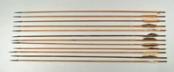
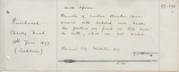
Description description | Group of twelve arrows with cane shafts, iron heads and feather fletching. |
Ethnic name (made by) ethnic attribution | Edo |
Date | 16thC - 19thC |
Findspot place collected | Found/Acquired: Benin City |
Materials material | cane ~iron ~feather |
Dimensions dimensions | Height: 61.00 cm (max) |
Curator’s comments provenance | Plankensteiner 2007 The crossbow known in Benin as ekpede was used by Benin warriors. It fired heavy arrows, which made it a significant weapon of war before the introduction of European firearms. It was predominantly used by archers who also carried weapons for hand-to-hand. Benin traditions claim that Ake of Ilobi of Isi, one of the deified heroes of Benin who lived during the reign of Oba Ewuare, who also invented the normal bow, was the creator of the crossbow as well. Possibly, the Benin model may have been invented by copying a Portuguese model, without being able to replicate the lock. Bows and arrows were well known locally, it was quite easy to transfer the technology to the manufacture of a simple crossbow. It is interesting to note though that on Benin artworks crossbows are only depicted as used by Poruguese soldiers. Arrows for crossbows, know in Benin as ifenmwen ekpede, were produced from treated wooden sticks with sharp pointed metal ends smeared with poisonous substances. The poison was made by a group of specialists who were versitile in preparing it from plants of harmful effects and venom. Such posion for arrow heads was fatal as it was intended to kill the enemy. |
Bibliographic references bibliography | Plankensteiner 2007: 251 |
Exhibition history exhibition history | Exhibited: 2007 May-Sept, Vienna, Museum für Völkerkunde, Benin. Kings and Rituals: Court Arts from Nigeria 2007-2008 Oct-Jan, Paris, Musée du quai Branly, Benin. Kings and Rituals: Court Arts from Nigeria 2008 Feb-May, Berlin, Staatliche Museen zu Berlin, Ethnologisches Museum, Benin. Kings and Rituals: Court Arts from Nigeria 2008 Jun-Sept, Chicago, The Art Institute of Chicago, Benin. Kings and Rituals: Court Arts from Nigeria 2024-2025, 17 Oct–9 Feb, London, BM, G35, 'Hew Locke: what have we here?' |
Associated events event | Associated Event: British Expedition to Benin City - Feb 1897 |
Acquisition name (acquisition) provenance | Major William Alexander Crawford Cockburn |
Acquisition date accession date | 18 June 1897 |
Acquisition notes (acquisition) provenance | The vendor served as Deputy Chief of Staff on the British expedition to Benin City, 1897. |
Acquisition notes (excavation) provenance | This object was looted from Benin City in 1897. |
Digital Benin collates digital material from institutions, and some of this material is inherently colonial and contains words, terms and phrases that are inaccurate, derogatory and harmful towards African and African diasporic communities. Catalogue transcriptions, book titles, exhibition titles and museum titles may contain harmful terms. We recognise the potential for the material to cause physical and mental distress as well as evoke strong emotions. Owing to the scale of the collection’s data, a process to implement sensitive-content warnings in the displayed data is still incomplete. The material within the catalogue does not represent Digital Benin’s views. Digital Benin maintains a strong anti-colonial, anti-racist position and affirms its support for centring the humanity of historically marginalised and disenfranchised communities. Read more about the background of this statement here