



Iconographies



Provenance
Institution data
| Institution field | Value |
|---|---|
object_number object id | 234 |
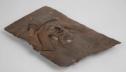
title designation object type | Plaque fragment representing a Portuguese soldier |
description description | Plaque fragment representing a Portuguese. West Africa, Nigeria: Benin. Middle period, mid 16th/mid 17th century. Bronze. h. 29.1 cm. Acquired 1971. Robert and Lisa Sainsbury Collection. UEA 234 |
free_field.content description | JA4613MH-234Digital photo (MD)This rectangular-shaped bronze plaque shows the facial image of a Portuguese soldier in raised relief. The helmet shows patterning and possible metal rivets. Hair is depicted either side of the face with evidence of vertical incised lines, together with a moustache and beard showing wavy incised lines. Facial features indicate European traits with slim lips and aquiline nose. Three holes in the top of the plaque indicate placement of nails for suspension. The background shows quatrefoil river leaf and dotted patterning. (VADS Helen Coleman) Plaques of this width were placed on the two narrow sides of the stout wood pillars on which the palace roofs were raised. The dimensions of these can be calculated from the two typical plaque sizes. One the same width as the present example, together with a wider one with side flanges, would accommodate a pillar of some eight by fifteen inches in section. Portuguese influence at Benin from about 1485 coincided with a time of great political and artistic development. The production of plaques flourished during the period of Portuguese contact and may have been inspired by books with illustrations. Since they came from across the sea, the Portuguese became associated with, or even generated, some of the complex of ideas linked up with Olokun, ruler of the seas and provider of earthly wealth through overseas trade in bronze manillas, coral beads and cloth, which were exchanged for pepper, ivory and slaves. By the beginning of the Middle periods (1550), Portuguese soldiers had become a kind of lay figure in art, who did honour to the Oba by their presence. They are depicted either full face or in profile, with straight hair, beard and moustache, aquiline nose and a helmet- perhaps officer types; infantrymen wear sixteenth- century uniforms and are beardless, usually with weapons such as matchlock guns or crossbows. Representations of Portuguese were often accompanied by Olokun symbols such as the quatrefoil as shown here; these were used by Olokun priestesses in curing rites. (Margret Carey. In: Steven Hooper (ed.), 1997, Catalogue to the Robert and Lisa Sainsbury Collection. University of East Anglia.) |
material material | Bronze |
dimension.free dimensions | h. 295 x w. 175 x d. 23 mm |
dimension.type dimensions | HeightWidthDepth |
dimension.unit dimensions | mmmmmm |
object_category object type | Relief (plaque)3D |
inscription.content inscriptions | Collection identification and object number |
inscription.method inscriptions | Silversafe paper coated and adhered with Paraloid B72 |
inscription.notes inscriptions | Pre-2001 |
inscription.type inscriptions | Object number label |
inscription.type.lref inscriptions | 1778 |
acquisition.source prior source | Robert and Lisa Sainsbury |
collection prior source | Robert and Lisa Sainsbury Collection |
owner_hist.notes prior source provenance | Formerly in the Pitt-Rivers Collection, Farnham, Dorset |
acquisition.notes provenance | Benin City was the principal settlement of the Edo Kingdom of Benin, situated in the south of Nigeria. In February 1897 the city was attacked by British military, ending the ruling indigenous administration, and the Oba (King) Ovonramwen Nogbaisi (reigned 1888–1897) was exiled. The city was destroyed along with its Royal Palaces. The royal regalia and important religious and memorial sculptures that survived the raid, were looted by the combined forces of British Royal marines and other colonial forces. The Oba’s son, Aiguobasinwin Ovonramwen, Eweka II (reigned 1914-1933) returned to Benin City in 1914, restored the city and Palace complex and the Oba dynasty continues today as a regional and cultural administration in Edo state, Nigeria. The number of artefacts taken in 1897 is believed to be around 2,500, which were shipped to the UK by the British Admiralty. About 40% of the objects were accessioned to the British Museum (700 works) and other works were given to individual military personnel. The remainder were sold at auction by the Admiralty to pay for the expedition , for example, at Stevens Auction Rooms, 38 King Street, London, May 25, 1897, followed by several sales at William Downing Webster, Bicester, between 1898 and 1900. The artefacts are now dispersed across museum collections, notably in Europe and the USA. Formerly in the Pitt Rivers museum, Dorset (illustrated in the catalogue of 1900) and bought from W.D.Webster in 1898. Items from the Pitt Rivers museum were sold on the open art market throughout the 1960’s and 1970’sPurchased by Robert and Lisa Sainsbury from John Hewett, 1971 Donated by Robert and Lisa Sainsbury to the University of East Anglia, 1973 (Sainsbury Centre for Visual Arts) |
credit_line provenance | Donated by Robert and Lisa Sainsbury, 1973 |
cultural_group ethnic attribution | Edo |
acquisition.date accession date | 1973 |
acquisition.method accession method | Gift |
notes notes | |
exhibition exhibition history | |
exhibition.date.end exhibition history | |
exhibition.date.start exhibition history | |
exhibition.lref exhibition history | |
exhibition.organiser exhibition history | |
exhibition.person_responsible exhibition history | |
exhibition.person_responsible.role exhibition history | |
exhibition.venue exhibition history | |
catalogue.illus_page bibliography | 154 |
catalogue.name bibliography | Robert and Lisa Sainsbury Collection / edited by Steven Hooper |
catalogue.name.lref bibliography | 7 |
catalogue.number bibliography | 117 |
catalogue.page bibliography | 154 |
catalogue.volume bibliography | 2 |
current_owner legal status | University of East Anglia |
condition condition | |
condition.lref condition | |
acquisition.method.lref | 8817 |
acquisition.source.lref | 2149 |
collection.lref | 297 |
cultural_group.lref | 519 |
current_location.context | LA Screen 2 B |
current_location.date | 1/4/18 |
current_location.lref | 1245 |
current_location.name | LA Screen 2 B |
current_location.notes | (TH) |
current_location.type | 1 |
current_owner.lref | 603 |
dimension.type.lref | 678 |
dimension.unit.lref | 999 |
dimension.value | 29517523 |
documentation.author | |
documentation.place | |
documentation.publisher | |
documentation.shelfmark | |
documentation.staff_library | |
documentation.title | |
documentation.title.lref | |
documentation.year | |
edit.date | 2020-08-122020-06-082020-06-082020-06-012020-06-012020-06-012020-05-182020-04-022019-10-14 |
edit.name | ruh16mruruh16mruruh16mruruh16mruruh16mruruh16mruawx19acuawx19acuwvs18rxu |
edit.source | collect>interncollect>interncollect>interncollect>interncollect>interncollect>interncollect>interncollect>internCOLLECT |
edit.time | 11:32:4610:35:4810:32:4913:22:3513:17:5811:48:5214:51:5515:16:3916:36:07 |
frame | Object mount |
frame.notes | Three holes on the top |
free_field.confidential | x |
free_field.type | B/W NegB/W NegColour |
input.date | 2/4/02 |
input.name | g122 |
input.source | collect>intern |
input.time | 4:38:13 PM |
label.date | |
label.source | |
label.text | |
label.type | |
material.lref | 55 |
object_category.lref | 278815 |
owner_hist.date.start | 1971 |
Digital Benin collates digital material from institutions, and some of this material is inherently colonial and contains words, terms and phrases that are inaccurate, derogatory and harmful towards African and African diasporic communities. Catalogue transcriptions, book titles, exhibition titles and museum titles may contain harmful terms. We recognise the potential for the material to cause physical and mental distress as well as evoke strong emotions. Owing to the scale of the collection’s data, a process to implement sensitive-content warnings in the displayed data is still incomplete. The material within the catalogue does not represent Digital Benin’s views. Digital Benin maintains a strong anti-colonial, anti-racist position and affirms its support for centring the humanity of historically marginalised and disenfranchised communities. Read more about the background of this statement here